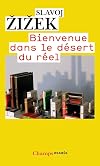
Welcome to the Desert of the Real: Five Essays on September 11 and Related Dates
by Slavoj Žižek
On This Page
Description
Liberals and conservatives proclaim the end of the American holiday from history. Now the easy games are over; one should take sides. Zizek argues this is precisely the temptation to be resisted. In such moments of apparently clear choices, the real alternatives are most hidden. Welcome to the Desert of the Real steps back, complicating the choices imposed on us. It proposes that global capitalism is fundamentalist and that America was complicit in the rise of Muslim fundamentalism. It show more points to our dreaming about the catastrophe in numerous disaster movies before it happened, and explores the irony that the tragedy has been used to legitimize torture. Last but not least it analyzes the fiasco of the predominant leftist response to the events. show lessTags
Recommendations




































Member Reviews
The thing you notice quickly: how often the bastard contradicts himself. At first I wanted to say that he was inconsistent, but then it became clear that it was a bigger part of his mission. And, indeed, his first wish is to problematize the simple choices we have been given. Honestly, too, few are better positioned to do so. As a Slovene, as someone who cut his teeth on Soviet intellectualism then found himself suddenly a part of the Captalist West, Zizek has the perspective and authority to denounce both the Left and the Right in their responses to 9/11.
The book is much larger than this, however, and throughout I think Zizek takes up the mantle of exposing the dangers of simplicity. He jumps in topic, he starts with one belief, stated show more resolutely, then swings to examples that seem to voice the exact opposite, yet every perspective is clearly fit together by his thoughts. In other words, as a bit of a political Tiresias, Zizek delivers a message to us stuck in our simpler ideological bodies: simplicity is part of the problem. show less
The book is much larger than this, however, and throughout I think Zizek takes up the mantle of exposing the dangers of simplicity. He jumps in topic, he starts with one belief, stated show more resolutely, then swings to examples that seem to voice the exact opposite, yet every perspective is clearly fit together by his thoughts. In other words, as a bit of a political Tiresias, Zizek delivers a message to us stuck in our simpler ideological bodies: simplicity is part of the problem. show less
I will confess that this book did not actually piss me off as much as I expected that it would, at least not after the first 10 pages. And it is the move that Žižek makes at this point, and several other points, that I take most issue with.
Let's not even argue over whether or not Žižek is right, because in the end it's irrelevant. But he makes it irrelevant by positing solutions that, according to the hard line of American politics, are decidedly anti-American -- and then accusing the reader that clings to patriotism as buying into precisely the kind of dialectical thinking that caused the September 11th attacks. There's validity to this, to be sure, but Žižek goes about it in a dangerous way, making controversial points that are show more hard to justify because of the swerving, stream-of-consciousness style of his argumentation.
What's most disturbing is when this backfires and exposes his own hypocrisy -- for instance, his display of patriotism for a European power after bemoaning American patriotism, or, even worse, when he argues that other attacks or situations in other countries were far worse than 9/11, a chapter after proclaiming that to put 9/11 on a scale is to fall into that same dialectical trap again.
In the end, what this book seems to show is how quickly theorists can seem out of touch with their topics when those issues are too topical. show less
Let's not even argue over whether or not Žižek is right, because in the end it's irrelevant. But he makes it irrelevant by positing solutions that, according to the hard line of American politics, are decidedly anti-American -- and then accusing the reader that clings to patriotism as buying into precisely the kind of dialectical thinking that caused the September 11th attacks. There's validity to this, to be sure, but Žižek goes about it in a dangerous way, making controversial points that are show more hard to justify because of the swerving, stream-of-consciousness style of his argumentation.
What's most disturbing is when this backfires and exposes his own hypocrisy -- for instance, his display of patriotism for a European power after bemoaning American patriotism, or, even worse, when he argues that other attacks or situations in other countries were far worse than 9/11, a chapter after proclaiming that to put 9/11 on a scale is to fall into that same dialectical trap again.
In the end, what this book seems to show is how quickly theorists can seem out of touch with their topics when those issues are too topical. show less
Slavoj Zizek is one of Europe's leading intellectuals and social theorists. In this book he doesn't seem to emulate those credentials. Perhaps it is his writing style, a vast sea of ever changing subjects and thoughts tied together by a vague theme. However his positions on "terrorism" and "liberal democracy" are spot on. In this book he seemed to utilize "Hegelian" reversals quite a bit, as well as revealing the psychological undertones of political events and players making the book a fascinating read.
In short, is it not that today, in our resigned postideological era which admits no positive Absolutes, the only legitimate candidate for the Absolute are radically evil acts?
This is a book about dreams. The philosopher notes early that in developing nations people dream about making it to the West, while First Worlders dream about the end of the world. Slavoj Žižek is coy like that. Throughout Welcome To The Desert of the Real he displays his range without much rigor. It doesn't read as caprice, it functions as serial questions, those that make us readers uncomfortable. The Western Malaise is one of excess. Lacan offered diagnosis some time back. we now need to cut ourselves, distract our neuroses in reality programming. We to be show more displaced by the Spectacle. Our choices leave us docile. We stared at the remains of the World Trade Center and asked how could this happen here? The author poses that we should've reacted that this shouldn't happen again anywhere.
This is a riveting work. Many are critical of Žižek's recourse to popular cultural. I am not. While being unaware of the title being a line from The Matrix, I find the analogy comfortably disturbing. show less
This is a book about dreams. The philosopher notes early that in developing nations people dream about making it to the West, while First Worlders dream about the end of the world. Slavoj Žižek is coy like that. Throughout Welcome To The Desert of the Real he displays his range without much rigor. It doesn't read as caprice, it functions as serial questions, those that make us readers uncomfortable. The Western Malaise is one of excess. Lacan offered diagnosis some time back. we now need to cut ourselves, distract our neuroses in reality programming. We to be show more displaced by the Spectacle. Our choices leave us docile. We stared at the remains of the World Trade Center and asked how could this happen here? The author poses that we should've reacted that this shouldn't happen again anywhere.
This is a riveting work. Many are critical of Žižek's recourse to popular cultural. I am not. While being unaware of the title being a line from The Matrix, I find the analogy comfortably disturbing. show less
Purporting to be an analysis of the 9/11 attacks, and the motivations behind them, this book wanders all over the place, and is so abstruse and inaccessible it isn't really worth the time; after all, there are many better books written on the topic, and I was unable to see that the author actually added anything new to the subject.
Zizek is a wacky, and occasionally brilliant, critic. His essays here range from over-the-top Lacanian analysis to some fairly perceptive (or "perspicuous", his favorite compliment) insights into the way the U.S. in navigating the shoals of terror. The book is also a bit dated now, since it seems to have been written mostly between 9/11 and its publication date in 2002. Overall definitely worth reading, however.
As always when I read Zizek/ some brilliant paragraphs that makes it worth reading a lot of philosophical text that makes no sense to me.
Members
- Recently Added By
Lists

02
28 works; 1 member
Author Information

325+ Works 18,008 Members
Slavoj Zizek is a Hegelian philosopher, Lacanian psychoanalyst, and political activist. He is international director of the Birkbeck Institute for the Humanities, and Global Distinguished Professor of German at New York University. He is the author of numerous books on dialectical materialism, as well as critique of ideology and art, including show more Event, and Trouble in Paradise, both published by Melville House. show less
Awards and Honors
Notable Lists
Series
Belongs to Publisher Series
Radical Thinkers (84 - Set 7(12))
Common Knowledge
- Canonical title*
- Benvenuti nel deserto del reale: cinque saggi sull'11 settembre e date simili
- Original title
- Welcome to the Desert of the Real: Five Essays on September 11 and Related Dates
- Original publication date
- 2002
- Important events
- September 11 Attacks (2001-09-11)
- Dedication
- To Pamela Pascoe and Eric Santner, without any doubt!
- First words
- In an old joke from the defunct German Democratic Republic, a German worker gets a job in Siberia; aware of how all mail will be read by the censors, he tells his friends: 'Let's establish a code: if a letter you get from me ... (show all)is written in ordinary blue ink, it's true; if it's written in red ink, it's false.'
- Last words
- (Click to show. Warning: May contain spoilers.)What if the 'terrorist attack', no matter how 'real' and terrifying, is ultimately a metaphoric substitute for this Act, for the shattering of our liberal-democratic consensus?
*Some information comes from Common Knowledge in other languages. Click "Edit" for more information.
Classifications
- Genres
- Nonfiction, Philosophy, General Nonfiction, History, Politics and Government, Literature Studies and Criticism
- DDC/MDS
- 973.931 — History & geography History of North America United States 1901- New Millennium, Post 9/11 (2001-Present) George W. Bush (2001-2009) Sept 11 Attacks, Iraq War, Patriot Act
- LCC
- E902 .Z49 — History of the United States George W. Bush's administrations, 2001-2009
- BISAC
Statistics
- Members
- 690
- Popularity
- 41,467
- Reviews
- 8
- Rating
- (3.78)
- Languages
- 11 — Dutch, English, Finnish, French, German, Hebrew, Italian, Lithuanian, Portuguese, Spanish, Swedish
- Media
- Paper, Ebook
- ISBNs
- 19
- ASINs
- 3