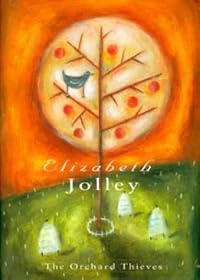
The Orchard Thieves
by Elizabeth Jolley
On This Page
Description
Every household is haunted by times of discord which destroy the wished-for calm. Every member feels that their own difficulties are unique. The grandmother, mother of three grown-up daughters, understands that it is the unseen, the unspoken and the unrevealed which either perplex or console people in their family dealings. When the middle sister returns home from England, without any explanations about her private life, peace in the grandmother's house is jeopardised. The grandmother, with show more imagination, acceptance and the quality of her affection, attempts a form of rescue in the face of rising conflict and tension. show lessTags
Recommendations





















Member Reviews
In The Orchard Thieves, Elizabeth Jolley employs an interesting (and at first disconcerting) device by naming her characters only in terms of their relationships to one another. She also sketches vague details regarding setting, placing further emphasis on her themes of family discord and, particularly, the complexities of the mother-daughter relationship.
In the grandmother of the clan, Jolley creates a nuanced narrator whose vivid imaginings of imminent catastrophe add pleasing touches of dry humour to the fable. Yet, as in life, it is not until real disaster strikes the family that each character's true colours are revealed.
The Orchard Thieves is a small but satisfying slice of Australian life.
In the grandmother of the clan, Jolley creates a nuanced narrator whose vivid imaginings of imminent catastrophe add pleasing touches of dry humour to the fable. Yet, as in life, it is not until real disaster strikes the family that each character's true colours are revealed.
The Orchard Thieves is a small but satisfying slice of Australian life.
An excellent short novel focusing on family life, specifically the relationships between mothers and daughters. The story is written from a grandmother’s perspective. She has three daughters and several grandchildren.
The grandmother lives with her eldest, unmarried daughter. Their domestic calm disintegrates when the ‘middle daughter’ arrives and urges the sale of the family house.
One of the unusual devices is that none of the characters have names; they are referred to only by their position in the family. In one sense this is unwelcome as it keeps the reader at a distance and lessens identification with the characters. However it also makes sense because the essence of the novel is this: it is via the changes in the family show more role that understanding of other family members develops. As daughters become mothers themselves they gain a new perspective on their own mother’s achievements, or otherwise.
The novel is a rumination on what it is to be a mother and a grandmother and as always with Jolley, family life is presented as complex and multilayered. It includes plenty of love, loyalty, strength, and tolerance, but anxieties are ever present (the grandmother has wildly active imagination), and destructive and selfish forces inevitably bubble to the surface. When the crisis takes place at the end of The Orchard Thieves it brings pain, but it also brings release, relief and growth.
This novel is not strong on plot or even character, but it examines the complexities of family relationships with great honesty and insight. Jolley explores the emotional landscape of family life without flinching. While her perspective is sometimes a little bleak, she writes with a wonderful wry humour. Mostly it is dark, but at times it is laugh out loud. For example, soon after the middle daughter’s arrival from England a letter arrives for the daughter from her lesbian partner. As the grandmother picks it up she sees this message scrawled on the back of the envelope in black felt pen ‘So sorry I’m late with this letter, I misjudged the length of an orgasm and missed the post.’ show less
The grandmother lives with her eldest, unmarried daughter. Their domestic calm disintegrates when the ‘middle daughter’ arrives and urges the sale of the family house.
One of the unusual devices is that none of the characters have names; they are referred to only by their position in the family. In one sense this is unwelcome as it keeps the reader at a distance and lessens identification with the characters. However it also makes sense because the essence of the novel is this: it is via the changes in the family show more role that understanding of other family members develops. As daughters become mothers themselves they gain a new perspective on their own mother’s achievements, or otherwise.
The novel is a rumination on what it is to be a mother and a grandmother and as always with Jolley, family life is presented as complex and multilayered. It includes plenty of love, loyalty, strength, and tolerance, but anxieties are ever present (the grandmother has wildly active imagination), and destructive and selfish forces inevitably bubble to the surface. When the crisis takes place at the end of The Orchard Thieves it brings pain, but it also brings release, relief and growth.
This novel is not strong on plot or even character, but it examines the complexities of family relationships with great honesty and insight. Jolley explores the emotional landscape of family life without flinching. While her perspective is sometimes a little bleak, she writes with a wonderful wry humour. Mostly it is dark, but at times it is laugh out loud. For example, soon after the middle daughter’s arrival from England a letter arrives for the daughter from her lesbian partner. As the grandmother picks it up she sees this message scrawled on the back of the envelope in black felt pen ‘So sorry I’m late with this letter, I misjudged the length of an orgasm and missed the post.’ show less
This is a short book which deals with the dynamics within families. In this particular family, there is the widowed grandmother who lives in the family home with her eldest unmarried daughter (the aunt). She loves the company but worries about her daughters happiness. She also delights in the visits from her youngest daughter's (the wife's) 2 boys although she finds their father a bit domineering. She worries about her youngest daughter's happiness. The arrival of the unmarried middle daughter from overseas, with a small daughter and another nearly due tests the resilience of the family. This daughter is lazy, demanding and scheming but " the grandmother..., knew that, as the middle sister's mother, she could not and would not send her show more away. Where could anyone go in their life if not back, if the need arose, to their own mother, and to that place which was called home with all that a person, having been given life, deserves to have; the safety and the comfort and the love? Who could turn away a son or a daughter? The child is always the child of the mother". And it is this love that saves the middle daughter and places the family back on its steady path.
Because the family members are never named, this could be any family.
I do enjoy Elizabeth Jolley's writing. show less
Because the family members are never named, this could be any family.
I do enjoy Elizabeth Jolley's writing. show less
Ratings
Members
- Recently Added By
Author Information

32+ Works 2,126 Members
Elizabeth Jolley was born Monica Elizabeth Knight in Birmingham, England on June 4, 1923. She was educated privately until age 11, when she was sent to Sibford School, a Quaker boarding school. At 17 she began training as nurse in London and was exposed firsthand to the horrors of World War II. She emigrated to Australia in 1959 with her husband show more and their three children. Before becoming a full-time author, she had numerous jobs including nursing, housecleaning, and farming. She published her first book of short stories, Five Acre Virgin and Other Stories, in 1976, and her first novel, Palomino, in 1980. Her other works included The Newspaper of Claremont Street, Mr. Scobie's Riddle, The Well, My Father's Moon, Miss Peabody's Inheritance, Foxybaby, and The Sugar Mother. She died on February 13, 2007 at the age of 83. (Bowker Author Biography) show less
Common Knowledge
- Dedication
- For Harry and Hannah Levey
And for Leonard Jolley
who borrowed the maps from
the Leveys and never returned them. - First words
- 'If you have the house,' the middle sister said to the aunt, the eldest sister, 'if you have the house you'll have to pay us each one-third of the current market price. One-third each of the value of the place.'
~ Pre... (show all)face
The aunt wanted to go out by herself.
~ Part One - Quotations
- ‘So sorry I’m late with this letter, I misjudged the length of an orgasm and missed the post.’
- Last words
- (Click to show. Warning: May contain spoilers.)The grandmother, putting the baby up to her shoulder and feeling the softness of the baby's cheek against her own, remarked that there was really only one week between a bad haircut and a good haircut.
Classifications
Statistics
- Members
- 84
- Popularity
- 378,328
- Reviews
- 3
- Rating
- (3.53)
- Languages
- English
- Media
- Paper
- ISBNs
- 3