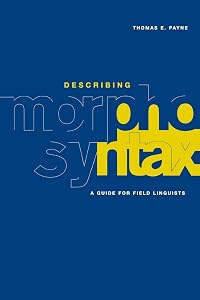
Describing Morphosyntax: A Guide for Field Linguists
by Thomas E. Payne
On This Page
Description
Current estimates are that around 3,000 of the 6,000 languages now spoken may become extinct during the next century. Some 4,000 of these existing languages have never been described, or described only inadequately. This book is a guide for linguistic fieldworkers who wish to write a description of the morphology and syntax of one of these many under-documented languages. It uses examples from many languages both well known and virtually unknown; it offers readers one possible outline for a show more grammatical description, with many questions designed to help them address the key topics. The appendices offer guidance on text and elicited data, and on sample reference grammars which readers might wish to consult. show lessTags
Recommendations










Member Reviews
Originally designed for those becoming field linguists, this book is a tremendous resource for those wanting to learn about the nitty-gritty details of morphology, syntax, grammar, etc. Starting at basic concepts and good explanations of what morphology is and how it can be used to study language, rapidly a clear picture emerges of how the different parts of language hang together. Not only is this shown for English but the text is designed to specifically show how all these mechanisms are at work in other languages. When you've studied the contents of this book carefully (e.g. not read it once) you should have a good picture of how different languages are related and how we can compare their grammatical mechanisms.
I would agree with show more other reviewers that this book is not for those with little or no linguistic background. It is possible to start fresh but given some subtle expert-blind spots in the writing it would be difficult to understand some of the chapters. It is highly recommended to use this book in combination with other works on grammar and syntax. The writing is clear and precise and contains lots and lots of examples. If there is a negative comment to be made I would say that the first three chapters contain wonderful visual examples that can help the reader mentally model the complexities of language, which are missing started at chapter 4. show less
I would agree with show more other reviewers that this book is not for those with little or no linguistic background. It is possible to start fresh but given some subtle expert-blind spots in the writing it would be difficult to understand some of the chapters. It is highly recommended to use this book in combination with other works on grammar and syntax. The writing is clear and precise and contains lots and lots of examples. If there is a negative comment to be made I would say that the first three chapters contain wonderful visual examples that can help the reader mentally model the complexities of language, which are missing started at chapter 4. show less
A friend insisted I *had* to read this (because I took a mandatory linguistics course in grad school).
What a snooze. I mean, if I were actually interested in the field, I would probably enjoy it - it's well laid out and goes quite in depth. The author offers many fascinating tidbits about various languages, but it doesn't really support the readers too well. It describes a concept once and assumes you have terminology memorized at that point - yet it constantly reminds you of the existence of the Yagua language of Columbia and Peru (it reminds you nearly every time it comes up what this language is - and it comes up OFTEN). It was very distracting to have to constantly flip to the glossary (which was hidden in the roman numeral pages at show more the beginning of the book that only the most die-hard enthusiasts ever read). I'm soooo glad this is over! show less
What a snooze. I mean, if I were actually interested in the field, I would probably enjoy it - it's well laid out and goes quite in depth. The author offers many fascinating tidbits about various languages, but it doesn't really support the readers too well. It describes a concept once and assumes you have terminology memorized at that point - yet it constantly reminds you of the existence of the Yagua language of Columbia and Peru (it reminds you nearly every time it comes up what this language is - and it comes up OFTEN). It was very distracting to have to constantly flip to the glossary (which was hidden in the roman numeral pages at show more the beginning of the book that only the most die-hard enthusiasts ever read). I'm soooo glad this is over! show less
I also bought this book because it was supposed to be useful for conlangers--which turned out to be true. It is one of my top three book recommendations for new conlangers (the other two are Historical Linguistics by Campbell for insight into historical processes, and The Languages of Native North America by Mithun for real-world examples of the variety of language).
Payne attempts to explain each new linguistic concept, and for the most part he succeeds, but some basic linguistic knowledge will probably be helpful for anyone using this book. There is a lot of information to process. There are also some issues with mistakes in many of the examples; they should be taken as examples of the concepts only, and not as authoritative source on show more the language. show less
Payne attempts to explain each new linguistic concept, and for the most part he succeeds, but some basic linguistic knowledge will probably be helpful for anyone using this book. There is a lot of information to process. There are also some issues with mistakes in many of the examples; they should be taken as examples of the concepts only, and not as authoritative source on show more the language. show less
What works for field linguists also works for conlangers. The most ingenious part of this book is that it contains several questions that ought to be answered in a thorough description of a language.
The questions could have been easier to find, as of now one must scan for them by hand.
The questions could have been easier to find, as of now one must scan for them by hand.
Ratings
Members
- Recently Added By
Lists

Great Books About Language
73 works; 45 members

Top Five Books of 2015
811 works; 241 members
Author Information
7 Works 208 Members
Common Knowledge
- First words
- This book is a guide and a bridge.
Classifications
Statistics
- Members
- 171
- Popularity
- 191,153
- Reviews
- 4
- Rating
- (4.50)
- Languages
- English
- Media
- Paper, Ebook
- ISBNs
- 3