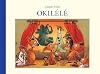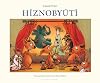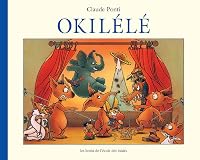
Hiznobyuti
by Claude Ponti
On This Page
Description
Unattractive from birth, Hiznobyuti hides himself away until a fight with his family and a message from the stars set him on an adventure of self-discovery, communication, and reconciliation.Tags
Recommendations



























Member Reviews
When the eponymous hero of this rather odd original fairy-tale is born, his parents and siblings all declare that "he's no beauty," repeating the phrase so often that he eventually becomes known as "Hiznobyuti." Retreating from his unsympathetic family, he first builds a hideout under the kitchen sink, befriending the broken-down alarm clock he finds there, and then he runs away altogether. Embarking on a quest to find the planet where he is needed (according to a strange voice he has heard), Hiznobyuti passes through many strange adventures, living life as a tree, defeating monsters on rope bridges, and eventually saving the aforementioned planet, by waking up their slumbering sun. Returning home, he finds his family homeless and show more destitute, and sets that to rights as well, before setting out to find a princess and marry her. If she'll have him...
If this all sounds a little random... a little strange, that's because it is. Originally published in France as Okilélé, this odd picture-book is the second I have read from celebrated French author/artist Charles Ponti, following upon his marvelous My Valley. After adoring that other title, I had high hopes for Hiznobyuti, but found in the end that my reaction was decidedly mixed. The story itself is inventive, having a sort of 'ugly duckling finds his way in life and eventually triumphs' sensibility to it, but it also sometimes felt a little too bizarre for my suspension of disbelief to hold. It didn't quite hold together as a cohesive whole for me, despite some of the constituent story elements being quite interesting. That said, the artwork did have great appeal for me, with a cute but surreal quality that tickled my funny bone at times. Although not destined to be a particular of mine, I'm glad I read this one, and that Brooklyn-based Elsewhere Editions has translated it into English! show less
If this all sounds a little random... a little strange, that's because it is. Originally published in France as Okilélé, this odd picture-book is the second I have read from celebrated French author/artist Charles Ponti, following upon his marvelous My Valley. After adoring that other title, I had high hopes for Hiznobyuti, but found in the end that my reaction was decidedly mixed. The story itself is inventive, having a sort of 'ugly duckling finds his way in life and eventually triumphs' sensibility to it, but it also sometimes felt a little too bizarre for my suspension of disbelief to hold. It didn't quite hold together as a cohesive whole for me, despite some of the constituent story elements being quite interesting. That said, the artwork did have great appeal for me, with a cute but surreal quality that tickled my funny bone at times. Although not destined to be a particular of mine, I'm glad I read this one, and that Brooklyn-based Elsewhere Editions has translated it into English! show less
Hīznobyūtī is an 'ugly duckling’ reweaving by French children's author Claude Ponti. When he is hatched, Hīznobyūtī didn't look like his family at all. He had a tiny trunk instead of a snout. They said 'he’s no beauty’ enough times that Hīznobyūtī thought it was his name. As he grew older, he realised he didn't look like the others in his family. He tried different things to blend in. He created masks to hide his face, but it didn't work. He always felt underfoot, or in the way, even when going out of his way to be alone and quiet. Hīznobyūtī finally decided to live under the sink, away from everyone, and they forgot about him. He was alone, save for Martin Clock. Eventually, he created a cozy home for himself show more underground. After a time, he and Martin leave to go explore, meeting all manner of folk, and helping those in need. His travels led him back to the beginning, where he found finally found acceptance. Most importantly, Hīznobyūtī learned that he was good enough in himself, and he needed no one else's approval to be happy.
This is translated from French, and recalled to my mind The Little Prince. There's definitely a great deal of cultural influence that cannot be directly translated. There's a harshness in how Hīznobyūtī’s family treated him, acting as if he weren't even part of the family. Yet, despite that, he persevered and learned that his own approval was all he needed. There are themes of resilience and going with the flow. In the end, all worked out for Hīznobyūtī! It is a marvelous glimpse into how a different culture perceives things as well, and this can be a great talking point with children if you are working with cultural awareness. I find that a great skill to pass on from a young age. My cubs loved this book, and the lessons offered. Great addition to any bookshelf!
***Many thanks to Netgalley and Archipelago for providing an egalley in exchange for a fair and honest review. show less
This is translated from French, and recalled to my mind The Little Prince. There's definitely a great deal of cultural influence that cannot be directly translated. There's a harshness in how Hīznobyūtī’s family treated him, acting as if he weren't even part of the family. Yet, despite that, he persevered and learned that his own approval was all he needed. There are themes of resilience and going with the flow. In the end, all worked out for Hīznobyūtī! It is a marvelous glimpse into how a different culture perceives things as well, and this can be a great talking point with children if you are working with cultural awareness. I find that a great skill to pass on from a young age. My cubs loved this book, and the lessons offered. Great addition to any bookshelf!
***Many thanks to Netgalley and Archipelago for providing an egalley in exchange for a fair and honest review. show less
Much too weird and random for me. I don't see any point at all, except for, maybe, don't lock your child under the sink even if his nose is different.
Ratings
Members
- Recently Added By
Author Information

107+ Works 1,113 Members
Some Editions
Awards and Honors
Common Knowledge
- Canonical title
- Hiznobyuti
- Original publication date
- 1993
- People/Characters*
- Okilélé; Martin Réveil
- First words*
- Quand il est né, Okilélé n'était pas beau. Ses parents, ses frères, sa sœur dirent : "Oh ! Qu'il est laid !"
- Last words*
- (Click to show. Warning: May contain spoilers.)Il lui restait donc une chose à faire : aller chercher la princesse et l'épouser, si elle le voulait bien..
- Original language
- French
*Some information comes from Common Knowledge in other languages. Click "Edit" for more information.
Classifications
Statistics
- Members
- 56
- Popularity
- 546,659
- Reviews
- 3
- Rating
- (3.44)
- Languages
- English, French
- Media
- Paper, Ebook
- ISBNs
- 7
- ASINs
- 1