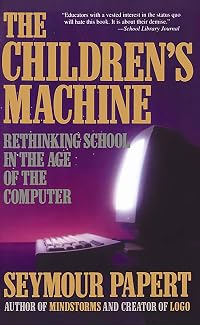
The Children's Machine: Rethinking School In The Age Of The Computer
by Seymour Papert
On This Page
Description
In his classsic book, Mindstorms: Children, Computers, and powerful Ideas, Seymour Papert set out a vision of how computers could change school. In The Children’s Machine he now looks back over a decade during which American schools acquired more than three million computers and assesses progress and resistance to progress.Tags
Recommendations



Member Reviews
Papert heralds the computer as a device that- though often misused by schools to maintain the current status quo- can give students the opportunity to learn to love often maligned subjects such as math, science, and computer science (as well as most any other so-called content area). Papert goes into detail on how he arrived at his conclusions and gives an excellent argument for "megachange" in our schools.
If you're interested in school reform or how technology can best be utilized in schools, then this is a definite must read.
If you're interested in school reform or how technology can best be utilized in schools, then this is a definite must read.
Ratings
Members
- Recently Added By
Lists

Alan Kay's Reading List
103 works; 3 members
Author Information

15+ Works 986 Members
Seymour Aubrey Papert was born in Pretoria, South Africa on February 29, 1928. He received doctorates from the University of the Witwatersrand in South Africa and the University of Cambridge in England. After his doctoral work, he spent four years at the University of Geneva exploring both mathematics and children's learning as a researcher for show more Jean Piaget. In 1964, he joined the Massachusetts Institute of Technology faculty and immediately delved into artificial intelligence research with Marvin Minsky. He was a co-director of the renowned Artificial Intelligence Laboratory at the Massachusetts Institute of Technology. Papert and Minsky published Perceptrons: An Introduction to Computational Geometry in 1969. Papert foresaw children using computers as instruments for learning and enhancing creativity well before the advent of the personal computer. In the late 1960's, he created a computer programming language, called Logo, to teach children how to use computers. He wrote several other books including Mindstorms: Children, Computers and Powerful Ideas and Constructionism written with Idit Harel. Papert retired from the faculty at M.I.T. in 1996, but continued to work there as a lecturer and consultant to doctoral students. He died from complications of a series of kidney and bladder infections on July 31, 2016 at the age of 88. (Bowker Author Biography) show less
Common Knowledge
- Canonical title*
- Hur gör giraffen när den sover : skolan, datorn och kunskapsprocessen
- First words
- Imagine a party of time travelers from an earlier century, among them one group of surgeons and another of schoolteachers, each group eager to see how much things have changed in their profession a hundred or more years into ... (show all)the future.
- Last words
- (Click to show. Warning: May contain spoilers.)The only rational choice I see is to forge ahead in the encouragement of educational diversity with a dedicated commitment not only to expanding its benefits to all who want them but also to making sure that those who choose not to want them are making an informed choice.
*Some information comes from Common Knowledge in other languages. Click "Edit" for more information.
Classifications
- Genres
- Technology, Nonfiction
- DDC/MDS
- 371.334 — Society, government, & culture Education Schools and their activities; special education Methods of instruction and study Teaching aids, equipment, materials
- LCC
- LB1028.5 .P325 — Education Theory and practice of education Theory and practice of education Teaching (Principles and practice)
- BISAC
Statistics
- Members
- 157
- Popularity
- 209,115
- Reviews
- 1
- Rating
- (4.28)
- Languages
- English, Portuguese, Swedish
- Media
- Paper
- ISBNs
- 5