On This Page
Description
A lump of concrete dropped deliberately from a little stone bridge over a relatively unfrequented road kills the wrong person. The driver behind is spared. But only for a while ... One particular member of the local press is gunning for the Chief Inspector, distinctly unimpressed with what he regards as old-fashioned police methods. But Wexford, with his old friend and partner, Mike Burden, along with two new recruits to the Kingsmarkham team, pursue their inquiries with a diligence and show more humanity that make Ruth Rendell's detective stories enthralling, exciting and very touching. show lessTags
Recommendations




Member Reviews
Bungled Murder
Review of the Seal Kindle eBook edition (2010) of the original Hutchinson (UK) hardcover (October 20, 2005).
A 4 star rating is on a relative scale, after my being somewhat disappointed with The Babes in the Wood (2002), the previous book in the Wexford series. This one had an intriguing case and combined it with various social issues such as surrogacy. It also made for a return to favourite Wexford quotes and banter. show more There are some cringey bits and a rather unbelievable scam which is uncovered towards the end (see the 1-star review linked below about that, but note that review is a spoiler as well).
The story opens with a botched murder attempt that occurred through an induced traffic accident where the intended victim survives but another driver is killed by mistake. Afterwards the intended victim is murdered after all and it takes a while before the two seemingly unrelated events are tied together. Then yet another murder occurs. It takes a considerably amount of time for the investigators to realize that the issue of surrogacy is somehow tied into the killings. Meanwhile, on the Wexford home front, his eldest daughter Sylvia is apparently willing to be a surrogate for her ex-husband and his new wife.
I did note that the cast list on the police side is expanding considerably over the earlier books in the series. Detective Sergeant Hannah Goldsmith and Detective Constable Baljinder 'Bal' Bhattacharya play prominent roles in the investigation and have their own romantic subplot.
End in Tears continues my 2023 binge read / re-read of Ruth Rendell and this is the 20th of the Inspector Wexford series. The Kirkus Review linked below says that it is her 64th book overall. I have had to skip over Wexford #15 to #18 as I haven’t been able to source them yet.
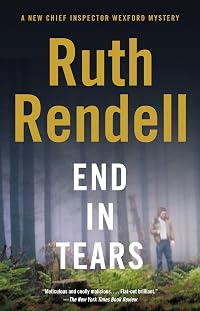
See cover at https://images-na.ssl-images-amazon.com/images/S/compressed.photo.goodreads.com/...
Cover image for the original Hutchinson (UK) hardcover edition from 2005. Image sourced from Goodreads..
Wexford's Laws
Wexford’s Laws do not appear in this book. Wexford’s Law No. 6 appeared in The Babes in the Wood (2002 - Wexford #19) and Wexford’s Law No. 7 will appear in Not in the Flesh (2007 - Wexford #21). Wexford’s Laws are occasional thoughts about quirky observations made by the Chief Inspector for which he assigns a number.
Favourite Quotes
Other Reviews
Review at Just a Whisker Below State of the Art by Kirkus Reviews, July 25, 2006.
And for contrast, here is a very opposing 1 ⭐ star review (with a Spoiler) on Goodreads by Kavita at Sexist crap. Racist crap. Stereotypical clichés crap..
Trivia and no Link
End in Tears was not adapted for television as part of the Ruth Rendell / Inspector Wexford Mysteries TV series (1987-2000) as the novel was published after the series had ended. show less
Review of the Seal Kindle eBook edition (2010) of the original Hutchinson (UK) hardcover (October 20, 2005).
'On the face of it, he seems a respectable sort of bloke …'
‘But yet,’ said Wexford, quoting from his favourite play. “I do not like 'but yet'.” What’s wrong with him, Mike?’ - Wexford's favourite play is apparently Shakespeare's 'Antony and Cleopatra' (2002) as he quotes from Act 2 Scene 5.
A 4 star rating is on a relative scale, after my being somewhat disappointed with The Babes in the Wood (2002), the previous book in the Wexford series. This one had an intriguing case and combined it with various social issues such as surrogacy. It also made for a return to favourite Wexford quotes and banter. show more There are some cringey bits and a rather unbelievable scam which is uncovered towards the end (see the 1-star review linked below about that, but note that review is a spoiler as well).
The story opens with a botched murder attempt that occurred through an induced traffic accident where the intended victim survives but another driver is killed by mistake. Afterwards the intended victim is murdered after all and it takes a while before the two seemingly unrelated events are tied together. Then yet another murder occurs. It takes a considerably amount of time for the investigators to realize that the issue of surrogacy is somehow tied into the killings. Meanwhile, on the Wexford home front, his eldest daughter Sylvia is apparently willing to be a surrogate for her ex-husband and his new wife.
I did note that the cast list on the police side is expanding considerably over the earlier books in the series. Detective Sergeant Hannah Goldsmith and Detective Constable Baljinder 'Bal' Bhattacharya play prominent roles in the investigation and have their own romantic subplot.
End in Tears continues my 2023 binge read / re-read of Ruth Rendell and this is the 20th of the Inspector Wexford series. The Kirkus Review linked below says that it is her 64th book overall. I have had to skip over Wexford #15 to #18 as I haven’t been able to source them yet.
See cover at https://images-na.ssl-images-amazon.com/images/S/compressed.photo.goodreads.com/...
Cover image for the original Hutchinson (UK) hardcover edition from 2005. Image sourced from Goodreads..
Wexford's Laws
Wexford’s Laws do not appear in this book. Wexford’s Law No. 6 appeared in The Babes in the Wood (2002 - Wexford #19) and Wexford’s Law No. 7 will appear in Not in the Flesh (2007 - Wexford #21). Wexford’s Laws are occasional thoughts about quirky observations made by the Chief Inspector for which he assigns a number.
Favourite Quotes
'I once learnt by heart something Bertrand Russell said. Let’s see if I can remember it. “The fact that an opinion has been widely held is no evidence whatever that it isn’t utterly absurd. Indeed, in view of the silliness of the majority of mankind, a widespread belief is more likely to be foolish than sensible.”'
‘It’s a funny thing’, said Wexford when they had sat down at a table in the window, ‘that everyone but the Danes call these things Danish pastries.’ ‘What do they call them, then?’ ‘Viennese bread.’
'He’s not your third murderer – sounds like something out of Macbeth, doesn’t it?' Their blank polite faces showed him that they had no idea whether it sounded like something out of Macbeth or not. It was no use lamenting the loss of poetry from the nation’s mindset. It was gone, never, he supposed, to return.
Other Reviews
Review at Just a Whisker Below State of the Art by Kirkus Reviews, July 25, 2006.
And for contrast, here is a very opposing 1 ⭐ star review (with a Spoiler) on Goodreads by Kavita at Sexist crap. Racist crap. Stereotypical clichés crap..
Trivia and no Link
End in Tears was not adapted for television as part of the Ruth Rendell / Inspector Wexford Mysteries TV series (1987-2000) as the novel was published after the series had ended. show less
End In Tears is an old phrase as well as the title of the 20th Inspector Wexford mystery. Plenty of characters will take actions that will end in tears -- their own, or others'. The murder victims are beyond tears, of course. Pity one of them didn't read the Miss Silver mysteries. Quite a few characters met their end trying the same thing in that series.
There's a cautionary tale for parents in the story of George Marshalson, whose beloved daughter might have lived if he hadn't spoiled her rotten. He still has her year-old son, but, like Mr. Craven in The Secret Garden, he can't bear to look at Brand because the boy looks like his mother. Brand's step-grandmother, Diana, complains about how she had to give up her own career, etc., show more because Amber continued to party after he was born. Inspector Wexford worries about the child. It's not as if his paternal grandmother has done a good job rearing her own over-privileged children. Daniel Hilland is a jerk (Wexford's opinion is harsher). His sister is thoughtless at the very least.
Another parent will lose her teen. That it won't be the more intelligent one attending business college isn't going to console her.
Remember Wexford's own daughters? Sheila's not the problem this time. It's Sylvia again. Sylvia Fairfax is divorced, but doing a huge favor for her ex and Naomi, the woman he wants to marry. For once, Reg is being the more patient parent. It makes his Dora almost as angry with him as she is with Sylvia. Given Naomi's behavior, I didn't want Sylvia to complete the favor. How could the mess be resolved? (See chapter 7 for young Robin Fairfax's reaction to what his mother told him. Ouch.)
In contrast to teen mothers who don't take care of their babies, there are women who are desperate to have babies of their own. Some are so desperate that they'll even believe in something impossible. (I do hope one legal response Wexford expects to have happen regarding their cases won't. I think it would do more harm than good.)
Expect some commentary (comic relief?) on modern ideas in the person of Detective Sergeant Hannah Goldsmith, whom I doubt we are expected to admire because she doesn't treat others as she would like to be treated. To give one example, she wishes Wexford would remember to say 'Ms.,' but continues to call him 'guv' even after he's asked her not to do it. The beautiful DS Goldsmith and the equally handsome Detective Constable Baljinder 'Bal' Bhattacharya fancy each other, but have different expectations. Is the relationship doomed before it can start?
I've made no secret of the fact that I dislike Wexford's assistant, Detective Inspector Mike Burden. He's still a prig. In fact, he and Hannah Goldsmith are siblings under the skin because he's just as intolerant of liberal ideas as she is of traditional ones. I enjoyed a cat's response to his whispered insults in chapter 14. By the way, Burden has given up his beautiful suits to wear 'smart casual' clothing. Wexford's thought about Burden and jeans made me snicker even though I didn't agree. Burden may read more since he married Jenny, but he still doesn't recognize a line he remembers Wexford saying as a Shakespeare quotation (Hamlet -- I had to look up which play. See chapter 22).
I really liked the way the puzzle pieces were fit together. There's plenty of suspense in the climax.
Notes:
If you want the names of the victims of the murder attempt in chapter 1, they're given near the end of chapter six.
See chapter 15 for where Wexford's grandmother told him babies came from. (It's not the stork.)
Yes, poor parents in real life have been known to use a drawer for a baby's bed, as happens in chapter 26. Dad mentioned it when he told me about a relative who lost a baby to SIDS back before Sudden Infant Death Syndrome was known to exist.
Dog lovers, there are cameos of a West Highland, a pug, and a terrier. The first two belong to witnesses and the third to a victim's kin.
Cat Lovers, a lynx-sized cat named Ginger provides an invaluable service to the police just by needing to be rescued. You might enjoy the description of the home Ginger's human has provided him in chapter 14. show less
There's a cautionary tale for parents in the story of George Marshalson, whose beloved daughter might have lived if he hadn't spoiled her rotten. He still has her year-old son, but, like Mr. Craven in The Secret Garden, he can't bear to look at Brand because the boy looks like his mother. Brand's step-grandmother, Diana, complains about how she had to give up her own career, etc., show more because Amber continued to party after he was born. Inspector Wexford worries about the child. It's not as if his paternal grandmother has done a good job rearing her own over-privileged children. Daniel Hilland is a jerk (Wexford's opinion is harsher). His sister is thoughtless at the very least.
Another parent will lose her teen. That it won't be the more intelligent one attending business college isn't going to console her.
Remember Wexford's own daughters? Sheila's not the problem this time. It's Sylvia again. Sylvia Fairfax is divorced, but doing a huge favor for her ex and Naomi, the woman he wants to marry. For once, Reg is being the more patient parent. It makes his Dora almost as angry with him as she is with Sylvia. Given Naomi's behavior, I didn't want Sylvia to complete the favor. How could the mess be resolved? (See chapter 7 for young Robin Fairfax's reaction to what his mother told him. Ouch.)
In contrast to teen mothers who don't take care of their babies, there are women who are desperate to have babies of their own. Some are so desperate that they'll even believe in something impossible. (I do hope one legal response Wexford expects to have happen regarding their cases won't. I think it would do more harm than good.)
Expect some commentary (comic relief?) on modern ideas in the person of Detective Sergeant Hannah Goldsmith, whom I doubt we are expected to admire because she doesn't treat others as she would like to be treated. To give one example, she wishes Wexford would remember to say 'Ms.,' but continues to call him 'guv' even after he's asked her not to do it. The beautiful DS Goldsmith and the equally handsome Detective Constable Baljinder 'Bal' Bhattacharya fancy each other, but have different expectations. Is the relationship doomed before it can start?
I've made no secret of the fact that I dislike Wexford's assistant, Detective Inspector Mike Burden. He's still a prig. In fact, he and Hannah Goldsmith are siblings under the skin because he's just as intolerant of liberal ideas as she is of traditional ones. I enjoyed a cat's response to his whispered insults in chapter 14. By the way, Burden has given up his beautiful suits to wear 'smart casual' clothing. Wexford's thought about Burden and jeans made me snicker even though I didn't agree. Burden may read more since he married Jenny, but he still doesn't recognize a line he remembers Wexford saying as a Shakespeare quotation (Hamlet -- I had to look up which play. See chapter 22).
I really liked the way the puzzle pieces were fit together. There's plenty of suspense in the climax.
Notes:
If you want the names of the victims of the murder attempt in chapter 1, they're given near the end of chapter six.
See chapter 15 for where Wexford's grandmother told him babies came from. (It's not the stork.)
Yes, poor parents in real life have been known to use a drawer for a baby's bed, as happens in chapter 26. Dad mentioned it when he told me about a relative who lost a baby to SIDS back before Sudden Infant Death Syndrome was known to exist.
Dog lovers, there are cameos of a West Highland, a pug, and a terrier. The first two belong to witnesses and the third to a victim's kin.
Cat Lovers, a lynx-sized cat named Ginger provides an invaluable service to the police just by needing to be rescued. You might enjoy the description of the home Ginger's human has provided him in chapter 14. show less
Reading a Ruth Rendell is like tucking into a meal cooked by a cordon bleu chef: you may hate the ingredients, but the artistry of the preparation will have you coming back for more.
End in Tears features Chief Inspector Wexford, investigating the murders of two very different young women, who are linked through a surrogate mother scam, while at the same time his daughter is carrying a surrogate child for her ex, whose new partner cannot have children. Some elements are unsavoury, but the whole is succulently prepared, well-spiced and served with aplomb. Although a good plot does not necessarily make a good book, a cordon bleu writer can turn even an unpalatable story into a feast.
End in Tears features Chief Inspector Wexford, investigating the murders of two very different young women, who are linked through a surrogate mother scam, while at the same time his daughter is carrying a surrogate child for her ex, whose new partner cannot have children. Some elements are unsavoury, but the whole is succulently prepared, well-spiced and served with aplomb. Although a good plot does not necessarily make a good book, a cordon bleu writer can turn even an unpalatable story into a feast.
The basic mystery here is the murder of two young women. Young Amber is murdered late at night, on her way home from a nightclub in London. Her friend Megan is murdered some days later.
Inspector Wexford is leading the hunt, with several on his team. We are treated to not only the investigation of the case itself but to incidents in the lives of Hannah and Bat as well as Wexford and his family.
The case becomes complex. There are many avenues to investigate, some of which come to have nothing to do with the murders, but which clearly confuse our sleuths - and the reader. Meanwhile, there are the other issues:
Hannah is a beautiful young woman who is a fierce advocate of women's liberation. She is, in this respect, a caricature. To me it show more felt like she was written almost as a vessel for others' beliefs, which she took for her own. Thus she is righteous and abrupt and forthright in how she states her positions and she is forever angry at those who hold other opinions. I found this characterization of a "modern woman" irritating, because I know that most young women who hold strong views about feminism come by them honestly and feel deeply about them. Hannah, instead, is set up as an actor, one who sometimes jerks back to earlier days, to feelings she has tried to suppress. I liked Hannah but wanted her to be more realistic. I felt that Rendell was imposing her own views of feminism on her, and those views perhaps are a bit dated.
It is difficult to imagine Rendell being the stuffy moralist, given what else she has written, so I may have it wrong. But then there is the matter of the surrogate mother.
Some of the following will be a "spoiler" - perhaps best to read after reading the book:
Wexford's daughter Sylvia, divorced with two children, has agreed to bear a child for her former husband and his new love, to which he is not yet married. The child is his, deliberately conceived for him and his new partner. Sylvia is happy to be carrying out this deed, but her mother and father are less than thrilled. In fact, I found their thoughts and behavior deplorable. Her mother, Dora, tells Sylvia that she will ruin the family forever by having a child and giving it away. Dora thinks about a grandchild she will never see. She cannot accept it. Wexford still loves his daughter and shows her that he does but internally he is torn up by the surrogacy. To both of them it is as if Sylvia is acting immorally.
When Sylvia is in labor - in her own home, caught in a snowstorm - neither Dora nor Wexford choose to be there. Dora can't stand to see the child under these circumstances and Wexford is trying to distance himself from it.
I can't accept this absurd position. How could they both essentially abandon their daughter at this time? What if she had a dangerous delivery? Why wouldn't they be there for her regardless of her decision about the baby? So here, too, I felt an overriding sense of moral indictment by Rendell.
Hannah and Bat, in the meantime, are testing the waters of each other. Bat wants to have a real connection with Hannah, to know her well, before having sex with her. To Hannah all of this seems borne of a previous era and she becomes increasingly impatient, to the point where the relationship goes off the rails. Fortunately, in this case, Rendell allows Bat to see how bizarre his behavior has been, and I do not feel she condemns the more "modern" acceptance of sex earlier in a relationship.
As for the mystery! I am revealing all here, but I did warn you. Finally Wexford determines who wanted Amber dead. Her stepmother. I had such trouble with this because Amber clearly was not all that involved in her own baby's life and had already given over his care to her stepmother. If Amber moved away chances are her stepmother could had worked a deal, even offered to adopt the baby. It seems a far more likely scenario than murder. Of course, sometimes our minds just don't work right. show less
Inspector Wexford is leading the hunt, with several on his team. We are treated to not only the investigation of the case itself but to incidents in the lives of Hannah and Bat as well as Wexford and his family.
The case becomes complex. There are many avenues to investigate, some of which come to have nothing to do with the murders, but which clearly confuse our sleuths - and the reader. Meanwhile, there are the other issues:
Hannah is a beautiful young woman who is a fierce advocate of women's liberation. She is, in this respect, a caricature. To me it show more felt like she was written almost as a vessel for others' beliefs, which she took for her own. Thus she is righteous and abrupt and forthright in how she states her positions and she is forever angry at those who hold other opinions. I found this characterization of a "modern woman" irritating, because I know that most young women who hold strong views about feminism come by them honestly and feel deeply about them. Hannah, instead, is set up as an actor, one who sometimes jerks back to earlier days, to feelings she has tried to suppress. I liked Hannah but wanted her to be more realistic. I felt that Rendell was imposing her own views of feminism on her, and those views perhaps are a bit dated.
It is difficult to imagine Rendell being the stuffy moralist, given what else she has written, so I may have it wrong. But then there is the matter of the surrogate mother.
Some of the following will be a "spoiler" - perhaps best to read after reading the book:
Wexford's daughter Sylvia, divorced with two children, has agreed to bear a child for her former husband and his new love, to which he is not yet married. The child is his, deliberately conceived for him and his new partner. Sylvia is happy to be carrying out this deed, but her mother and father are less than thrilled. In fact, I found their thoughts and behavior deplorable. Her mother, Dora, tells Sylvia that she will ruin the family forever by having a child and giving it away. Dora thinks about a grandchild she will never see. She cannot accept it. Wexford still loves his daughter and shows her that he does but internally he is torn up by the surrogacy. To both of them it is as if Sylvia is acting immorally.
When Sylvia is in labor - in her own home, caught in a snowstorm - neither Dora nor Wexford choose to be there. Dora can't stand to see the child under these circumstances and Wexford is trying to distance himself from it.
I can't accept this absurd position. How could they both essentially abandon their daughter at this time? What if she had a dangerous delivery? Why wouldn't they be there for her regardless of her decision about the baby? So here, too, I felt an overriding sense of moral indictment by Rendell.
Hannah and Bat, in the meantime, are testing the waters of each other. Bat wants to have a real connection with Hannah, to know her well, before having sex with her. To Hannah all of this seems borne of a previous era and she becomes increasingly impatient, to the point where the relationship goes off the rails. Fortunately, in this case, Rendell allows Bat to see how bizarre his behavior has been, and I do not feel she condemns the more "modern" acceptance of sex earlier in a relationship.
As for the mystery! I am revealing all here, but I did warn you. Finally Wexford determines who wanted Amber dead. Her stepmother. I had such trouble with this because Amber clearly was not all that involved in her own baby's life and had already given over his care to her stepmother. If Amber moved away chances are her stepmother could had worked a deal, even offered to adopt the baby. It seems a far more likely scenario than murder. Of course, sometimes our minds just don't work right. show less
Another terrific Inspector Wexford mystery, with lots of fascinating characters--the begrudging stepmother, the wild and carefree neglectful new mother, the doting father, the strange identical twins (one presentable and one creepy and weird)... as well as a new set of police officers under Wexford with their own drama, Hannah and Bal.
Rendell doesn't just do twists and turns. She does u-turns and sometimes even throws in a red herring as big as a whale.
Rendell doesn't just do twists and turns. She does u-turns and sometimes even throws in a red herring as big as a whale.
20th in the Inspector Wexford series. A man lies awake worrying about his daughter who's out late. She's often out late, but that doesn't stop him worrying, and this time he's right. When he goes out at first light to look for her, what he finds is her murdered body.
Wexford's worrying about his own daughter, who has announced that she's going to be a surrogate mother for her ex-husband and his new partner. The murder of a teenage single mother is a little too close to home for him. And that's before there is a second murder of a young woman. The murders are clearly linked, but how?
The plot's good, but I didn't enjoy this book as much as I have some of the earlier Wexfords. A major part of this is that Wexford's sidekick is such a show more cardboard stereotype of a humourless politically correct social justice activist who can't see her own prejudices that I felt I was being lectured. I nearly abandoned the book because I found it so irritating. I don't regret sticking with it, but it's not one I'm inclined to re-read. show less
Wexford's worrying about his own daughter, who has announced that she's going to be a surrogate mother for her ex-husband and his new partner. The murder of a teenage single mother is a little too close to home for him. And that's before there is a second murder of a young woman. The murders are clearly linked, but how?
The plot's good, but I didn't enjoy this book as much as I have some of the earlier Wexfords. A major part of this is that Wexford's sidekick is such a show more cardboard stereotype of a humourless politically correct social justice activist who can't see her own prejudices that I felt I was being lectured. I nearly abandoned the book because I found it so irritating. I don't regret sticking with it, but it's not one I'm inclined to re-read. show less
Not a bad crime novel, but End in Tears, for all its complications, was a flat one. It's the first Ruth Rendell book I've read, chosen simply because it's the one I have.
Teenager Amber Marshalson is found by her father, her head stoved in by a brick. She'd been out with friends. When she didn't return by the wee morning hours, her doting dad walked out looking for her. Her body was only a few yards from home. Investigators soon learn she'd totaled the car her father had given her. A block of masonry dropped from a bridge had crushed a car very similar to hers, killing a passenger. Following closely behind the first car, Amber was unable to stop and backended it. Now, the investigators believe she was the target, not the person who show more died. Shortly thereafter, a teenage friend disappears, her body ultimately found, her head crushed, apparently with a brick.
A huge team of investigators spread across town to interview family members and friends, as well as friends and acquaintances and co-workers of family and of friends. Stories are shared with police by a couple of citizens who just want to do the right thing. Lots of driving around, lots of verbal sparring, lots of ancillary storylines. In the end, all the secondary plots are resolved happily and the resolution of the case itself has to be explained by the chief inspector in a staff assembly. Nick Charles and Hercule Poirot settle some of their cases with this sort of show 'n' tell, but usually the miscreants are in the audience alongside the cops and we the readers share in the tension and surprises. This one ends in a staff meeting. Boring. show less
Teenager Amber Marshalson is found by her father, her head stoved in by a brick. She'd been out with friends. When she didn't return by the wee morning hours, her doting dad walked out looking for her. Her body was only a few yards from home. Investigators soon learn she'd totaled the car her father had given her. A block of masonry dropped from a bridge had crushed a car very similar to hers, killing a passenger. Following closely behind the first car, Amber was unable to stop and backended it. Now, the investigators believe she was the target, not the person who show more died. Shortly thereafter, a teenage friend disappears, her body ultimately found, her head crushed, apparently with a brick.
A huge team of investigators spread across town to interview family members and friends, as well as friends and acquaintances and co-workers of family and of friends. Stories are shared with police by a couple of citizens who just want to do the right thing. Lots of driving around, lots of verbal sparring, lots of ancillary storylines. In the end, all the secondary plots are resolved happily and the resolution of the case itself has to be explained by the chief inspector in a staff assembly. Nick Charles and Hercule Poirot settle some of their cases with this sort of show 'n' tell, but usually the miscreants are in the audience alongside the cops and we the readers share in the tension and surprises. This one ends in a staff meeting. Boring. show less
Members
- Recently Added By
Lists

Books Read in 2016
4,666 works; 199 members
Author Information

316+ Works 51,390 Members
Ruth Rendell (1930-2015) Ruth Rendell was born in Essex, England on February 17, 1930. She was educated at Loughton County High School. Rendell began her career as a journalist. She wrote six novels before sending her work in to a publisher. She writes crime novels and psychological thrillers, and is best known for her Inspector Wexford books. show more Rendell also writes under the pseudonym Barbara Vine. Rendell has received many awards for her writing, including the Silver, Gold, and Cartier Diamond Daggers from the Crime Writers' Association, three Edgars from the Mystery Writers of America, The Arts Council National Book Awards, and The Sunday Times Literary Award. She is a fellow of the Royal Society of Literature. Many of her titles have been made into films and made-for-tv movies. Rendell died on May 2, 2015. She was 85 years old. (Bowker Author Biography) show less
Some Editions
Awards and Honors
Series

Belongs to Publisher Series
Il giallo Mondadori (3146)
Common Knowledge
- Canonical title
- End in Tears
- Original title
- End in Tears
- Original publication date
- 2005
- People/Characters
- Mike Burden (Detective Inspector); Reginald Wexford (Chief Inspector); Dora Wexford (Reg's wife, mother of their daughters); Sylvia Wexford Fairfax (the divorced elder daughter, pregant); Robin Fairfax (Sylvia & ex-husband Neil's son); Ben Fairfax (Sylvia & Neil's son) (show all 55); Jenny Ireland Burden (Mike's 2nd wife, teacher, mother of his third child); Detective Sergeant Hannah Goldsmith (Kingsmarkham CID); Detective Constable Baljinder Bhattacharya (Kingsmarkham CID); Detective Sergeant Barry Vine (Kingsmarkham CID); George Marshalson (worried about his daughter, lives on Jewel Terrace); Diana Marshalson (George's 2nd wife, the first died); Amber Marshalson (George's 18-yr-old daughter); Brand Marshalson (Amber often leaves her boy in her stepmother's care); Detective Sergeant Karen Malahyde (Kingsmarkham CID); Lydia Burton (Brimhurst Primary School head teacher, #3, Jewel Terrace); Ms. Burton's dog (a small West Highland); Henry Nash (elderly man, #1, Jewel Terrace); John Brooks (#2, Jewel Terrace); Gwenda Brooks (#2, Jewel Terrace); Jim Donaldson (Wexford's police driver); Carina Laxton (pathologist); Darren Lovelace (new reporter on the 'Courier,' not accurate); Daniel Hilland (Brand Marshalson's father, U of Edinburgh student, a jerk); Cosima Hilland (Daniel's sister); Vivien Hilland (their mother -- Stuart, their father, used to be an MP); Ben Miller (university student, Amber's friend); Samantha Collins (Ben's girlfriend); Detective Constable Lynn Fancourt (Kingsmarkham CID); Megan Bartlow (works at Gew-Gaws souvenir shop, she put her baby girl, Kili, up for adoption); Lara Bartlow (Megan's smarter sister, friendly with Amber); Keith Prinsip (Megan lived with her much older boyfriend); Sandra Morgan Bartlow Lapper Warner (Megan & Lara's mother); Warner (Sandra's new husband); Jimmy Gawson (Gew-Gaws owner); Grace Morgan (Megan & Lara's 93-yr-old grandmother); Naomi Wyndham (Neil Fairfax's girlfriend, desperate to be a mother); Mary Beaumont (Sylvia's midwife neighbor, married, volunteers at SOCC - Sussex Overcoming Childlessness Circle); Police Constable Overton (dog handler); Paula Vincent (knows John Brooks); PS Peach (Kingsmarkham CID); Pauline Lyall (elderly woman, needs help rescuing her cat); John Spear (watches Victoria Terrace from his wheelchair); Eileen Spear (John's wife); Ross Samphire (of Surrage-Samphire decorating firm, handsome); Rick Samphire (Ross' twin, his ex-wife's name is Alison); Colin Fry (works for Surrage-Samphire); Emma (Colin Fry's live-in girlfriend); Gary Bartlow (Megan & Lara's father); the second Mrs. Bartlow (mother of Gary's younger kids); Frau Ingrid Stadler (manager, Hotel Die Vier Pferde, Frankfurt); Norman Arlen (owner of posh Pomfret Hall, went to school with the Samphire twins); Stephen Lawson (charity fund-raiser & alibi); Rainer König-Hensel (witness, his wife's name is Sabine); Ken Quickwood (SOCC Social Worker)
- Important places
- Kingsmarkham, West Sussex, England, UK (village); Yorstone Bridge, West Sussex, England, UK (over Brimhurst Lane, which runs from Myfleet to Brimhurst Prideaux); Number 4, Victoria Terrace, West Stowerton, Sussex, England, UK; Hotel Die Vier Pferde, Frankfurt am Main, Hesse, Germany
- First words
- When he lifted it off the seat the backpack felt heavier than when he had first put it into the car.
- Quotations
- They worked as a team whenever they could and particularly when Wexford felt that another hour or two in the company of Hannah Goldsmith might make him say things he would regret. They got on, he and Mike. If they couldn't ... (show all)quite say everything that came into their heads to each other, they got as near to doing this as two people ever can. He liked Mike better than anyone he knew after his own wife, children, and grandchildren -- and perhaps not exactly after them. For those seven people he loved and no one knew better than he that liking and loving are two different things. Even the Catholic Church at its most stringent had never attempted adjuring the faithful to like each other. (chapter 3)
- Last words
- (Click to show. Warning: May contain spoilers.)Look no further.
Classifications
Statistics
- Members
- 1,108
- Popularity
- 23,038
- Reviews
- 24
- Rating
- (3.47)
- Languages
- 9 — Czech, Danish, Dutch, English, French, German, Italian, Portuguese, Swedish
- Media
- Paper, Audiobook, Ebook
- ISBNs
- 58
- ASINs
- 12