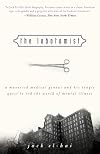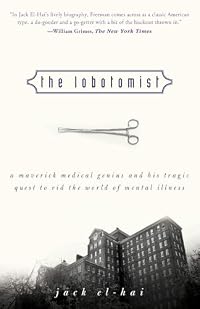
The Lobotomist: A Maverick Medical Genius and His Tragic Quest to Rid the World of Mental Illness
by Jack El-Hai
On This Page
Description
Dr. Walter J. Freeman ranks as one of the most scorned physicians of the 20th century, widely remembered as a loose cannon who worked beyond the boundaries of acceptable medical practice. Yet many of the most important medical figures during his time lent their support to his work, effectively pulling lobotomy--the operation that made him famous--into the mainstream. Many of his patients observed how their lobotomies had changed them for the better. So how is it that both physicians and show more patients supported a procedure that today seems outrageous, even barbaric? This book takes a penetrating look into the life of a complex scientific genius who defies easy description, a brilliant but flawed figure who tried to rescue people once deemed incurable from permanent institutionalization.--From publisher description. show lessTags
Recommendations





















Member Reviews
A biography of the physician Walter Freeman, who pioneered and popularized the practice of lobotomy, eventually performing the procedure on thousands of people suffering from conditions such as depression, schizophrenia, and even chronic pain.
There's something about the very idea of a lobotomy that is deeply, viscerally, and legitimately horrifying. It is, after all, a deliberate mutilation of the human brain, the very seat of the self. Some of the descriptions here of lobotomies being performed actually made me feel slightly nauseated, not because they are gory or lurid, but because they involve such a profound and disturbing act being carried out in such a shockingly cavalier fashion.
However, as El-Hai points out without downplaying show more the disturbing nature of the procedure, our pop culture-based ideas about lobotomy -- mainly that it served as a means to turn difficult and uncooperative patients into drooling, docile idiots -- are significantly oversimplified. The results of the operation were highly variable, and while the outcome was sometimes disastrous, many who received the procedure went on to live reasonably normal and productive lives, which was generally (if, sadly, not always) the goal. The book also avoids oversimplification in the portrayal of Freeman, who comes across as fame-seeking, self-assured almost to the point of hubris, and more than a little reckless, but also as a fairly gifted doctor who was genuinely interested in making people better and who displayed a remarkable amount of concern for his patients long after they left his office. El-Hai seldom editorializes, instead showing us how things looked from Freeman's point of view, along with contemporaries' criticisms of his methods and occasional quotes from medical historians to put it all into perspective. It's an approach that works very well, leaving readers to draw their own conclusions and to pose for themselves the thought-provoking questions raised by this bizarre bit of medical history. And there are a great many such questions, involving ethics, philosophy, psychology, and the practice of medicine in general.
I think the strongest reaction that I came away with is an unsettling realization of just how much of the history of medicine has involved well-meaning doctors flailing around almost blindly, doing radical things to human bodies based on semi-formed hypotheses and hoping for the best. It has also reinforced my belief in the massive importance of scientific method in medicine. It may be a flawed and difficult approach, but the alternative leaves us open to possibilities such as doctors mangling patients' brains with ice picks based on little more than "it seems like it might be a good idea" and then convincing themselves with a bit of wishful thinking that they've found some kind of mental illness panacea. show less
There's something about the very idea of a lobotomy that is deeply, viscerally, and legitimately horrifying. It is, after all, a deliberate mutilation of the human brain, the very seat of the self. Some of the descriptions here of lobotomies being performed actually made me feel slightly nauseated, not because they are gory or lurid, but because they involve such a profound and disturbing act being carried out in such a shockingly cavalier fashion.
However, as El-Hai points out without downplaying show more the disturbing nature of the procedure, our pop culture-based ideas about lobotomy -- mainly that it served as a means to turn difficult and uncooperative patients into drooling, docile idiots -- are significantly oversimplified. The results of the operation were highly variable, and while the outcome was sometimes disastrous, many who received the procedure went on to live reasonably normal and productive lives, which was generally (if, sadly, not always) the goal. The book also avoids oversimplification in the portrayal of Freeman, who comes across as fame-seeking, self-assured almost to the point of hubris, and more than a little reckless, but also as a fairly gifted doctor who was genuinely interested in making people better and who displayed a remarkable amount of concern for his patients long after they left his office. El-Hai seldom editorializes, instead showing us how things looked from Freeman's point of view, along with contemporaries' criticisms of his methods and occasional quotes from medical historians to put it all into perspective. It's an approach that works very well, leaving readers to draw their own conclusions and to pose for themselves the thought-provoking questions raised by this bizarre bit of medical history. And there are a great many such questions, involving ethics, philosophy, psychology, and the practice of medicine in general.
I think the strongest reaction that I came away with is an unsettling realization of just how much of the history of medicine has involved well-meaning doctors flailing around almost blindly, doing radical things to human bodies based on semi-formed hypotheses and hoping for the best. It has also reinforced my belief in the massive importance of scientific method in medicine. It may be a flawed and difficult approach, but the alternative leaves us open to possibilities such as doctors mangling patients' brains with ice picks based on little more than "it seems like it might be a good idea" and then convincing themselves with a bit of wishful thinking that they've found some kind of mental illness panacea. show less
Extremely well written book about the infamous lobotomist Dr - some bits were very gruesome especially when he did his 'operations' on children. A really interesting, if horrific, book. Would recommend.
Yet to read.
Ratings
Members
- Recently Added By
Author Information

17 Works 666 Members
Awards and Honors
Awards
Classifications
- Genres
- Nonfiction, General Nonfiction, History, Biography & Memoir, Science & Nature
- DDC/MDS
- 617.48092 — Technology Medicine & health Surgery, regional medicine, dentistry, ophthalmology, otology, audiology Surgery by systems
- LCC
- RD594 .F74 .E4 — Medicine Surgery Surgery Surgery by region, system, or organ
- BISAC
Statistics
- Members
- 217
- Popularity
- 149,624
- Reviews
- 3
- Rating
- (3.83)
- Languages
- English
- Media
- Paper, Audiobook, Ebook
- ISBNs
- 4
- UPCs
- 1
- ASINs
- 1