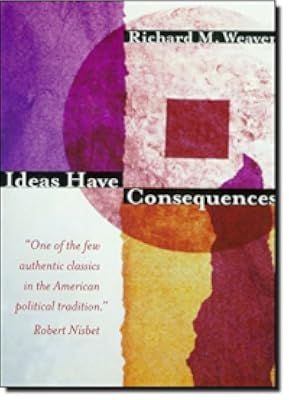
Ideas Have Consequences
by Richard M. Weaver
On This Page
Description
A foundational text of the modern conservative movement, this 1948 philosophical treatise argues the decline of Western civilization and offers a remedy. Originally published in 1948, at the height of post-World War II optimism and confidence in collective security, Ideas Have Consequences uses "words hard as cannonballs" to present an unsparing diagnosis of the ills of the modern age. Widely read and debated at the time of its first publication, the book is now seen as one of the show more foundational texts of the modern conservative movement. In its pages, Richard M. Weaver argues that the decline of Western civilization resulted from the rising acceptance of relativism over absolute reality. In spite of increased knowledge, this retreat from the realist intellectual tradition has weakened the Western capacity to reason, with catastrophic consequences for social order and individual rights. But Weaver also offers a realistic remedy. These difficulties are the product not of necessity, but of intelligent choice. And, today, as decades ago, the remedy lies in the renewed acceptance of absolute reality and the recognition that ideas-like actions-have consequences. This expanded edition of the classic work contains a foreword by New Criterion editor Roger Kimball that offers insight into the rich intellectual and historical contexts of Weaver and his work and an afterword by Ted J. Smith III that relates the remarkable story of the book's writing and publication. show lessTags
Recommendations
















Member Reviews
Summary: An argument tracing the dissolution of Western society to the abandonment of philosophical realism for nominalism and what may be done to reverse that decline.
Many authors have traced the decline of the West (if there is such a thing) to the ideas that shape our culture. Few have argued that more trenchantly or been cited more often that Richard M. Weaver, an intellectual historian and professor of English at the University of Chicago during the mid-twentieth century. I’ve been aware of this book for over twenty years but just now have gotten around to it.
Weaver’s argument begins with the abandonment of philosophical realism, the existence of transcendent or metaphysical truth for nominalism, the denial of absolute show more universals but only the particulars of our existence. He then traces some of the ways this manifests itself. First he discusses the obliteration of the distinctions and hierarchies which constitute society for an egalitarian ideal. He then notes the fragmentation of modern societies. No longer capable of philosophy, we are reduced to facts without coherent structure. Without the transcendent, the self is the measure of value. Egotism is a word that runs through his discussion. When work is only about self-realization rather than being divinely ordained, work becomes a matter of getting the better of others rather than pursuing the common good. Art, as it becomes solipsistic, degenerates. Weaver saves his harshest criticism for the distinctly American music of jazz.
In the rejection of a transcendent metaphysic, moderns come up with a modern synthesis which Weaver calls “the great stereopticon” consisting of the trinity of the press, the motion picture, and the radio (television was just coming on the scene in 1948). These foster the fragmented, disharmonious experience of our lives, often distracting us from their banal character, a critique that seems to have anticipated Neil Postman’s, Amusing Ourselves to Death. All of this fosters in us a “spoiled child” psychology amid technological advances that believes in a material heaven easily achieved.
Weaver’s final three chapters address his proposed remedy–what must be done. First is to reassert and protect the right of private property, the only metaphysical right he believes has not yet been jettisoned in the four hundred year decline he traces. The extension of this from homes to businesses to agriculture preserves and restores volition and undercuts authoritarian tyrannies–whether capitalist or communist. He also argues for the power of the word, both poetic and logical, advocating for instruction in logic and rhetoric. Finally, he contends for restoration of “spirit of piety” with regard for nature, for one’s neighbors, and the past.
For me, what I would most criticize is his concern about distinctions and orders, that seem for him established on the basis of heredity and immutable characteristics, like gender. It felt like women, and perhaps the races must be kept in their places, an idea more in a Platonic rather than Christian metaphysic. It also makes me wonder whether Weaver would want to extend private property to all in society, or is arguing for the protection of the “haves.” I also don’t think much of his application of egotism to the arts, and especially to jazz, rooted in the laments of the blues, and the transcendent hope of the spirituals. I thought this deeply dismissive and a critique imposed from a superficial extension of his basic idea of egotism that little considers the actual work of the artists.
That said, his basic discussion of the consequences of the shift from realism to nominalism, from absolutes to relativism, particularly in the rise of fragmentation, exacerbated by the stereopticon of our media is worth our attention, prescient as it was in 1948. I find myself wondering whether his remedies of private property, the power of words, and the recovery of piety toward the earth, our neighbors, and history get us all the way back to life grounded in transcendent realities, from which he traces our decline. These seem more a holding action at best.
I also found this a challenging read in which the thread of argument gets buried in prose, sparkling at times, and obscuring at others. It felt like reading John Henry Newman–there is a great argument in here, somewhere! It’s an important work, especially for classic conservatives, that anticipates the thought of others. Just be ready for some work as you read it! show less
Many authors have traced the decline of the West (if there is such a thing) to the ideas that shape our culture. Few have argued that more trenchantly or been cited more often that Richard M. Weaver, an intellectual historian and professor of English at the University of Chicago during the mid-twentieth century. I’ve been aware of this book for over twenty years but just now have gotten around to it.
Weaver’s argument begins with the abandonment of philosophical realism, the existence of transcendent or metaphysical truth for nominalism, the denial of absolute show more universals but only the particulars of our existence. He then traces some of the ways this manifests itself. First he discusses the obliteration of the distinctions and hierarchies which constitute society for an egalitarian ideal. He then notes the fragmentation of modern societies. No longer capable of philosophy, we are reduced to facts without coherent structure. Without the transcendent, the self is the measure of value. Egotism is a word that runs through his discussion. When work is only about self-realization rather than being divinely ordained, work becomes a matter of getting the better of others rather than pursuing the common good. Art, as it becomes solipsistic, degenerates. Weaver saves his harshest criticism for the distinctly American music of jazz.
In the rejection of a transcendent metaphysic, moderns come up with a modern synthesis which Weaver calls “the great stereopticon” consisting of the trinity of the press, the motion picture, and the radio (television was just coming on the scene in 1948). These foster the fragmented, disharmonious experience of our lives, often distracting us from their banal character, a critique that seems to have anticipated Neil Postman’s, Amusing Ourselves to Death. All of this fosters in us a “spoiled child” psychology amid technological advances that believes in a material heaven easily achieved.
Weaver’s final three chapters address his proposed remedy–what must be done. First is to reassert and protect the right of private property, the only metaphysical right he believes has not yet been jettisoned in the four hundred year decline he traces. The extension of this from homes to businesses to agriculture preserves and restores volition and undercuts authoritarian tyrannies–whether capitalist or communist. He also argues for the power of the word, both poetic and logical, advocating for instruction in logic and rhetoric. Finally, he contends for restoration of “spirit of piety” with regard for nature, for one’s neighbors, and the past.
For me, what I would most criticize is his concern about distinctions and orders, that seem for him established on the basis of heredity and immutable characteristics, like gender. It felt like women, and perhaps the races must be kept in their places, an idea more in a Platonic rather than Christian metaphysic. It also makes me wonder whether Weaver would want to extend private property to all in society, or is arguing for the protection of the “haves.” I also don’t think much of his application of egotism to the arts, and especially to jazz, rooted in the laments of the blues, and the transcendent hope of the spirituals. I thought this deeply dismissive and a critique imposed from a superficial extension of his basic idea of egotism that little considers the actual work of the artists.
That said, his basic discussion of the consequences of the shift from realism to nominalism, from absolutes to relativism, particularly in the rise of fragmentation, exacerbated by the stereopticon of our media is worth our attention, prescient as it was in 1948. I find myself wondering whether his remedies of private property, the power of words, and the recovery of piety toward the earth, our neighbors, and history get us all the way back to life grounded in transcendent realities, from which he traces our decline. These seem more a holding action at best.
I also found this a challenging read in which the thread of argument gets buried in prose, sparkling at times, and obscuring at others. It felt like reading John Henry Newman–there is a great argument in here, somewhere! It’s an important work, especially for classic conservatives, that anticipates the thought of others. Just be ready for some work as you read it! show less
Of all the books I've read in my life, this one has radicalized my view of western culture and America in every way possible. Weaver's writing style is fervent and raging with the obvious intent of assisting the minds of his readers in the hopes true progress be made. This book has influenced my thinking profoundly, and I highly recommend that everyone, Americans in particular, spend the time to read and ponder the points Weaver makes.
Tightly-written short book on the philosophical origins of the postwar traditionalist conservative movement in the United States. Weaver opens by stating in a matter-of-fact tone that "this is another book about the dissolution of the West." Weaver attacks moral relativism insistently, suggesting that the "denial of everything transcending experience means inevitably…the denial of truth. With the denial of objective truth there is no escape from the relativism of ‘man is the measure of all things.'"
Since nominalism gained popularity in the Late Middle Ages, this book primarily discusses the detrimental effects of this doctrine on Western civilization. It then suggests a course of action that Weaver believes could save the West from its decline.
I don't agree with everything Weaver says (e.g., he might have a small point about jazz, but his criticism is much too harsh and general), but he's a very original thinker whose ideas merit serious consideration. If he doesn't always hit the nail on the head, I think he's ohten not far from the truth.
This is, quite simply, a dreadful book to read. It's philosophical in nature; Weaver asserts a cause for the evils in society (back in the 40's or so), attempts to prove his assertion, and then offers a solution. It's full of terms and word meanings that are not common to those not already immersed in philosophy, and he makes no attempt to accommodate the new reader. And his solution doesn't really match his stated problem, so the book is even of questionable value. I really can't recommend it, except to those who are diehard fans of philosophy.
Hasn't aged well. Only redeeming feature is its catchy title.
Members
- Recently Added By
Lists

Generation Joshua
115 works; 3 members

CCE 100 Great Books List
145 works; 8 members
Author Information

18+ Works 1,543 Members
Richard M. Weaver taught for nearly two decades at the University of Chicago before his death in 1963. A student under both' John Crowe Ransom and Cleanth Brooks, Weaver was a well-known adherent of the Southern Agrarian school of social criticism. His books and essays have established him as one of the most important and influential philosophers show more of the twentieth century. show less
Awards and Honors
Classifications
- Genres
- Philosophy, Nonfiction, General Nonfiction, Politics and Government, Religion & Spirituality, History
- DDC/MDS
- 100 — Philosophy & psychology Philosophy Philosophy, parapsychology and occultism, psychology
- LCC
- CB19 .W4 — Auxiliary Sciences of History History of Civilization History of Civilization
- BISAC
Statistics
- Members
- 1,032
- Popularity
- 25,160
- Reviews
- 11
- Rating
- (4.20)
- Languages
- 5 — Czech, English, Polish, Portuguese, Spanish
- Media
- Paper, Audiobook, Ebook
- ISBNs
- 18
- ASINs
- 13