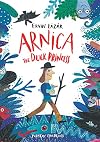
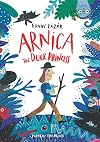
Arnica, The Duck Princess
by Ervin Lázár
On This Page
Description
Princess Arnica is so sweet and gentle that when she smiles even wolves and bears forget their fierceness. Everyone loves her, but she loves only Poor Johnny. Luckily, he loves her too, and even more luckily she has a very sensible king for a father, who is happy for her to marry whomever her heart desires. So, no problems then? Well, maybe just one - The Witch with a Hundred Faces has cast a spell on Arnica and Johnny which means that one of them, at any one time, must always be a duck, and show more the other human! Who can help them? Only the Seven-headed Fairy. Will they be able to find her? show lessTags
Recommendations



























Member Reviews
Originally published in 1981 as Szegény Dzsoni és Árnika, this Hungarian children's classic is a delightfully original fairy-tale, one which presents an amusing and entertaining story, as well as an engaging side-narrative between the storyteller and listener. The fairy-tale itself concerns the beautiful and gentle Arnica, a princess whose sensible and kindly father, King Tirunt, wishes her to marry whom she pleases. Poor Jonny, a footloose and fancy-free wanderer, soon enters the picture, and he and Arnica fall deeply in love. Unfortunately for our lovers, Johnny had previously fallen afoul of the Witch with a Hundred Faces, and he and Arnica end up separated by her curse - while one is in human form, the other must be a duck. The show more two set out to find the Seven-Headed Fairy, in the hopes that she can cure them, meeting and helping many interesting characters along the way. In between the episodes devoted to this pair of wandering lovers, there are exchanges between what one presumes to be the author and his young listener, in which the child asks questions, makes demands of the storyteller, and discusses issues arising in the tale...
Although I can certainly understand why some readers have found Arnica, The Duck Princess rather off-putting - criticisms of its length and format seem most common - I found the whole thing absolutely charming! The fairy-tale itself is rather absurd, but the sense of humor throughout makes it plain that it isn't to be read as a serious melodrama (if melodrama can ever be said to be serious), but rather, as a gentle satire. The exchanges between the author/storyteller and the child listener - perhaps his child or grandchild? - were often quite amusing, sometimes quite poignant, and almost always thought-provoking. This style of direct communication from the author, whether intended for the reader or, as here, for a hypothetical listener, doesn't work for everyone. One need only look at the responses to Kate DiCamillo's The Tale of Despereaux to see that. For me however, the results were delightful, and I chuckled on more than one occasion, while reading these interludes. The discussion of the Victor Coppermine chapter particularly stood out to me, as narrator and listener discuss the narcissism of those who make a habit of becoming offended over small things. When I read the following: - "he thinks the world revolves around him, and that he's the only one who can be fed up, that he's the only one who can be having a difficult time. It's all him, him, him. It never occurs that other people have their troubles too" - I had a moment of strong recognition. How apt this is, in our current zeitgeist of perpetual offense, and how neatly Lázár has captured the fundamental problem of this trend of becoming angry and aggressive about every perceived cultural slight or transgression. That moment of insight was only strengthened by the nuance of the discussion, as storyteller and child then discuss the idea that offense can sometimes be legitimate, when not fueled by this kind of selfish naval-gazing.
I really appreciate the respect that Lázár shows his young readers here, how he offers such a thoughtful discussion of the underlying philosophical issues raised by his tale. With an entertaining story, a thoughtful story discussion, and charmingly quirky and colorful artwork from Jacqueline Molnár, Arnica, The Duck Princess was a real winner for me. I certainly hope that London-based Pushkin Books translate more of this author's work! show less
Although I can certainly understand why some readers have found Arnica, The Duck Princess rather off-putting - criticisms of its length and format seem most common - I found the whole thing absolutely charming! The fairy-tale itself is rather absurd, but the sense of humor throughout makes it plain that it isn't to be read as a serious melodrama (if melodrama can ever be said to be serious), but rather, as a gentle satire. The exchanges between the author/storyteller and the child listener - perhaps his child or grandchild? - were often quite amusing, sometimes quite poignant, and almost always thought-provoking. This style of direct communication from the author, whether intended for the reader or, as here, for a hypothetical listener, doesn't work for everyone. One need only look at the responses to Kate DiCamillo's The Tale of Despereaux to see that. For me however, the results were delightful, and I chuckled on more than one occasion, while reading these interludes. The discussion of the Victor Coppermine chapter particularly stood out to me, as narrator and listener discuss the narcissism of those who make a habit of becoming offended over small things. When I read the following: - "he thinks the world revolves around him, and that he's the only one who can be fed up, that he's the only one who can be having a difficult time. It's all him, him, him. It never occurs that other people have their troubles too" - I had a moment of strong recognition. How apt this is, in our current zeitgeist of perpetual offense, and how neatly Lázár has captured the fundamental problem of this trend of becoming angry and aggressive about every perceived cultural slight or transgression. That moment of insight was only strengthened by the nuance of the discussion, as storyteller and child then discuss the idea that offense can sometimes be legitimate, when not fueled by this kind of selfish naval-gazing.
I really appreciate the respect that Lázár shows his young readers here, how he offers such a thoughtful discussion of the underlying philosophical issues raised by his tale. With an entertaining story, a thoughtful story discussion, and charmingly quirky and colorful artwork from Jacqueline Molnár, Arnica, The Duck Princess was a real winner for me. I certainly hope that London-based Pushkin Books translate more of this author's work! show less
Lázár Ervin beszélget a kislányával, szóval együtt szövik a mesét. Kiről szólhat másról egy ilyen mese, mint a becsületes, egyszerű szegény legényről, a jószívű királykisasszonyról, a hirtelen haragú királyról és a vasorrú bábáról, aki természetesen összekeveri a dolgokat. Végül helyreáll a rend, és szegény Dzsoni feleségül veheti Árnikát, és elnyerheti vele a királyságot is. Minden olyan egyszerű, de mégis annyi mindenen lehet elgondolkozni. És mi jobb alkalom arra, hogy az emberi jóságon, barátságon, szereteten elgondolkodjunk, mint egy közös mesélés apa és lánya között? Lázár Ervin és kislánya új mesei világba kalauzolja el az olvasókat; ebben a könyvben nincs jelen show more Mikkamakka, sem Vacskamati, még Bruckner Szigfrid sem, de a Hétfejű Tündér szeretetvilágának minden szépségét megtaláljuk benne. Réber László magával ragadó bájjal, mély humorral teszi láthatóvá Lázár Ervin mesevilágát. show less
Apr 29, 2020Hungarian
Ratings
Members
- Recently Added By
Lists

Childhood: Books for or about children in different cultures around the wor
345 works; 17 members
Author Information

57 Works 252 Members
Some Editions
Common Knowledge
- Canonical title
- Arnica, The Duck Princess
- Original title
- Szegény Dzsoni és Árnika
Classifications
- Genres
- Fiction and Literature, Children's Books
- DDC/MDS
- 894.511334 — Literature & rhetoric Asian Literature Literatures of Altaic, Uralic, Hyperborean, Dravidian languages; literatures of miscellaneous languages of south Asia Finno-Ugric languages Ugric languages Hungarian Hungarian fiction 1900–2000 Late 20th century 1945–2000
- LCC
- PZ7 .L44775 — Language and Literature Fiction and juvenile belles lettres Fiction and juvenile belles lettres Juvenile belles lettres
- BISAC
Statistics
- Members
- 23
- Popularity
- 1,144,796
- Reviews
- 2
- Rating
- (4.67)
- Languages
- English, German, Hungarian
- Media
- Paper, Ebook
- ISBNs
- 7
- ASINs
- 1