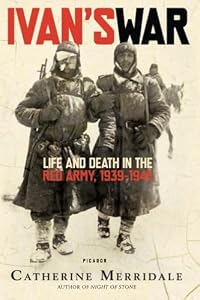
Ivan's War: Life and Death in the Red Army, 1939-1945
by Catherine Merridale
On This Page
Description
A narrative of the ordinary Russian soldier's experience of the worst war in history, based on newly revealed sources. The men and women of the Red Army, a ragtag mass of soldiers, confronted Europe's most lethal fighting force and by 1945 had defeated it. Sixty years have passed since their epic triumph, but the heart and mind of Ivan--as the ordinary Russian soldier was called--remain a mystery. We know something about how the soldiers died, but nearly nothing about how they lived, how show more they saw the world, or why they fought. Drawing on previously closed military and secret police archives, interviews with veterans, and private letters and diaries, Merridale presents the first comprehensive history of the Red Army rank and file, revealing the singular mixture of courage, patriotism, anger, and fear that made it possible for these underfed, badly led troops to defeat the Nazi army.--From publisher description. show lessTags
Recommendations












Member Reviews
Superb, absorbing account of something that hasn't been addressed too often; that is, what World War II was like for the average "frontoviki," the "Ivan," the soldier of the Red Army. Well-organized, with good illustrations, but most of all, some excellent writing. The angle of what the soldiers went home to in 1945-1946 is also explored; the disappointment at promises dashed is something you don't see anywhere else, except for hints of it in Solzhenitsyn. If I had one criticism of the book, it's that it has only one map, a large-scale one in the front. More maps might have helped trace the narrative. But overall, this is a highly interesting book, and one I would not hesitate to recommend.
What a devastating book. It seems so trite to point it out, but a history of the Red Army during the Second World War makes incredibly depressing reading. ‘Ivan’s War’ covers a litany of disasters, cruelties, and mistakes inflicted on the Red Army, some by their commanders and some by their enemies. As well as documentary evidence, the book includes interviews with the rare surviving veterans. These interviews seem to demonstrate that carrying on after such extreme, traumatic experience requires some denial. Those who served on the Eastern Front after the initial chaos of 1941 had grown up in Soviet Russia and knew only Stalin’s rule. Even sixty years later, they recall the propaganda version of the war. Whilst this has an show more element of truth, it ignores many horrors. The book describes conditions for Red Army front line soldiers - perpetually under-supplied, watched for the slightest sedition by 'politruks', shadowed by the NKVD, and not allowed any leave whatsoever.
Most importantly, this book conveys the sheer reckless disregard that the entire Soviet war machine, from Stalin downwards, had for human life. It is impossible to wrap your head around the scale of Soviet losses during the Second World War. The estimated totals have margins of error in the multi-millions! Even after the tide had turned and the Red Army was pursuing German forces into Western Europe, losses continued to be far greater on the Soviet side. An entire generation of young men was nearly wiped out; whole areas were depopulated as they became war zones. Whilst reading about this, I had to wonder - was this what it took to defeat the evil of Nazism? Was it the willingness to send soldiers upon soldiers to their deaths that turned the tide? This book certainly argues that initial losses were high during the German invasion due to disorganisation and incompetence in the Red Army, as well as denial in senior political circles. What is frightening to contemplate, though, is whether only a regime like Stalin’s could defeat the Nazi armies. (We have no way to know, obviously.)
One of the reasons that this book is so chilling to read is the hollowness of the eventual victory. Not only because of the cost in lives, but due to the horrors that attended it. Merridale discusses the Red Army’s use of rape and violence as weapons of revenge against the German population, as well as noting that one of the Nazi concentration camps was immediately re-purposed by the Soviet regime as a gulag. The front line soldiers of the Red Army returned to shattered homes, hard labour, shortages, and a paranoid and vicious political regime. It isn’t difficult to see why veterans would prefer that simple, heroic Soviet war narrative, which celebrated their victory to a point but also saw the war as mostly best forgotten. As Merridale says, ‘the path to survival lay in stoical acceptance, a focus on the job in hand’. The message I really took from this book, though, was how this clash of cruel ideologies led to such massive loss of life that no-one can really comprehend it. Trying to do so is an unpleasant yet important experience. Nazism was thankfully defeated, but we should not forget at what cost. I need to read something uplifting next, this book really got me down. show less
Most importantly, this book conveys the sheer reckless disregard that the entire Soviet war machine, from Stalin downwards, had for human life. It is impossible to wrap your head around the scale of Soviet losses during the Second World War. The estimated totals have margins of error in the multi-millions! Even after the tide had turned and the Red Army was pursuing German forces into Western Europe, losses continued to be far greater on the Soviet side. An entire generation of young men was nearly wiped out; whole areas were depopulated as they became war zones. Whilst reading about this, I had to wonder - was this what it took to defeat the evil of Nazism? Was it the willingness to send soldiers upon soldiers to their deaths that turned the tide? This book certainly argues that initial losses were high during the German invasion due to disorganisation and incompetence in the Red Army, as well as denial in senior political circles. What is frightening to contemplate, though, is whether only a regime like Stalin’s could defeat the Nazi armies. (We have no way to know, obviously.)
One of the reasons that this book is so chilling to read is the hollowness of the eventual victory. Not only because of the cost in lives, but due to the horrors that attended it. Merridale discusses the Red Army’s use of rape and violence as weapons of revenge against the German population, as well as noting that one of the Nazi concentration camps was immediately re-purposed by the Soviet regime as a gulag. The front line soldiers of the Red Army returned to shattered homes, hard labour, shortages, and a paranoid and vicious political regime. It isn’t difficult to see why veterans would prefer that simple, heroic Soviet war narrative, which celebrated their victory to a point but also saw the war as mostly best forgotten. As Merridale says, ‘the path to survival lay in stoical acceptance, a focus on the job in hand’. The message I really took from this book, though, was how this clash of cruel ideologies led to such massive loss of life that no-one can really comprehend it. Trying to do so is an unpleasant yet important experience. Nazism was thankfully defeated, but we should not forget at what cost. I need to read something uplifting next, this book really got me down. show less
Ivan's War is a social history of the Red Army in WWII. Merridale describes the make-up of the army, its training, its devastation by Stalin's purges, its lack of preparation and equipment, its tragedy in the first months and year of the war, its growing confidence after Stalingrad, the curbing of political influence to let the military leaders make military decisions, the incredible waste of lives which all too often characterized Soviet offensives, the actions and attitudes of the Army when it crossed Soviet borders into Poland and then into Germany itself. But more interestingly, Merridale delves into what motivated the soldiers of the Red Army, what was the relationship of the Army to Soviet society, what were the attitudes of the show more soldiers who had to live with the "Stalinist bacillus of mistrust". She has done this by combing old records, letters, reports, and talking to veterans of all types.
The numbers are staggering and dwarf anything in any other theatre of the war. By February, 1942, the Red Army had lost 3 million captured and 2.7 million dead, but even so, by the end of 1942, it had more than 6 million soldiers in the field. Three million Soviet POWs were killed in German captivity. 1.6 million ethnic peoples were deported by the Soviets for alleged disloyalty or sympathy with the Germans. 7.5 million Soviet civilians were killed by the Germans. 3.5 million Soviets were shipped west as slave labour, of whom 2 million died. The best estimate is that 8.6 million Soviet military personnel were killed either on the battlefield or as POWs. 5.5 million Soviet citizen were "repatriated" to the Soviet Union at the end of the war and about one-fifth of those were executed or sentenced to 25 years hard labour.
Merridale also explores the betrayal, by the system, of the sacrifices made by those who fought and risked their lives. So many had hoped that the tyranny of the Soviet system would ameliorate after the war, but all were disappointed. As Merridale says, "For those whom the state punished, postwar life was cruel. For all the rest, it was a time when relief was tinged with disquiet. Everyone would find, too, that Soviet society had grown harder, more brutal, and cold.....War itself, too, had shattered Soviet family and social networks and debased further the values of mercy, cooperation, and even simple good manners.....the real tragedy, the perfidy of Stalin's final years, was the theft that forced decent citizens to acquiesce in tyranny because of fear, the theft of almost every grand ideal that they had fought to save."
This is a book about the "facts" of the war, but even more so, it is about the power of myth and memory; about how memory distorts to filter out the worst to retain the positives, and how this can be influenced by myths that grow up on their own or, in the case of the Soviet Union, are deliberately manufactured by the state, for the glory and perpetuation of the state and the political system; how under the Soviet system it was suicidal to question the official myths.
As the Spanish historian Felipe Fernandez-Armesto said, "...facts are less potent than the falsehoods that people believe. If enough people believe a falsehood, it eventually becomes true; in the meantime they behave as if it were true and its influence on the course of events becomes immense."
Ivan's War is well researched, well written, and well worth a read. show less
The numbers are staggering and dwarf anything in any other theatre of the war. By February, 1942, the Red Army had lost 3 million captured and 2.7 million dead, but even so, by the end of 1942, it had more than 6 million soldiers in the field. Three million Soviet POWs were killed in German captivity. 1.6 million ethnic peoples were deported by the Soviets for alleged disloyalty or sympathy with the Germans. 7.5 million Soviet civilians were killed by the Germans. 3.5 million Soviets were shipped west as slave labour, of whom 2 million died. The best estimate is that 8.6 million Soviet military personnel were killed either on the battlefield or as POWs. 5.5 million Soviet citizen were "repatriated" to the Soviet Union at the end of the war and about one-fifth of those were executed or sentenced to 25 years hard labour.
Merridale also explores the betrayal, by the system, of the sacrifices made by those who fought and risked their lives. So many had hoped that the tyranny of the Soviet system would ameliorate after the war, but all were disappointed. As Merridale says, "For those whom the state punished, postwar life was cruel. For all the rest, it was a time when relief was tinged with disquiet. Everyone would find, too, that Soviet society had grown harder, more brutal, and cold.....War itself, too, had shattered Soviet family and social networks and debased further the values of mercy, cooperation, and even simple good manners.....the real tragedy, the perfidy of Stalin's final years, was the theft that forced decent citizens to acquiesce in tyranny because of fear, the theft of almost every grand ideal that they had fought to save."
This is a book about the "facts" of the war, but even more so, it is about the power of myth and memory; about how memory distorts to filter out the worst to retain the positives, and how this can be influenced by myths that grow up on their own or, in the case of the Soviet Union, are deliberately manufactured by the state, for the glory and perpetuation of the state and the political system; how under the Soviet system it was suicidal to question the official myths.
As the Spanish historian Felipe Fernandez-Armesto said, "...facts are less potent than the falsehoods that people believe. If enough people believe a falsehood, it eventually becomes true; in the meantime they behave as if it were true and its influence on the course of events becomes immense."
Ivan's War is well researched, well written, and well worth a read. show less
Brillante historia social del Ejército Rojo durante la Segunda Guerra Mundial a partir (principalmente) de documentos de la época. El libro va alternando la descripción de los acontecimientos con la de la vida cotidiana de los soldados.
Thank you Catherine Merridale, absolutely enthralling. The author is a British social historian and her outsider status both as British and as a woman is also interesting. And has also renewed my desires to read equivalently well researched books on places/times where the author is an outsider and I am at least partly insider to add that extra dimension! Must be some out there - perhaps a book on British massacres in Africa by a Peruvian historian.
It has been a strangely comforting read alongside the current Brexit and Covid pandemic. I hope the comfort lies less in the contrast of world chaos in the comfort of a warm home, and more in the work and effort the author has made to listen to people who lived through it and dig through the show more archives to recover something of the souls of individuals without praise or blame. Loved the photos sprinkled through the book.
For a brilliant review just see Mariel who has put the time in to write the kind of review the book deserves. show less
It has been a strangely comforting read alongside the current Brexit and Covid pandemic. I hope the comfort lies less in the contrast of world chaos in the comfort of a warm home, and more in the work and effort the author has made to listen to people who lived through it and dig through the show more archives to recover something of the souls of individuals without praise or blame. Loved the photos sprinkled through the book.
For a brilliant review just see Mariel who has put the time in to write the kind of review the book deserves. show less
There have been many books written about the Soviet Union’s Role in WW II but this book is unique for it focuses on the Ivans, those millions of nameless men who fought in the Red Army. Through access to diaries, interviews, letters home, and investigation in the military and police archives opened by Gorbachev’s glasnost, Merridale has rolled back the state vision of the Red Army soldier to reveal the average Soviet soldier, ill trained, ill equipped, poorly led, and viewed by Stalin as so much meat to be fed to the grinder of war. "
Merridale's highly in-depth research and interviews show through-out this book & it pays off by painting a very clear picture of what it was like for the soldiers individually in this army of faceless masses. They suffered, they died, but in the end they persevered & overcame. War is never the right way for humans to interact. May my children never see such things.
Members
- Recently Added By
Lists

Best Military History Books
123 works; 21 members

All Things Russia
459 works; 11 members

r/AskHistorians' Recommended Books
1,068 works; 17 members
Author Information

7+ Works 1,828 Members
Catherine Merridale is a Senior Lecturer in history at the University of Bristol. She holds degrees from Cambridge & Birmingham. This book was supported by grants from the MacArthur Foundation, the British Academy, & the Russian Academy of Science. She is the author of two academic books on Russia & has written for the prestigious History Workshop show more Journal. She lives in Bristol, England. (Bowker Author Biography) show less
Series
Belongs to Publisher Series
Common Knowledge
- Canonical title*
- Les guerriers du froid. Vie et mort des soldats de l'Armée rouge, 1939-1945
- Original title
- Ivan's War. Life and Death in the Red Army, 1939-1945
- Original publication date
- 2006
- Important places
- USSR
- Important events
- World War II (1939 | 1945); World War II, Eastern Front (1941-06-22 | 1945-05-05)
- Epigraph*
- /
- Dedication*
- À mon père,
Philip Merridale - First words*
- Introduction
Des histoires de guerre véridiques
Il n’y a pas d’ombre à Koursk en juillet. C’est assez remarquable, car cette ville est située sur une des terres les plus fertiles de Russie, le... (show all) tchernoziom, un sol noir qui s’étend au sud et à l’ouest vers l’intérieur de l’Ukraine. [...] - Original language*
- Anglais (Royaume-Uni) (Royaume-Uni)
*Some information comes from Common Knowledge in other languages. Click "Edit" for more information.
Classifications
Statistics
- Members
- 852
- Popularity
- 31,884
- Reviews
- 15
- Rating
- (4.02)
- Languages
- 13 — Czech, Danish, Dutch, English, Estonian, French, German, Greek, Italian, Norwegian (Bokmål), Polish, Spanish, Swedish
- Media
- Paper, Audiobook, Ebook
- ISBNs
- 27
- ASINs
- 5