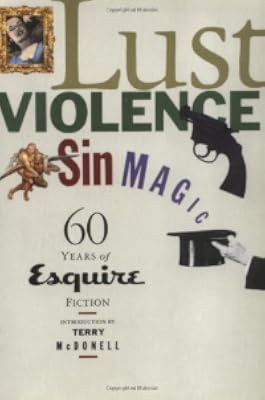
Lust, Violence, Sin, Magic: Sixty Years of Esquire Fiction
by Rust Hills, Esquire
On This Page
Description
From its premier issue in 1933, which featured writing by Ernest Hemingway, Dashiell Hammett, and John Dos Passos, Esquire has been dedicated to publishing fiction and renowned for its literary excellence; during this century, through the Depression, both World Wars, and into the 1990s, Esquire has maintained a passionate involvement with both celebrated authors and gifted new writers. Lust, Violence, Sin, Magic is a collection of some of the stories that first appeared in Esquire magazine. show more The names are familiar, and they serve as testimony to both Esquire's literary prominence and the incredible breadth of styles that have graced its pages. Here, gathered in one volume, are writers such as: Ernest Hemingway, F. Scott Fitzgerald, John Steinbeck, Irwin Shaw, Norman Mailer, Louise Erdrich, John Cheever, Philip Roth, Flannery O'Connor, Raymond Carver, Joy Williams, Harold Brodkey, Truman Capote, Gail Godwin, Richard Ford, John Updike, Jayne Anne Phillips, Barry Hannah, Gabriel Garcia Marquez, T. Coraghessan Boyle, Tim O'Brien, Denis Johnson, Ethan Canin, Don Delillo show lessTags
Recommendations











Member Reviews
Really - is there any way to go wrong when your list of authors includes the likes of Truman Capote, Philip Roth, Saul Bellow, Ernest Hemingway, John Steinbeck, Norman Mailer, F. Scott Fitzgerald, John Cheever, Flannery O’Connor, John Updike, Gabrial Garcia Marquez, and Ray Bradbury? (That is just part of the 24 authors included.) I suppose there is. For example, it could be one of those collections we were all forced to read in college where “great literature” was gathered to make us all smarter. But such is not the case here. This is a collection culled from Esquire magazine by people who apparently love the short story and are not trying to prove any point but that it is a joy to read good stories.
Of course there are low show more points – stories that didn’t work for me. But the overall quality of this collection is so high that the points seem low only by comparison, and, even if a story didn’t work for me, I could still the craft and quality inherent in the story.
Because the stories come from Esquire, it does not necessarily include the authors’ best stories. Sure, there is “The Snows of Kilimanjaro” and other stories you may recognize. But there are just as many new delights in the collection as you will find anywhere. My thought was to list some of the new surprises, but it is just too much. This is an overall strong collection which is perfect for someone just learning about the short story or for the seasoned veteran. show less
Of course there are low show more points – stories that didn’t work for me. But the overall quality of this collection is so high that the points seem low only by comparison, and, even if a story didn’t work for me, I could still the craft and quality inherent in the story.
Because the stories come from Esquire, it does not necessarily include the authors’ best stories. Sure, there is “The Snows of Kilimanjaro” and other stories you may recognize. But there are just as many new delights in the collection as you will find anywhere. My thought was to list some of the new surprises, but it is just too much. This is an overall strong collection which is perfect for someone just learning about the short story or for the seasoned veteran. show less
Ratings
Members
- Recently Added By
Author Information
9+ Works 619 Members
Rust Hills was the long time fiction editor of "Esquire." The author of the trilogy "The Memoirs of a Fussy Man," he divides his time between Florida & Connecticut. (Publisher Provided) Writer and editor L. Rust Hills was born on November 9, 1924. He attended the Kings Point Merchant Marine Academy, served in the merchant marines during World War show more II, and graduated from Kenyon College. He was hired as the fiction editor for Esquire in 1957. He left in 1964 to go to The Saturday Evening Post, but would return to Esquire in 1969 and again in 1978. He was associated with the magazine until 1999. In the 1970s, he wrote three books of personal essays entitled How to Do Things Right: The Revelations of a Fussy Man; How to Retire at 41, or Dropping Out of the Rat Race Without Going Down the Drain; and How to Be Good, or the Somewhat Tricky Business of Attaining Moral Virtue in a Society That's Not Just Corrupt But Corrupting, Without Being Completely Out-of-It. He also wrote a writing manual entitled Writing in General and the Short Story in Particular and edited numerous anthologies including How We Live: Contemporary Life in Contemporary Fiction. He died from cardiac arrest on August 12, 2008. (Bowker Author Biography) show less

155 Works 2,024 Members
Classifications
Statistics
- Members
- 38
- Popularity
- 763,018
- Reviews
- 1
- Rating
- (3.93)
- Languages
- English
- Media
- Paper
- ISBNs
- 2