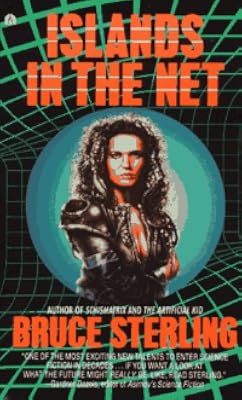
Islands in the Net
by Bruce Sterling
On This Page
Description
In a near-future new age of corporate control, hacker mercenaries, and electronic terrorism, a public relations executive on the rise finds herself caught in the violent epicenter of a data war Two decades into the twenty-first century, the world's nations are becoming irrelevant. Corporations are the true global powers, with information the most valuable currency, while the smaller island nations have become sanctuaries for data pirates and terrorists. A globe-trotting PR executive for the show more large corporate economic democracy Rizome Industries Group, Laura Webster is present when a foreign representative is assassinated on Rizome soil during a conference for offshore data havens. Dispatched immediately on an international mission of diplomacy, Laura hopes she can make a difference in a volatile, unsteady world, but instead finds herself trapped on the front lines of rapidly escalating third-world hostilities and caught up in an inescapable net of conspiracy, terrorism, post-millennial voodoo, and electronic warfare. During the 1980s, science fiction luminary Bruce Sterling envisioned the future . . . and hit it almost dead-on. The author who, along with William Gibson, Neal Stephenson, and Rudy Rucker, helped create and define the cyberpunk subgenre imagines a world of tomorrow in Islands in the Net that bears a striking--and disturbing--resemblance to our present-day information-age reality. Nominated for the Hugo and Locus Awards and winner of the John W. Campbell Memorial Award, Sterling's extraordinary novel is a gripping, eye-opening, and remarkably prescient science fiction classic. show lessTags
Recommendations














Member Reviews
A review I wrote in 1990. Spoilers follow.
For all his hyperbole, posturing, and preaching as to what sf should and shouldn’t be and his wild proclamations on the evil’s of Reagan, Sterling is a first rater writer. He knows his science and technology (that you can terrorize -- quite literaly -- someone’s brain with carboline, what you can do with an abandoned supertanker, the possibiliites of a VCR as a revolutionary broadcast system) and he knows the workings of society (down to the rumors of Pope John Paul I’s death being connected to a Vatican banking scandal); he extrapolates in depth with a detailed style that thoroughly convinces; he creates plausible, complex characters; and he’s not afraid to ask the hard questions in show more this sometimes ambiguous political novel.
Sterling, chief theoretician of the cybperpunk/Neuromantic movement, creates a novel with a middleclass character, Laura Webster, not the low-life criminals or rich, sinister tycoons of, say, early William Gibson novels. Sterling uses the new sf device of the data Net, but it is a realistic portrayal, wide in scope including more than just the fringes of the global society (though, with the data pirates and mercenaries he does that too).
The central spiritual feature of this new world, new Millennium, is the abolition of all nuclear weapons. It is a credit to the overwhelming creditability, plausibility, and versimilitude of the novel that I have trouble accepting this premise. Its flaw as a conceit is due to the near perfection of the structure it’s embedded in. I would have accepted such a conceit readily from a lesser writer. It would be just another wild conceit in a nest of them. Perhaps this reaction of mine dogs most writers who try to do a plausible near-future sf story.
Larua Webster, circa 2022, the year the story begins, is a child of the Post-Abolition. She seems, to me, smug. To her its only abvious that nukes would have abolished. It’s the only logical course. She finds it puzzling that my contemporary’s would pat themselves on the back for doing the obvious. (She is naive and somewhat complacent. Yet her character seems plausible, realistic, well-drawn even if I didn’t warm to her.
I thought one of the most brilliant metaphors Sterling used was when Webster views the video games of Missle Command, Space Invaders, and Pacman as symbols of the pre-Millennium -- games where one’s foe is an inhuman, implacable, joyless computer and that no matter how long you play the game always ends in apocalypse. A very memorable bit.
I find Webster's employer, Rizome Industries Group, insufferable, smug, self-righteous. (It’s significant that I react to the story’s characters and plot in terms of emotions, emotions sparked by the novel’s plausibility rather than as impersonal plot conceits). Rizome pretends to be egalitarian but is really hierarchial and too much like a zaibatsu: the kind of company that wants to be your buddy as well as your employer, that thrusts itself into your personal life. However, I think its "economic democracy is a workable setup and social order some -- not me -- might find desireable. It was also, in it’s own way, rather alien.
The central ambivalence of this novel is the great ambivalence of society: the double edged sword of technology literally, strikingly embodied by Sterling in a ceramic machete. Simple, deadly, devastating tech. The modern superpowers and industrial countries have become technologically conservative, their cutting edge dulled, buried under (as a Grenadian says) “lawyers and bureaucrats and social impact statements’”. The islands in the net are Grenada, Singapore, and Luxembourg, nations who are outlaws in refusing to play along with the cautious globalism of the rest of the world. To Grenada the technological castoffs of the rest of the world and the forbidden tech of extensive genetic engineering are methods to a higher standard of living, self-reliance, and revenge against American and Europe. They may stifle their people in a Marxist closed-economy, but they are vibrant. Scientists and technicians flock there to do researching in areas no one else is interested in or will permit. And they’re paid well.
It is a strange world of supertankers turned into habitations and voodoo with a high-tech patina. Singapore is ambitious, hustling, views the rest of the world as decadent, cynical, lazy, and conspiring to keep them from their rightful place in the sun. They are pushing space utilization forward. Into this world of data piracy, Sterling throws in terrorists who specifically strike against the pirates and set one against the other. Sterling deftly punctures some silly cyberpunk notions of the future -- no all-powerful corporations for him. His corporations have no armed forces. They covertly pay the F.A.C.T terrorists for action against the pirates. Eventually, some corporations talk of a global coup against the Vienna forces so they can take on F.A.C.T. when they turn on them. Sterling, unlike many authors, seems to realize nationalism is a powerful force and will not readily disappear from human affairs.
I think Sterling’s plot unravels though in the vague machinations of F.A.C.T in Mali. Do they intend to establish an African empire? There’s talk of genocide, but nothing is adequately explained. F.A.C.T blackmailing Vienna by threatening to use nukes seems a bit contrived. The novel ends when F.A.C.T. tries to nuke Hiroshima and fails. Vienna and the world comes down hard on it. It seems Vienna wouldn’t have just let F.A.C.T. alone just so no one would know nukes were still around. Even if the revulsion against nukes is that great -- and people are oddly, plausibly, very predictably fascinated when the sorid, terrifying scandal breaks -- Vienna would still have clamped down. The novel’s one failing is vagueness in the final thirds politics including the Lawrence of Arabia like Colonel Gresham who seems to want to help the basket case Africans shrug off Western, Net culture with the technological trappings of that culture. Paradoxical, yes, but like the real Colonel Lawrence.
Sterling seems to wander between siding with the conservative, safe, sane forces of the Net and the radical, innovative, vibrant culture of the islands. However, at novel’s end, those islands are absorbed. Perhaps Sterling’s novel on the ethical and political uses of technology is best characterised when a renegade scientists says “All tech is dangerous -- even with no moving parts.” Tech creates its own problems, solves problems, is a tool of liberation and suppression, sanity and irrationality. The islands are absorbed into a global social order. Tech can be used by either side in any struggle be it with nature or other men. What ethic prevails depends on morals, the social structure. An unoriginal point but one seldom realized. show less
For all his hyperbole, posturing, and preaching as to what sf should and shouldn’t be and his wild proclamations on the evil’s of Reagan, Sterling is a first rater writer. He knows his science and technology (that you can terrorize -- quite literaly -- someone’s brain with carboline, what you can do with an abandoned supertanker, the possibiliites of a VCR as a revolutionary broadcast system) and he knows the workings of society (down to the rumors of Pope John Paul I’s death being connected to a Vatican banking scandal); he extrapolates in depth with a detailed style that thoroughly convinces; he creates plausible, complex characters; and he’s not afraid to ask the hard questions in show more this sometimes ambiguous political novel.
Sterling, chief theoretician of the cybperpunk/Neuromantic movement, creates a novel with a middleclass character, Laura Webster, not the low-life criminals or rich, sinister tycoons of, say, early William Gibson novels. Sterling uses the new sf device of the data Net, but it is a realistic portrayal, wide in scope including more than just the fringes of the global society (though, with the data pirates and mercenaries he does that too).
The central spiritual feature of this new world, new Millennium, is the abolition of all nuclear weapons. It is a credit to the overwhelming creditability, plausibility, and versimilitude of the novel that I have trouble accepting this premise. Its flaw as a conceit is due to the near perfection of the structure it’s embedded in. I would have accepted such a conceit readily from a lesser writer. It would be just another wild conceit in a nest of them. Perhaps this reaction of mine dogs most writers who try to do a plausible near-future sf story.
Larua Webster, circa 2022, the year the story begins, is a child of the Post-Abolition. She seems, to me, smug. To her its only abvious that nukes would have abolished. It’s the only logical course. She finds it puzzling that my contemporary’s would pat themselves on the back for doing the obvious. (She is naive and somewhat complacent. Yet her character seems plausible, realistic, well-drawn even if I didn’t warm to her.
I thought one of the most brilliant metaphors Sterling used was when Webster views the video games of Missle Command, Space Invaders, and Pacman as symbols of the pre-Millennium -- games where one’s foe is an inhuman, implacable, joyless computer and that no matter how long you play the game always ends in apocalypse. A very memorable bit.
I find Webster's employer, Rizome Industries Group, insufferable, smug, self-righteous. (It’s significant that I react to the story’s characters and plot in terms of emotions, emotions sparked by the novel’s plausibility rather than as impersonal plot conceits). Rizome pretends to be egalitarian but is really hierarchial and too much like a zaibatsu: the kind of company that wants to be your buddy as well as your employer, that thrusts itself into your personal life. However, I think its "economic democracy is a workable setup and social order some -- not me -- might find desireable. It was also, in it’s own way, rather alien.
The central ambivalence of this novel is the great ambivalence of society: the double edged sword of technology literally, strikingly embodied by Sterling in a ceramic machete. Simple, deadly, devastating tech. The modern superpowers and industrial countries have become technologically conservative, their cutting edge dulled, buried under (as a Grenadian says) “lawyers and bureaucrats and social impact statements’”. The islands in the net are Grenada, Singapore, and Luxembourg, nations who are outlaws in refusing to play along with the cautious globalism of the rest of the world. To Grenada the technological castoffs of the rest of the world and the forbidden tech of extensive genetic engineering are methods to a higher standard of living, self-reliance, and revenge against American and Europe. They may stifle their people in a Marxist closed-economy, but they are vibrant. Scientists and technicians flock there to do researching in areas no one else is interested in or will permit. And they’re paid well.
It is a strange world of supertankers turned into habitations and voodoo with a high-tech patina. Singapore is ambitious, hustling, views the rest of the world as decadent, cynical, lazy, and conspiring to keep them from their rightful place in the sun. They are pushing space utilization forward. Into this world of data piracy, Sterling throws in terrorists who specifically strike against the pirates and set one against the other. Sterling deftly punctures some silly cyberpunk notions of the future -- no all-powerful corporations for him. His corporations have no armed forces. They covertly pay the F.A.C.T terrorists for action against the pirates. Eventually, some corporations talk of a global coup against the Vienna forces so they can take on F.A.C.T. when they turn on them. Sterling, unlike many authors, seems to realize nationalism is a powerful force and will not readily disappear from human affairs.
I think Sterling’s plot unravels though in the vague machinations of F.A.C.T in Mali. Do they intend to establish an African empire? There’s talk of genocide, but nothing is adequately explained. F.A.C.T blackmailing Vienna by threatening to use nukes seems a bit contrived. The novel ends when F.A.C.T. tries to nuke Hiroshima and fails. Vienna and the world comes down hard on it. It seems Vienna wouldn’t have just let F.A.C.T. alone just so no one would know nukes were still around. Even if the revulsion against nukes is that great -- and people are oddly, plausibly, very predictably fascinated when the sorid, terrifying scandal breaks -- Vienna would still have clamped down. The novel’s one failing is vagueness in the final thirds politics including the Lawrence of Arabia like Colonel Gresham who seems to want to help the basket case Africans shrug off Western, Net culture with the technological trappings of that culture. Paradoxical, yes, but like the real Colonel Lawrence.
Sterling seems to wander between siding with the conservative, safe, sane forces of the Net and the radical, innovative, vibrant culture of the islands. However, at novel’s end, those islands are absorbed. Perhaps Sterling’s novel on the ethical and political uses of technology is best characterised when a renegade scientists says “All tech is dangerous -- even with no moving parts.” Tech creates its own problems, solves problems, is a tool of liberation and suppression, sanity and irrationality. The islands are absorbed into a global social order. Tech can be used by either side in any struggle be it with nature or other men. What ethic prevails depends on morals, the social structure. An unoriginal point but one seldom realized. show less
http://nhw.livejournal.com/1080154.html
A really good read, set in an early 21st century future but written in 1988. It is of course not intended as a work of prediction, but it's impossible not to read it in that way now - yes, end of Cold War; no, didn't see collapse of communism; yes, video-recorders obsolete; yes, non-state actors capable of major damage to industrialised society; no, rogue states on the whole not providing havens for "data piracy". The passages explaining how fax machines operate seem particularly quaint - were they really so unusual back in '88? But on the whole, this was an interesting envisioning of the future we are now in.
The central character, Laura Webster, is taken on a tour of the underside of her world - I show more hoped at first that the "islands" theme would be consistently maintained, as she starts on Galveston Island in Texas, then goes on to Grenada and then to Singapore, disaster following her as she goes. But she then ends up in the desert of northern Africa, which is about as far as you can get from being an island. (Though that is perhaps too literal - she is certainly pretty isolated in Mali.) I would have preferred also if a bit more of the climax had happened on-screen, as it were, given how much of the setting depends on the concept of the Net, the wired world in which everything is observed by anyone who wants to observe it. But these are fairly minor quibbles - it's a great story of a world which, twenty years ago, was just coming into existence and now is pretty much here.
Bechdel test: a very easy pass, as Laura has numerous female peers. She also talks to her baby daughter, if that is allowed to count. show less
A really good read, set in an early 21st century future but written in 1988. It is of course not intended as a work of prediction, but it's impossible not to read it in that way now - yes, end of Cold War; no, didn't see collapse of communism; yes, video-recorders obsolete; yes, non-state actors capable of major damage to industrialised society; no, rogue states on the whole not providing havens for "data piracy". The passages explaining how fax machines operate seem particularly quaint - were they really so unusual back in '88? But on the whole, this was an interesting envisioning of the future we are now in.
The central character, Laura Webster, is taken on a tour of the underside of her world - I show more hoped at first that the "islands" theme would be consistently maintained, as she starts on Galveston Island in Texas, then goes on to Grenada and then to Singapore, disaster following her as she goes. But she then ends up in the desert of northern Africa, which is about as far as you can get from being an island. (Though that is perhaps too literal - she is certainly pretty isolated in Mali.) I would have preferred also if a bit more of the climax had happened on-screen, as it were, given how much of the setting depends on the concept of the Net, the wired world in which everything is observed by anyone who wants to observe it. But these are fairly minor quibbles - it's a great story of a world which, twenty years ago, was just coming into existence and now is pretty much here.
Bechdel test: a very easy pass, as Laura has numerous female peers. She also talks to her baby daughter, if that is allowed to count. show less
Surprisingly prescient Sterling from 1988; at a time when cyberpunk was the rage, Sterling was actually guessing at the political effect of a networked world and the growth of pirate enclaves. Not as self-assured as Distraction ten years later, but (allowing for the 1980s trappings of video chat and faxes) not too different in flavour from the world of 2023 in which it's actually set.
Ho letto questo libro alla fine dell'estate del 2001 e l'ho terminato 6 giorni prima dell'11 settembre. Nella settimana che seguì all'attacco al World Trade Center, moltissimi avvenimenti internazionali mi convinsero che il lungo libro che avevo appena finito di leggere non era un libro di fantascienza come invece era scritto nel retro copertina, ma una vera e propria analisi geopolitica di ciò che stava succedendo in quei giorni... Certo, l'equivoco era comprensibile perché questo romanzo fu scritto nel 88 e molte delle cose che erano descritte, all'epoca, erano veramente fantascientifiche..ma non all'inizio del XXI secolo. Sterling aveva previsto tutto e lo aveva messo nero su bianco... Isole nella rete è un libro da leggere show more assolutamente se si vuole capire cosa diavolo sta succedendo oggi al mondo! show less
This was an interesting reading experience for me. Bruce Sterling published this novel in 1988 with the setting in the early 2020s which is when I read it (2022). As a result, much of the “science fiction” has become reality and so the novel read to me like a thriller rather than a science fiction novel. Which was fine once I realized this was the situation. As someone wrote over in the Sci Fi community of LibraryThing my expectation of the novel being science fiction was the paratext that I brought to the book as a reader. Once I adjusted my paratext to a thriller, I enjoyed the novel just fine. What I found interesting is that the heroine is works for a multinational collective that uses the language of being a benign helpful show more entity, yet is still looking for the angle in which to make a profit. So I wonder if Sterling did not write a hidden subtext that perhaps the “good guys” and the “bad guys” are not as black and white as initially written. It reminded a little of The Business by Iain Banks which was written a decade after Islands In The Net. Did Sterling’s novel influence Banks?
I like this rating system by ashleytylerjohn of LibraryThing (https://www.librarything.com/profile/ashleytylerjohn) that I have also adopted:
(Note: 5 stars = rare and amazing, 4 = quite good book, 3 = a decent read, 2 = disappointing, 1 = awful, just awful.) show less
I like this rating system by ashleytylerjohn of LibraryThing (https://www.librarything.com/profile/ashleytylerjohn) that I have also adopted:
(Note: 5 stars = rare and amazing, 4 = quite good book, 3 = a decent read, 2 = disappointing, 1 = awful, just awful.) show less
Billed at the time as the major prophetic novel of the coming wired world, this 1988 novel depicts the distant future world of 35 years thence, i.e. 2023. Now we are much, much closer to 2023, this novel does look quaint and visionary in equal measures. It would be easy to run down the list of hits and misses, but that would be to suggest that this was intended as a work of prophecy, and whatever the blurb writers might say, that isn't and never has been the job of science fiction. Instead, science fiction at its best is about pointing out some of the consequences of where we may be heading at any one time, and in that this novel succeeds. Of course, the central premise of 'data pirates' who live outside the world net and trade in show more stolen data and technology is very relevent, even if the nuts and bolts of Sterling's cybercrime have turned out differently. show less
I grew up knowing that this was supposed to be a great cyberpunk novel right in the heart of the genre as it was a few years after [b:Neuromancer|22328|Neuromancer (Sprawl, #1)|William Gibson|https://d2arxad8u2l0g7.cloudfront.net/books/1167348726s/22328.jpg|909457], and I did eventually get around to reading his novel with William Gibson, [b:The Difference Engine|337116|The Difference Engine |William Gibson|https://d2arxad8u2l0g7.cloudfront.net/books/1327891675s/337116.jpg|1806578], which was pretty much a steampunk novel.
Other than that, I kept berating myself that I'd never gone back and read what should have been a staple of the genre.
So what did I think?
He was well ahead of the curve when it came to predicting the future, pretty show more much nailing the EU, data havens and digital currency well back in the mid eighties. Back closer to that time, I'd probably be glorifying this novel as a predictive masterpiece.
Unfortunately, the story isn't strong enough to carry us through what is apparently our new norm.
It's great to read this novel from an archeological standpoint, seeing just how much he predicted that had come true, but beyond that it was just okay. Topless women and exploding buildings was pretty much the high-action points, imho. There really could have been some better character exploration and more interesting plots. That's pretty much the worst I can say about it. The tech seemed modern TODAY even though we're 30 years ahead from when it was written.
That's impressive as all hell. I could even trace a lot of the great elements that Neal Stephenson wrote about in [b:Cryptonomicon|816|Cryptonomicon|Neal Stephenson|https://d2arxad8u2l0g7.cloudfront.net/books/1327931476s/816.jpg|1166797] a good fifteen years past this book. I wanted to applaud. But unfortunately, great ideas and a great heritage doesn't always prove to be a timeless classic, and that's a real shame.
I could see the outline of something that might have been a timeless classic. It's just a shame that it didn't make it. show less
Other than that, I kept berating myself that I'd never gone back and read what should have been a staple of the genre.
So what did I think?
He was well ahead of the curve when it came to predicting the future, pretty show more much nailing the EU, data havens and digital currency well back in the mid eighties. Back closer to that time, I'd probably be glorifying this novel as a predictive masterpiece.
Unfortunately, the story isn't strong enough to carry us through what is apparently our new norm.
It's great to read this novel from an archeological standpoint, seeing just how much he predicted that had come true, but beyond that it was just okay. Topless women and exploding buildings was pretty much the high-action points, imho. There really could have been some better character exploration and more interesting plots. That's pretty much the worst I can say about it. The tech seemed modern TODAY even though we're 30 years ahead from when it was written.
That's impressive as all hell. I could even trace a lot of the great elements that Neal Stephenson wrote about in [b:Cryptonomicon|816|Cryptonomicon|Neal Stephenson|https://d2arxad8u2l0g7.cloudfront.net/books/1327931476s/816.jpg|1166797] a good fifteen years past this book. I wanted to applaud. But unfortunately, great ideas and a great heritage doesn't always prove to be a timeless classic, and that's a real shame.
I could see the outline of something that might have been a timeless classic. It's just a shame that it didn't make it. show less
Members
- Recently Added By
Lists

Best Cyberpunk
41 works; 7 members

Female Protagonist
1,056 works; 57 members

Favourite Books
1,819 works; 309 members

Read-alike - Ready Player One
11 works; 1 member

Books Read in 2026
1,970 works; 66 members
Author Information

131+ Works 20,979 Members
Bruce Sterling is a recent winner of the Nebula Award and the author of the nonfiction book "The Hacker Crackdown" as well as novels and short story collections. He co-authored, with William Gibson, the critically acclaimed novel "The Difference Engine." He lives in Austin, Texas, with his wife and daughter. (Publisher Provided)
Some Editions
Awards and Honors
Awards
Notable Lists
Series
Belongs to Publisher Series
Work Relationships
Is contained in
Common Knowledge
- Original title
- Islands in the Net
- Original publication date
- 1988
- People/Characters
- Laura Webster; David Webster; Loretta Webster; Margaret Alice Day Garfield; Nakamura Simpson; Monsieur Karageorgiu
- First words
- The sea lay in simmering quiet, a slate-green gumbo seasoned with warm mud.
- Quotations
- The Lodge was a smooth half cylinder of dense concretized sand, more or less the color and shape of a burnt bread loaf. A round two-story tower rose from the center. Massive concrete arches held it a dozen feet above the beac... (show all)h.
"Vegetables are full of poisons!" he insisted loudly. "They're crammed with natural insecticides! Plants use chemical warfare. Ask any botanist." - Last words*
- (Click to show. Warning: May contain spoilers.)Er streckte nur die Hand aus.
- Blurbers
- Dozois, Gardner; Zelazny, Roger; Spinrad, Norman
*Some information comes from Common Knowledge in other languages. Click "Edit" for more information.
Classifications
Statistics
- Members
- 1,587
- Popularity
- 14,348
- Reviews
- 18
- Rating
- (3.49)
- Languages
- 8 — Danish, English, French, German, Hebrew, Italian, Portuguese, Spanish
- Media
- Paper, Audiobook, Ebook
- ISBNs
- 19
- ASINs
- 18