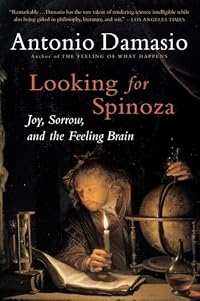
Looking for Spinoza: Joy, Sorrow, and the Feeling Brain
by Antonio Damasio
On This Page
Description
In the seventeenth century, the philosopher Spinoza examined the role emotion played in human survival and culture. Yet, the neurobiological roots of joy and sorrow remained a mystery. Today, we spend countless resources doctoring our feelings with alcohol, prescription drugs, health clubs, therapy, vacation retreats, and other sorts of consumption; yet the inner workings of our minds-what feelings are, how they work, and what they mean-are still largely an unexplored frontier. Here, show more bestselling author and distinguished scientist Antonio Demasio concludes the groundbreaking trilogy he began with Descartes' Error by drawing on his innovative research and experience with neurological patients to examine the cerebral processes of human emotion. show lessTags
Recommendations


Member Reviews
I love genre-less books...or at least ones that don't fit neatly into one category. This book is chockfull of accessible neuroscience with helpful diagrams, but it is also a memoir of searching, of curiosity, of embracing the past to understand the present. Damasio makes a strong case that Spinoza was ahead of the game in terms of understanding feeling and emotion in terms of a body-mind connection, but this is no dry scientific work of Spinozan-apologetics. Damasio embraces humanistic inquiry, contextualizing Spinoza's work in a well-researched (and sometimes suprisingly enjoyably sentimental) study of his life. Anathematized from the Sephardic community in Amsterdam, Spinoza's identity during his life was well-known, but his ideas show more were sub rosa. The inverse was to be his legacy (257). With this study, Damasio contends that Spinoza was a "forerunner of modern biological thinking" (259) in a very important and specific way. He does not resort to hero-worship--Damasio is clear regarding where he think Spinoza misses the mark. But in this book, the result of his "quiet simmering of hints and reflections" (263-4)--one of the best descriptions of the historian's craft I've encountered--Damasio concludes the big takeaway from Spinoza is that "Science can be combined with the best of a humanist tradition to permit a new approach to human affairs and lead to human flourishing." (283). But he is more expansive yet, making the case that our brain, with all its mappings and homeostatic processes and endeavor for self-preservation, is crucial in carrying out Spinoza's "virtuous life in civitas" (274), and that ultimately, even in the face of all we see in the news, "there simply is no alternative to believing we can make a difference." (288) show less
This is a well written book and at times almost lyrical (especially the first chapters on Spinoza). Damasio not only explains well the neuroscience of the brain but also the philosophy of Spinoza. The part about neuroscience comes from Damasio's own work and it has to do with how feelings and emotions, that underlie feelings, regulate our bodies to achieve survival and well-being. He also explains how Spinoza had said as much in the Ethics and how he stood alone against Descartes' mind-body duality.
The book was written in 2003. As such, I am not sure if there have been any further developments on this topic that either enhance or diminish Damasio's theory of feelings. But the part about Spinoza is worth reading given the fact that show more Spinoza is a very well-know, but little-read, philosopher, mainly because of his difficult-to-read writing style. show less
The book was written in 2003. As such, I am not sure if there have been any further developments on this topic that either enhance or diminish Damasio's theory of feelings. But the part about Spinoza is worth reading given the fact that show more Spinoza is a very well-know, but little-read, philosopher, mainly because of his difficult-to-read writing style. show less
George Santayana described Benedict Spinoza (1632-1677), the renowned Dutch philosopher and proponent of Pantheism, as "one of those great men whose eminence grows more obvious with the lapse of years. Like a mountain obscured at first by it foothills, he rises as he recedes."
So it is that Spinoza’s ideas, largely suppressed as heresy in his own time, have received appreciative treatment in several recent works, notably in Looking for Spinoza. Author Antonio Damasio, head of the department of neurology at the University of Iowa Medical Center, links cutting edge neurobiological research with the Spinoza’s philosophy. As it turns out, they dovetail beautifully. Damasio relates how Spinoza anticipated modern findings about the show more biological basis of feelings and consciousness.
Although Damasio plumbs the biological underpinnings of spirituality, he strives to avoid reductionism: “By connecting spiritual experiences to the neurobiology of feelings, my purpose is not to reduce the sublime to the mechanic and by so doing reduce its dignity. The purpose is to suggest that the sublimity of the spiritual is embodied in the sublimity of biology and that we can begin to understand the process in biological terms. As for the results of the process, there is no need and no value to explaining them: The experience of the spiritual amply suffices."
"Accounting for the physiological process behind the spiritual does not explain the mystery of the life process to which that particular feeling is connected. It reveals the connection to the mystery but not the mystery itself. Spinoza and those thinkers whose ideas have Spinozian elements make feelings come full circle, from life in progress, which is where they originate, to the sources of life, toward which they point.” show less
So it is that Spinoza’s ideas, largely suppressed as heresy in his own time, have received appreciative treatment in several recent works, notably in Looking for Spinoza. Author Antonio Damasio, head of the department of neurology at the University of Iowa Medical Center, links cutting edge neurobiological research with the Spinoza’s philosophy. As it turns out, they dovetail beautifully. Damasio relates how Spinoza anticipated modern findings about the show more biological basis of feelings and consciousness.
Although Damasio plumbs the biological underpinnings of spirituality, he strives to avoid reductionism: “By connecting spiritual experiences to the neurobiology of feelings, my purpose is not to reduce the sublime to the mechanic and by so doing reduce its dignity. The purpose is to suggest that the sublimity of the spiritual is embodied in the sublimity of biology and that we can begin to understand the process in biological terms. As for the results of the process, there is no need and no value to explaining them: The experience of the spiritual amply suffices."
"Accounting for the physiological process behind the spiritual does not explain the mystery of the life process to which that particular feeling is connected. It reveals the connection to the mystery but not the mystery itself. Spinoza and those thinkers whose ideas have Spinozian elements make feelings come full circle, from life in progress, which is where they originate, to the sources of life, toward which they point.” show less
Damasio is an articulate, elegant writer and provides a lucid neurological explanation of the role of emotions and feelings. While his interest and exposition of these processes does overlap with Spinoza I didn't get as much out of the philosophy nor had much interest in the biography of Spinoza in chapter 6.
Well written, really insightful.
I find it a bit confusing if you don't have already good understanding how the brain works.
The introduction of Spinoza thesis is not necessary and a kind of a secondary story.
The introduction of Spinoza thesis is not necessary and a kind of a secondary story.
Supposedly about the biological basis of feelings & emotions - but lost me. Dreadful.
Read Aug 2006
Read Aug 2006
Members
- Recently Added By
Lists

Books Read in 2023
5,547 works; 145 members
Author Information

19+ Works 6,911 Members
Antonio Damasio was born in Lisbon, Portugal and studied medicine at the University of Lisbon Medical School, where he also did his neurological residency and completed his doctorate. Eventually, he moved to the United States as a research fellow at the Aphasia Research Center in Boston. From 1976 to 2005, he was M.W. Van Allen Professor and Head show more of Neurology at the University of Iowa Hospitals and Clinics. He is currently the David Dornsife Professor of Neuroscience, Psychology, and Neurology, and director of the Brain and Creativity Institute at the University of Southern California. He has written several books on his research including Descartes' Error: Emotion, Reason, and the Human Brain, which won the Science et Vie prize; The Feeling of What Happens: Body and Emotion in the Making of Consciousness; and Looking for Spinoza: Joy, Sorrow, and the Feeling Brain. He has also received the Prince of Asturias Award in Science and Technology, the Kappers Neuroscience Medal, the Beaumont Medal from the American Medical Association, the Nonino Prize, the Reenpaa Prize in Neuroscience, and the Honda Prize. (Bowker Author Biography) show less
All Editions
Some Editions
Awards and Honors
Awards
Common Knowledge
- Original title
- Looking for Spinoza: Joy, Sorrow, and the Feeling Brain
- Original publication date
- 2003
- People/Characters
- Spinoza, Baruch, 1632-1677
- Important places
- Amsterdam, North Holland, Netherlands
- Dedication
- To Hanna
- First words
- Feelings of pain or pleasure or some quality in between are the bedrock of our minds.
- Last words
- (Click to show. Warning: May contain spoilers.)He defined it as follows: "Hope is nothing else but an inconstant joy, arising form the image of something future or past, whose outcome to some exent we doubt."
- Publisher's editor
- Donna Wares
- Blurbers
- Sacks, Oliver; Styron, William; Kandel, Eric R.; Hubel, David; Changeux, Jean Pierre; Brook, Peter
- Original language
- English
Classifications
Statistics
- Members
- 1,314
- Popularity
- 18,271
- Reviews
- 11
- Rating
- (3.65)
- Languages
- 11 — Dutch, English, Finnish, French, German, Italian, Norwegian (Bokmål), Portuguese, Romanian, Spanish, Swedish
- Media
- Paper, Ebook
- ISBNs
- 29
- ASINs
- 5