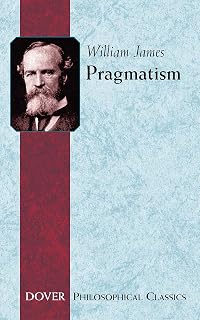
Pragmatism: A New Name for Some Old Ways of Thinking
by William James
On This Page
Description
William James was an influential American thinker who was deeply interested in the burgeoning philosophy of psychology. This volume contains two lectures he delivered on the philosophy of pragmatism.Tags
Recommendations










Member Reviews
This reread helped me to realize just how fundamental this book is to Richard Rorty's more recent formulation of pragmatism, and to his book Philosophy and the Mirror of Nature. A lot seems antiquated in James (e.g. his use of humanism as a stand in for pragmatism), but his discussion of Truth/truth, his attempts to resist charges of idealism, his approach to defining a material world that is not there to be corresponded to and that is not o be ignored except at one's own hazard, his repeated emphasis on the consequences of pragmatism are all core building blocks for Rorty (and, yes, many other neo-pragmatists).
What does it mean to be a pragmatist? How come an actual attitude towards knowledge becomes a philosophical school? This is what William James develops throughout eight one hour lectures given at the Lowell Institute (Boston) in 1906.
Throughout these lectures, James explores different aspects of the pragmatic thinking, how it relates to different schools of thought and how it distinguishes itself in terms of its results. Be it in the domain of the classic philosophical disciplines, such as metaphysics or epistemology (in its striving to come up with a workable definition of truth), be it dealing with more down to earth matters, such as common sense and even religion, James guides his listeners/readers through a superbly reasoned show more journey in defense of pragmatism as a genuine philosophical school of thought worth of study and practice.
If you’re interested in learning what makes pragmatism one of the great contenders in the philosophical arena, this is an essential book, one of the best introductions to this topic. Give it a try and maybe you’ll discover how much philosophy has to offer on a practical level. show less
Throughout these lectures, James explores different aspects of the pragmatic thinking, how it relates to different schools of thought and how it distinguishes itself in terms of its results. Be it in the domain of the classic philosophical disciplines, such as metaphysics or epistemology (in its striving to come up with a workable definition of truth), be it dealing with more down to earth matters, such as common sense and even religion, James guides his listeners/readers through a superbly reasoned show more journey in defense of pragmatism as a genuine philosophical school of thought worth of study and practice.
If you’re interested in learning what makes pragmatism one of the great contenders in the philosophical arena, this is an essential book, one of the best introductions to this topic. Give it a try and maybe you’ll discover how much philosophy has to offer on a practical level. show less
It's easy to see how this would be so readily adopted by Dewey and other reformers, since Truth is really just a conveyance to an end. I'm not quite as critical as that might seem. James is convincing in his argument that the other philosophers rely too much on abstraction and logic, when much of that rationality becomes too unwieldy for use.
A classic. Maybe James didn't really understand C S Pierce, but he was that rare thing, a readable philosopher.
The is a collection of eight lectures that James gave at a university on pragmatism, a school of philosophy that accepts the validity of an idea based on its practical uses and applications for humanity. I picked out a handful of interesting ideas from this collection, but I struggled with it overall. I’m not sure if I just wasn’t in the right frame of mind for something this serious right now or if it was just too dense for me in general, although I suspect it was some of both.
I can’t “rate” this book because I only understood a tiny fraction of it. It’s a series of 8 lectures, and I had the impression it was not delivered to professional philosophers or even to philosophy students - but the attendees must have been quite well educated if they had any chance of comprehending the lectures. The book was published in 1907 but I think the lectures may have been given several years before that. Anyway, I “read” the book in some sense but vast portions were completely meaningless to me. Oh well. I’m really fascinated by philosophy, but so much of it is impenetrable for me.
Pragmatism is an okay philosophy. When espoused by Pierce. Not so much by James.
Members
- Recently Added By
Lists

Filosofía - Clásicos
217 works; 1 member

Harold Bloom - The Western Canon: C. The Democratic Age
336 works; 15 members

How to Read a Book's Recommended Reading List
309 works; 10 members

Greatest Books, allegedly
484 works; 9 members

Books Referenced by Izetbegovic's Islam Between East and West
233 works; 2 members
New Lifetime Reading Plan by Fadiman and Major
225 works; 5 members

Recommended Reading : 600 Classics Reviewed, Editors of Salem Press, 2015
634 works; 6 members
Author Information

137+ Works 14,628 Members
William James, oldest of five children (including Henry James and Alice James) in the extraordinary James family, was born in New York City on January 11, 1842. He has had a far-reaching influence on writers and thinkers of the nineteenth and twentieth centuries. Broadly educated by private tutors and through European travel, James initially show more studied painting. During the Civil War, however, he turned to medicine and physiology, attended Harvard medical school, and became interested in the workings of the mind. His text, The Principles of Psychology (1890), presents psychology as a science rather than a philosophy and emphasizes the connection between the mind and the body. James believed in free will and the power of the mind to affect events and determine the future. In The Will to Believe (1897) and The Varieties of Religious Experience (1902), he explores metaphysical concepts and mystical experiences. He saw truth not as absolute but as relative, depending on the given situation and the forces at work in it. He believed that the universe was not static and orderly but ever-changing and chaotic. His most important work, Pragmatism (1907), examines the practical consequences of behavior and rejects the idealist philosophy of the transcendentalists. This philosophy seems to reinforce the tenets of social Darwinism and the idea of financial success as the justification of the means in a materialistic society; nevertheless, James strove to demonstrate the practical value of ethical behavior. Overall, James's lifelong concern with what he called the "stream of thought" or "stream of consciousness" changed the way writers conceptualize characters and present the relationship between humans, society, and the natural world. He died due to heart failure on August 26, 1910. (Bowker Author Biography) show less
Awards and Honors
Notable Lists
Series
Belongs to Publisher Series
Work Relationships
Is contained in
Has the (non-series) sequel
Common Knowledge
- Canonical title
- Pragmatism: A New Name for Some Old Ways of Thinking
- Original publication date
- 1907
- People/Characters
- William James, 1842-1910
- Dedication
- To the Memory of John Stuart Mill
from whom I first learned the pragmatic openness of mind and whom my
fancy likes to picture as our leader were he alive to-day.
To the memory of...John Stuart Mill, from whom I first learned the pragmatic openness of mind and whom my fancy likes to picture as our leader were he alive to-day. - First words
- The lectures that follow were delivered at the Lowell Institute in
Boston in November and December, 1906, and in January, 1907, at
Columbia University, in New York. They are printed as delivered,
without developments... (show all) or notes. The pragmatic movement, so-called--I
do not like the name, but apparently it is too late to change it--
seems to have rather suddenly precipitated itself out of the air.
The lectures that follow were delivered at the Lowell Institute in Boston in November and December, 1906, and in January, 1907, at Columbia University, in New York. (Preface)
In the preface to that admirable collection of essays of his called 'Heretics,' Mr. Chesterton writes these words: "There are some people—and I am one of them—who think that the most practical and important thing about a ... (show all)man is still his view of the universe." - Last words
- (Click to show. Warning: May contain spoilers.)But if you are neither tough nor tender in an extreme and radical
sense, but mixed as most of us are, it may seem to you that the type
of pluralistic and moralistic religion that I have offered is as
good a religious synthesis as you are likely to find. Between the
two extremes of crude naturalism on the one hand and transcendental
absolutism on the other, you may find that what I take the liberty
of calling the pragmatistic or melioristic type of theism is exactly
what you require.
(Click to show. Warning: May contain spoilers.)Between the two extremes of crude naturalism on the one hand and transcendental absolutism on the other, you may find that what I take the liberty of calling the pragmatistic or melioristic type of theism is exactly what you require.
Classifications
- Genres
- Philosophy, Nonfiction, General Nonfiction
- DDC/MDS
- 144.3 — Philosophy & psychology Philosophical schools of thought Humanism and related systems and doctrines Pragmatism
- LCC
- B832 .J2 — Philosophy, Psychology and Religion Philosophy (General) By period Modern Special topics and schools of philosophy
- BISAC
Statistics
- Members
- 1,414
- Popularity
- 16,742
- Reviews
- 15
- Rating
- (3.67)
- Languages
- 14 — Dutch, English, Estonian, Finnish, French, German, Greek, Italian, Polish, Portuguese, Russian, Spanish, Swedish, Turkish
- Media
- Paper, Audiobook, Ebook
- ISBNs
- 108
- UPCs
- 2
- ASINs
- 42