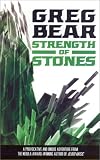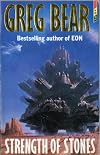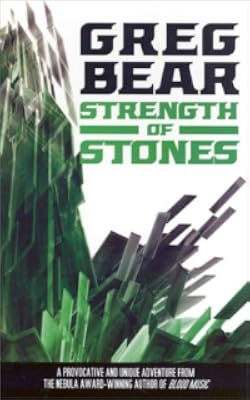
Strength of Stones
by Greg Bear
On This Page
Description
Only one woman can communicate with the living city that has evicted humanity and only she holds the key restore life to their crumpling walls.Tags
Recommendations















Member Reviews
Thoughtful and deep. The reader sees the exploration of an abandoned world and empty cities and then he is drawn into a deftly woven world of biotech and sentience and wonder-science all knotted about the questions of mortality. No other writer handled the religion aspects better than Bear in my view. And the end is both grand and sad at the same time.
This is a 3 part novel, composed of 2 novellas previously published. In a far future, the religious people of humanity have settled a single planet and built fully aware, highly advanced cities. Unfortunately for them, the cities promptly decided that humans were dangerous sinners and expelled them all. I guess that makes this a post-apocalyptic Mad Max style book, but with no great war or natural disaster. Humans are still living on God-Does-Battle, trying to break back into the great cities and struggling to rise above medieval level technology. All 3 stories deal with human interaction with the remains of the dying cities and how humans could be saved by getting back in - or leave the planet all together. Good, solid science fiction.
Post-apocalyptic on a distant world in the far future. Toss in some religious mysticism and too-complicated-to-explain technology.
The planet "God-Does-Battle" was purchased and colonized by Christians, Jews, and Moslems. They contracted architect Robert Kahn to build their high-tech cities - designed to re-inforce their shared religious ideals. Only centuries after their creation the cities expelled their inhabitants for failing to live up to those ideals. Without citizens, the cities have no mission and wander and decay.
This book concerns events on "God-Does-Battle" almost a millenium after the events above and itself spans a few centuries. The texture of this book is much different than other works by Greg Bear I have read. I found it show more somewhat to remain engaged in the storyline since there was no single unifying character to which the events held a personal significance so everything that happened seemed to have a "distance" to it that I had trouble overcoming. show less
The planet "God-Does-Battle" was purchased and colonized by Christians, Jews, and Moslems. They contracted architect Robert Kahn to build their high-tech cities - designed to re-inforce their shared religious ideals. Only centuries after their creation the cities expelled their inhabitants for failing to live up to those ideals. Without citizens, the cities have no mission and wander and decay.
This book concerns events on "God-Does-Battle" almost a millenium after the events above and itself spans a few centuries. The texture of this book is much different than other works by Greg Bear I have read. I found it show more somewhat to remain engaged in the storyline since there was no single unifying character to which the events held a personal significance so everything that happened seemed to have a "distance" to it that I had trouble overcoming. show less
Hmmm not the best Bear book. I found the religious aspect confusing and upon reaching the end I was left feeling not quite sure what happened! The big problem with this book is there's no main central character. The book is in 3 parts, 3 large chapters and after the first 'chapter' (54 pages) I got to know the main character only to find in the next part (set 10 years later) there's a new main character. Then later the original character returns but the focus has changed. Most books are about one person-not so with this book! Will list it on bookmooch so someone else can read it!
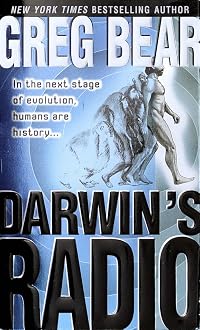
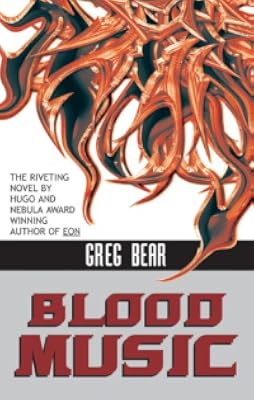
Not his best by a long shot. Try The Infinity Concerto or Blood Music if you want to sample Greg Bear.
A könyv három összefüggő kisregényből áll, nincs hagyományos értelemben vett főszereplője. Bár olvastam hasonló felépítésű nagyszerű könyveket, itt csak megnehezítette az olvasást. Az volt az érzésem, hogy egy jó (bár nem igazán befejezett) kisregényt bővített ki idővel az író, elég feleslegesen. Az alaptörténet szerint egy bolygón intelligens városokat épít az emberiség ahol zsidók, keresztények és muszlimok élnek. Később persze a városok öntudatra ébrednek... Nem igazán jöttem rá, hogy mi lenne a könyv mondanivalója. A mesterséges intelligencia veszélyeit akarta bemutatni? A vallások erejét/károsságát? Alig bírtam befejezni.
May 26, 2019Hungarian
Ratings
Members
- Recently Added By
Author Information

140+ Works 47,142 Members
Greg Bear was born in San Diego, California, on August 20, 1951. He received a Bachelor of Arts degree from San Diego State University in 1973. At age 14, he began submitting pieces to magazines and at 15 he sold his first story to Robert Lowndes' Famous Science Fiction. It would be five years before he sold another piece, but by 23 he was selling show more stories regularly. He has written more than 30 science fiction and fantasy books and has won numerous awards for his work. In 1984, Hardfought and Blood Music won the Nebula Awards for best novella and novelette; Blood Music went on to win the Hugo Award. The novel version of that story, also called Blood Music, won the Prix Apollo in France. In 1987, Tangents won the Hugo and Nebula awards for best short story. He also won a Nebula in 1994 for Moving Mars and in 2001 for Darwin's Radio. Both Dinosaur Summer and Darwin's Radio have been awarded the Endeavour for best novel published by a Northwest science fiction author. He is also an illustrator and his work has appeared in Galaxy, Fantasy and Science Fiction, and Vertex, and in both hardcover and paperback books. He was a founding member of ASFA, the Association of Science Fiction Artists. His works include City at the End of Time, Hull Zero Three, The Mongoliad, Mariposa, Halo: Cryptum, Halo: Primordium and Halo: Silentium. (Bowker Author Biography) show less
Some Editions
Series
Belongs to Publisher Series
Work Relationships
Has as a commentary on the text
Common Knowledge
- Canonical title*
- Le città vive
- Original title
- Strength of Stones
- Original publication date
- 1981-12
- Epigraph
- 11 "What is my strength, that I should wait?
And what is mine end, that I should be patient?
12 Is my strength the strength of stones?
Or is my flesh of brass?
13 Is it that I have no help in me,
And... (show all) that sound wisdom is driven quite from me?"
-- JOB 6, the Masoretic Text - Dedication
- For my grandmother, Florence M. Bear, provider of a home for wandering adventurers.
- First words
- The final decade of Earth's twentieth century was catacylsmic.
- Last words
- (Click to show. Warning: May contain spoilers.)And they took him home again.
*Some information comes from Common Knowledge in other languages. Click "Edit" for more information.
Classifications
Statistics
- Members
- 612
- Popularity
- 47,580
- Reviews
- 6
- Rating
- (3.11)
- Languages
- English, German, Italian, Portuguese
- Media
- Paper, Ebook
- ISBNs
- 17
- ASINs
- 5