On This Page
Description
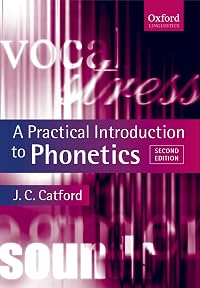
Catford's unique interactive approach to the study of phonetics leads readers to explore the entire range of human sounds through a series of introspective experiments carried out in their own vocal tracts, proceeding systematically from familiar vocal postures and articulations to new and unknown ones. By actually articulating sounds, and attending to the motor sensations they produce, the reader acquires a deep, personal understanding of the principles of phonetic classification. Informed show more throughout by recent research in aerodynamics and acoustics, this book will interest a wide range of students and teachers of languages, linguistics, speech therapy, and anthropology. show lessTags
Recommendations












Member Reviews
Well, let's begin by confess that, contrary to Catford's strictures, I simply read this through without doing the practical exercises. Thus, I can't have any informed opinion on how well the book achieves its purpose.
That said, I found the survey of articulatory phonetics well-organized and clear.
(So why did I ignore Catford's strictures? Simply because while I have a reasonable amount of opportunity to read silently, such to do practical exercises in articulatory phonetics are scant. Maybe I'll return to the book at some point when such is more plentiful and derive greater benefit from it.)
That said, I found the survey of articulatory phonetics well-organized and clear.
(So why did I ignore Catford's strictures? Simply because while I have a reasonable amount of opportunity to read silently, such to do practical exercises in articulatory phonetics are scant. Maybe I'll return to the book at some point when such is more plentiful and derive greater benefit from it.)
LIKE I SAID: Specialists should never write introductory textbooks to any subject. Unless they're specialists in writing introductory textbooks to any subject. "Practical introduction" indeed.
LATER: Okay, he gets an extra .5 for this: "Note, in parenthesis, that all basic phonetic experiments must be done with firm, definite articulation and with a reasonably powerful initiation. There is little to be learned from indecisive fumbling articulation and feeble kitten-like mewings."
LATER STILL: Okay, and this thing of classing fricatives, approximants (including vowels like [i]), and resonants (open vowels) is intriguing and probably makes more sense ultimately than Ladefoged's way of doing it. I guess this is why you shouldn't review a show more book before you're done reading it:)
AND FINALLY: Oh, damn it. You know what this is? It's Ladefoged II, providing an alternative look at a lot of judgment calls he makes, but more importantly, expanding and breaking down a lot of his descriptions. All the stuff I've been thinking about with possible phonemic distinctions, it's basically all here. I just spend twenty minutes contorting my lips and sticking my fingers down my throat. Second only to A Course in Phonetics, this is (it turns out) a must-read. show less
LATER: Okay, he gets an extra .5 for this: "Note, in parenthesis, that all basic phonetic experiments must be done with firm, definite articulation and with a reasonably powerful initiation. There is little to be learned from indecisive fumbling articulation and feeble kitten-like mewings."
LATER STILL: Okay, and this thing of classing fricatives, approximants (including vowels like [i]), and resonants (open vowels) is intriguing and probably makes more sense ultimately than Ladefoged's way of doing it. I guess this is why you shouldn't review a show more book before you're done reading it:)
AND FINALLY: Oh, damn it. You know what this is? It's Ladefoged II, providing an alternative look at a lot of judgment calls he makes, but more importantly, expanding and breaking down a lot of his descriptions. All the stuff I've been thinking about with possible phonemic distinctions, it's basically all here. I just spend twenty minutes contorting my lips and sticking my fingers down my throat. Second only to A Course in Phonetics, this is (it turns out) a must-read. show less
It has very good exercises about how to learn pronouncing the IPA phonemes. One of its ideas is that you can learn this by yourself. Also, good tips about the phonemes.
Ratings
Members
- Recently Added By
Author Information

8+ Works 209 Members
Series

Belongs to Publisher Series
Common Knowledge
- Canonical title
- A Practical Introduction to Phonetics
Classifications
Statistics
- Members
- 125
- Popularity
- 258,709
- Reviews
- 3
- Rating
- (3.69)
- Languages
- English
- Media
- Paper
- ISBNs
- 3