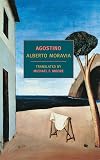
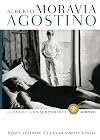
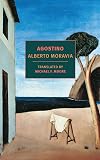
Agostino
by Alberto Moravia
On This Page
Description
"A thirteen-year-old boy spending the summer at a Tuscan seaside resort feels displaced in his beautiful widowed mother's affections by her cocksure new companion and strays into the company of some local young toughs and their unsettling leader, a fleshy older boatman with six fingers on each hand. Initially repelled by their squalor and brutality, repeatedly humiliated for his well-bred frailty and above all for his ingenuousness in matters of women and sex, the boy nonetheless finds show more himself masochistically drawn back to the gang's rough games. And yet what he has learned is too much for him to assimilate; instead of the manly calm he had hoped for he is beset by guilty curiosity and an urgent desire to sever, at any cost, the thread of troubled sensuality that binds him to his mother still. Alberto Moravia's classic and yet still startling portrait of innocence lost was written in 1941 but rejected by Fascist censors and not published until 1944, when it became a best seller and secured the author the first literary prize of his career. Revived here in a sparkling new translation by Michael F. Moore, Agostino is poised to enthrall and astonish a twenty-first-century audience"-- show lessTags
Recommendations





















Member Reviews
Young Agostino is enjoying a summer vacation with his mother, a beautiful widow whose elegance attracts admiration he likes basking in. But that all changes when a young man begins a flirtation with Agostino's mother. Ashamed and hurt, Agostino takes up acquaintance with a bunch of boys around his age, but who have lived a very different life from his wealthy, privileged one. Their savagery and obscenity both repulses and compels him to spend more time in their world.
I don't recall anymore why I wanted to read this book; I have a dim memory of reading an article about essential books in translation to read. So when I actually got around to reading it, I didn't really have any particular expectations. The book is really more of a show more novella, clocking in at just a hundred pages. Somehow it still felt long in a way though; perhaps because nothing much really happens in the book. Nominally, it is a "coming of age" type story for Agostino, except that becoming a man for him simply means sexual relations, not anything else about responsibility or awareness of the world. Arguably, there is something contained within the book about class distinctions, but it is slight (and not flattering for anyone depicted). Mostly, the narrative is just full of Agostino's angst about how he's suddenly aware that his mother has a life outside of being a mother, aka that she also has sexual desire. Poor Agostino (in sarcasm).
Moravio's prose reads smoothly and evocatively, and a note from the translator puts his writing into context, explaining how Moravio was trying something new for 1940s Italy -- a break away from the classical and lyrical style based on poetry with a more realistic, colloquial bent. Still, I didn't enjoy this book all the much and I'm not sure I would recommend it, even though it was an award winner back in its day. The sexist attitude toward women in general and the mother (literally how she is referred to all the time -- the mother, with no name) in particular were off-putting. Men don't get a much better portrait, with the wild and violent boys depicted: "He found it utterly unjust that on such a sea, beneath such a sky, a boat like theirs should be so full of spite, cruelty, and malicious corruption. A boat overflowing with boys acting like monkeys, gesticulating and obscene, helmed by the blissful and bloated Saro, created between the sea and sky a sad unbelievable vision." It's not a pretty view of humanity, and it's certainly not a feel-good kind of book by any stretch. show less
I don't recall anymore why I wanted to read this book; I have a dim memory of reading an article about essential books in translation to read. So when I actually got around to reading it, I didn't really have any particular expectations. The book is really more of a show more novella, clocking in at just a hundred pages. Somehow it still felt long in a way though; perhaps because nothing much really happens in the book. Nominally, it is a "coming of age" type story for Agostino, except that becoming a man for him simply means sexual relations, not anything else about responsibility or awareness of the world. Arguably, there is something contained within the book about class distinctions, but it is slight (and not flattering for anyone depicted). Mostly, the narrative is just full of Agostino's angst about how he's suddenly aware that his mother has a life outside of being a mother, aka that she also has sexual desire. Poor Agostino (in sarcasm).
Moravio's prose reads smoothly and evocatively, and a note from the translator puts his writing into context, explaining how Moravio was trying something new for 1940s Italy -- a break away from the classical and lyrical style based on poetry with a more realistic, colloquial bent. Still, I didn't enjoy this book all the much and I'm not sure I would recommend it, even though it was an award winner back in its day. The sexist attitude toward women in general and the mother (literally how she is referred to all the time -- the mother, with no name) in particular were off-putting. Men don't get a much better portrait, with the wild and violent boys depicted: "He found it utterly unjust that on such a sea, beneath such a sky, a boat like theirs should be so full of spite, cruelty, and malicious corruption. A boat overflowing with boys acting like monkeys, gesticulating and obscene, helmed by the blissful and bloated Saro, created between the sea and sky a sad unbelievable vision." It's not a pretty view of humanity, and it's certainly not a feel-good kind of book by any stretch. show less
Agostino is a short coming-of-age tale with majestic descriptions of a Tuscan seaside town. The tale of a young, privileged teen trying to fit in with the rough boys and engage in their uncouth adventures is nothing new. Coddled Agostino's frustrations are familiar and heartwarming.
Since the book is told from his perspective, it has a contained scope and effective focus. It is not concerned with politics or philosophy, but the reader can draw many connections between the interior sensations of the main character and the outward acts of immaturity and confusion.
Moravia is an important author in Italy, from what I've gathered, but often neglected in English-speaking countries. A small portion of his works have made their way into English, show more and I would love to see him given the same attention as Umberto Eco. He wrote dozens of novels, stories, plays, and essays. In some ways, his style reminds me of W. Somerset Maugham's - a refined, unhurried, wise, and observant style, concerned with subtle characters interactions and elegant settings.
Apparently, Moravia was nominated for the Nobel Prize 13 times, and comparing him to certain winners (I'm thinking of Orhan Pamuk and Pirandello) I'm wishing he'd won.
Moravia really uses his character's childlike innocence and naivety to comedic and dramatic effect. It makes it really easy to put yourself in this boy's shoes, and to experience the wonder and bittersweet sorrow that is growing up. From an adult's perspective there is constant dramatic irony in the fact that you know his idols and fascinations and agony, will all fade away when the world finally opens up its wonders to him. But there is also a loss we all experience, I think, when the universe loses some of its mystery, and human nature in particular is revealed to us in all of its wickedness and intricacy.
This is a loving portrait of youth and a simple, but discerning fable with universal appeal.
It was a bestseller in its day, and it remains an easy, evocative read 70 years later. show less
Since the book is told from his perspective, it has a contained scope and effective focus. It is not concerned with politics or philosophy, but the reader can draw many connections between the interior sensations of the main character and the outward acts of immaturity and confusion.
Moravia is an important author in Italy, from what I've gathered, but often neglected in English-speaking countries. A small portion of his works have made their way into English, show more and I would love to see him given the same attention as Umberto Eco. He wrote dozens of novels, stories, plays, and essays. In some ways, his style reminds me of W. Somerset Maugham's - a refined, unhurried, wise, and observant style, concerned with subtle characters interactions and elegant settings.
Apparently, Moravia was nominated for the Nobel Prize 13 times, and comparing him to certain winners (I'm thinking of Orhan Pamuk and Pirandello) I'm wishing he'd won.
Moravia really uses his character's childlike innocence and naivety to comedic and dramatic effect. It makes it really easy to put yourself in this boy's shoes, and to experience the wonder and bittersweet sorrow that is growing up. From an adult's perspective there is constant dramatic irony in the fact that you know his idols and fascinations and agony, will all fade away when the world finally opens up its wonders to him. But there is also a loss we all experience, I think, when the universe loses some of its mystery, and human nature in particular is revealed to us in all of its wickedness and intricacy.
This is a loving portrait of youth and a simple, but discerning fable with universal appeal.
It was a bestseller in its day, and it remains an easy, evocative read 70 years later. show less
This novella, translated from the original Italian, is a primal, deeply psychological tale of one young man's loss of innocence. While staying at the beach with his beloved mother, Agostino ' s eyes are opened to the world of sensuality and violence, of deep male drives. As a woman, I felt like I had been gifted a glimpse of the painful male passage from childhood to adulthood, and it seemed so authentic that I almost felt I was trespassing.
Agostino is a 13-year-old boy on vacation in Venice with his widowed mother. When a local stud seduces her, jealous Agostino joins a local group of juvenile delinquents out of protest. They force him to face his budding sexuality.
A dull little book about which I struggle to find anything to say, perhaps because I am a woman and this book depicts a stunted, masculine coming-of-age. Unfair to call it ‘stunted’—better to say that it depicts the stunted, confused period before a coming-of-age. Some passages concerning the mother were deeply unpleasant from my perspective; although, I’m sure that they ring with reality to certain male readers. I don’t like to see myself making summary statements that hinge upon a gender binary, but this is the only way I find myself forming thoughts about the book.
Young Agostino's relationship to his mother comes apart as he discovers that she has interests other than him. He takes up with a young gang of toughs seemingly as a rebellion, an assertion of himself as a separate individual. But they treat him with cruelty and mock his mother. I felt that the reader was kept at a distance, unable to truly sympathize with either the mother or the son, just to view the sad predicament.
Now we're talking. Moravia's got style!
This is a short novel. The story is simple, not even necessarily original (a Freudian coming-of-age tale). But... it was fun to read. I was immediately drawn into Agostino's world. I wanted to keep reading it.
This is style.
This is a short novel. The story is simple, not even necessarily original (a Freudian coming-of-age tale). But... it was fun to read. I was immediately drawn into Agostino's world. I wanted to keep reading it.
This is style.
Members
- Recently Added By
Lists

Favorite Coming of Age Novels.
164 works; 51 members

1940s
221 works; 25 members

Italian Literature
558 works; 43 members

Short and Sweet
246 works; 24 members

Erotic Fiction
53 works; 5 members

Summer Books
82 works; 9 members

Tammen Keltainen kirjasto
81 works; 1 member
Great Short Books: A Year of Reading-Briefly
59 works; 4 members
Author Information

475+ Works 10,559 Members
Born in Rome of Jewish-Roman Catholic parents, Moravia was not much affected by the "Fascist racial laws" until Mussolini's fall in 1943 and the consequent German occupation of Rome. Under fascism, Moravia published his first novel, The Time of Indifference (1929), at his own expense when he was only 22; yet it was a great success and remains his show more most characteristic work. He produced nothing to match it until after World War II, when he emerged as the leading Italian neorealist, publishing in rapid order The Woman of Rome (1947), Disobedience (1948), The Conformist (1951), Ghost at Noon (1948), Roman Tales (1954), and Two Women (1957). Many believe the latter is his best novel, telling of the efforts of a shopkeeper and her daughter, raped by Italy's liberators and learning to adapt themselves to the postwar new order. Moravia made a great stir in world literary circles after World War II by announcing his conversion to Roman Catholicism, which had given him solace and protection during the German occupation. Among his more recent publications is 1984. In 1941 Moravia married ~Elsa Morante. They separated in 1962. (Bowker Author Biography) show less
Some Editions
Awards and Honors
Distinctions
Notable Lists
Series
Belongs to Publisher Series
Work Relationships
Common Knowledge
- Canonical title
- Agostino
- Original title
- Agostino
- Original publication date
- 1943
- People/Characters*
- Agostino; Berto; Sandro; Tortima; Homs; Saro (show all 7); Madre
- Important places*
- Versilia
- Related movies*
- Agostino (1962 | IMDb)
- First words*
- Nei primi giorni d'estate, Agostino e sua madre uscivano tutte le mattine sul mare in patino.
- Last words*
- (Click to show. Warning: May contain spoilers.)Come un uomo, non poté fare a meno di pensare prima di addormentarsi. Ma non era un uomo; e molto tempo infelice sarebbe passato prima che lo fosse.
- Original language
- Italian
*Some information comes from Common Knowledge in other languages. Click "Edit" for more information.
Classifications
- Genres
- Fiction and Literature, General Fiction
- DDC/MDS
- 853.912 — Literature & rhetoric Italian, Romanian & related literatures Italian fiction 1900- 20th Century 1900-1945
- LCC
- PQ4829 .O62 .A6313 — Language and Literature French, Italian, Spanish and Portuguese literatures Italian literature Individual authors, 1900-1960
- BISAC
Statistics
- Members
- 561
- Popularity
- 53,018
- Reviews
- 16
- Rating
- (3.35)
- Languages
- 10 — Catalan, Dutch, English, Finnish, French, German, Hungarian, Italian, Portuguese, Spanish
- Media
- Paper, Ebook
- ISBNs
- 27
- ASINs
- 16