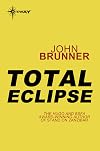
Total Eclipse
by John Brunner
On This Page
Description
Nineteen light years from Earth, on Sigma Draconis, an international space team stumbles upon the first evidence of another highly advanced civilization in the universe. Tragically, however, the Draconians are extinct and have been for a hundred thousand years. What mysterious disaster destroyed man's nearest neighbour in the colossal emptiness of space? And will the same fate befall Earth?Tags
Recommendations
















Member Reviews
review of
John Brunner's Total Eclipse
by tENTATIVELY, a cONVENIENCE - October 30, 2013
Whenever I read Brunner & I'm reminded of another writer it's always someone whose work I respect - J. G. Ballard, eg. In this case, I made a note to myself as soon as I started reading this that I was reminded of Arthur C. Clarke & Ursula K. LeGuin - again, 2 writers that I respect - but ones that don't quite fit into my personal canon as much as Ballard does (well, actually, LeGuin is probably in there but Clarke's a little too drily 'hard science' for it - altho it's mainly b/c I haven't read anything by him for 40 yrs). Why Clarke? I was probably just thinking of the monolith in 2001 in comparison to the giant telescope on a moon in Total show more Eclipse.
The basic story is that humanity finds traces of a sophisticated civilization that blossomed & died at an unusually quick rate. The explorer's job is to try & figure out what happened to them? Did they really die off? If so, why? How? "He had sometimes mentioned to close friends a dream that haunted him concerning the disappearance of the Draconians: the possibility that they had been less lucky than mankind when they made their first experiments with hyperdrive." (p 9) The "Draconians" are so-called b/c their planet is "Sigma Draconis III". Nonetheless, I still wonder about the oddity of the 'inevitable' association w/ the legal meaning of the word "Draconian" - a harsh punishment.
Complicating this is that the socio-political situation back on Earth, many light yrs away, is getting worse & worse. The scientist astronauts are depending on support from Earth in order to keep their research going. & the problems on Earth & their associated bigotries are a threat to the research. A 1st hint of this is in something like this:
"And because Irene was both female and black, the choice was more likely to fall on Lieutenant Gyorgy Somogyi.
"Who's less well qualified and far less quick-thinking. High on the list of possible explanations for the extinction of the Draconians, so they tell me, is the idea that it was due to some fatal flaw in their nature. All too easily some stupid irrational prejudice could get rid of us, too, couldn't it?" - pp 11-12
As I read more & more by Brunner, this is the 23rd story I've read by him so far, the more respect I have for his various takes on the psychological affects of setting up humanity on another planet. There's Castaway's World ( http://www.goodreads.com/book/show/7215530-the-rites-of-ohe-castaways-world ), Bedlam Planet ( https://www.goodreads.com/book/show/17865188-bedlam-planet ), & now this.
Brunner, ever the political realist, portrays the problems on Earth:
"There had been famine in half a dozen densely populated countries, all of whose governments were controlled by greedy, short-sighted, thoughtless med whose first reaction when the starving mobs came battering at their gates was to accuse a scapegoat. The Starflight Fund was an obvious target. Rumours took their rise: here's another way the rich are cheating the poor, for if you hadn't had to subsidize the fund, there'd be another million in the treasury to spend on food!
"No mention, of course, of the fact that the Prime Minister had made his fortune by hoarding rice during the previous famine, or that the President's brother owned the nation's largest pharmaceutical factory and was taking a profit of 1700 per cent on every ampul of niacin, ascorbic acid and B12. That news was stale." - p 17
B/c of this situation & paranoias associated w/ it, a general has been sent from Earth to investigate the Sigma Draconis III base "and that was why General Ordoñez-Vico had been given power to order the abandonment of the Draco base, and the abolition of the Starflight Fund, if any hint, clue, trifling suspicion, triggered his all too obvious latent paranoia." (p 18)
Under pressure from the paranoid general, one of the less self-controlled of the scientists has an outburst in an attempt to explain the reality of the scientist's situation:
""There's a landslide somewhere. A concrete wall collapses, opens a whole building to the weather. There's a temblor, and a hundred buildings fall. All that can happen in one hundred years, and it's only the beginning. La Paz after a century, tumbledown, covered with creepers, the home of wild animals and snakes and butterflies and birds—how much could you tell about the way of life of a human family by burrowing into the rubble and rotting leaf mold, hm—if you were from another planet and had never seen a live human being? Ask yourself that! Here's a piano frame—but you have no ears, you never imagined music! Here's a tableknife—but you don't eat, you only drank liquids! Here's a sewing machine—but you have fur and don't wear clothes! After one century, how much sense would you make of what remained? And we're not talking about a hundred years here. We're talking about a hundred thousand! Ignorance? Don't make me laugh! It's taken genius for the people here to find out what they do know, and it's small thanks to the shortsighted fools who picked on you to come and pester them!" - p 63
Short-sightedness is a key idea here. Brunner explores the short-sightedness of polluters brilliantly in his ecological masterpiece The Sheep Look Up ( http://www.goodreads.com/story/show/344636-a-review-of-john-brunner-s-ecological... ). People w/o vision of expansive future possibilities inhibit the imagination & the pursuit of knowledge. Brunner explores the possibility of trying to figure out whether the Draconians even had multiple languages, as we wd expect given our own Earthly experience:
""Well, Igor's insight suggested that they may not have had languages, plural, but at worst the equivalent of dialects . . . which would be a logical starting point anywhere in the universe, come to think of it. It's been shown that all human languages have a fundamentally identical structure—"
[..]
"["]You surely must have been told that baby talk in every known human language is grammatically consistent?"" - p 86
This is a subject that I will, 'no doubt', return to again & again for the rest of my life. One can read my essay about my relevant feature-length movie entitled Story of a Fructiferous Society here: http://www.othercinema.com/otherzine/?issueid=22&article_id=96 . & this justifies my reprinting a relevant part of an interview that I conducted under the name of "Party Teen on Couch #2" w/ someone calling himself "Party Teen on Couch #3":
*************************************
3: Adamitic language..
2: Adamitic? I think that the idea of an Adamitic language is interesting but I’m wondering, you would know much more about this than I do because I know nothing about it since I know nothing about everything & everything about nothing, etc, etc.. - but, is there any sort of theory amongst linguists, or whatever the appropriate field of study would be, that you know of that tends to trace language back to common roots of any sort?
3: Yeah, there is, um, for example in Chomsky & linguistics you have this idea that you have something like semantics & patterns in a language which are common to all languages.
2: Does he develop this theory in great detail? In other words does he have a technical description of it?
3: Yeah, it’s called [unintelligible] schematic transformational grammar.
2: Could you say that again, please?
3: Generative transformational grammar.
2: Ok.
3: But actually I’m not that familiar with this kind of linguistics because linguistics in this century has very much split into various fields. You could say, from something like literary linguistics, which is mainly from the structuralist tradition; from Ferdinand de Saussure over Roman Jakobson to post-structuralism, deconstructionist approach as well as Roland Barthes, Umberto Eco - but, on the other hand, you have this kind of technical linguistics, Chomsky, for example, which is, actually, more the kind of linguistics which you study if you study linguistics properly, which is, for example, also important for computer linguistics if you generate speech recognition or speech systems & then you, mostly [unintelligible] to this kind of scientific linguistics - & then you also have philosophical linguistics like, uh, for example, speech act theory by Austin & Searle..
2: Which is what?
3: Well, uh, this is actually something where you could say that modern linguistics have an approach which is closer to the idea of Adamitic language because, well, the primary assumption of modern linguistics is that language is arbitrary - that a linguistic sign has no absolutely whatever organic relation to the thing which we represent.
2: So no onomatopoiea? or whatever?
3: Yes, that would be, actually this is a different [unintelligible] which has been introduced by Charles Saunders Peirce who differentiated between the iconic, the indexical, & the symbolic sign where you actually have these possibilities of the onomatopetic relationships but, um, no, the question’s rather, to quote Austin, how to do things with words. There is 1 problem - if you have arbitrary language, it just means that, for example, if I say the word "cassette” or if I write it down then it has no relationship whatsoever to a cassette & by saying the word "cassette” I’m not manipulating the matter of the cassette in a way. So, it’s a purely arbitrary relationship..
2: So that’s..
3: Somebody has just decided just to call this piece a cassette.
2: Which is opposite to Adamitic language.
3: Which is opposite to Adamitic language because in Adamitic language you will have an organic relationship between the word & the thing so that by uttering the word you would, for example, invoke or manipulate the thing so like the classical example is of the Genesis where god says, uh "It shall be light” & then it’s light. This is Adamitic language. & the theory, the theory of Adamitic language as it’s notably present in the Kabala & in Jewish mysticism is that in the paradise, before the expulsion from the paradise Adam actually possessed a language which was similar to that of the divine language - where he was capable, for example, of naming animals. & that this original language where you could invoke & manipulate things with was lost when humanity was expelled from the Garden of Eden. So, um, the whole, um, occupation of Kabalism, or also you could say magic in general, is to, sortof, regain command over things by the means of language. & you could say that, in a way you could use it as a critique against modern linguistics because, for example, if Bill Clinton, today, says, uh, "Drop the atom bomb over Moscow” then the atom bomb would actually be dropped because he has the power & the possibility to do so. & just by saying this & by, maybe, having a few codes, or whatever, this would be made to happen today. So you could say that modern linguistics in defining language as arbitrary is actually missing some aspects. It cannot answer the question of how language is actually capable of directly invoking things or making things happen. & this is, for example, a matter which has been discussed by speech act theory - that’s exactly the question of speech act theory, how you..
2: Speech act?
3: Speech act theory, yes, by, notably by Austin & um..
2: Austin’s spelled A,u,s,t,i,n?
3: Exactly, yeah. He was an Oxford linguist, I think in the 1930s.
2: So is the concept of Adamitic language mainly supposedly originating from Kabalists or from who?
3: I would say it’s probably related in all kinds of magical or even metaphysical notions of language. I have thought about, for example, what, how 1 could locate multiple names as they are used in Neoism - in, uh, in either Adamitic or arbitrary language. I think this is extremely interesting because my theory is that they are both - or neither of them, in a way - because, when you say, you have a multiple name, an open situation, everybody can use that name & share this identity there was an extreme case of an arbitrary name - because the name is not naturally given to you - you know, it’s not like somebody’s born & he has, uh, he gets a name & the name is stamped on the passport but, it’s, it’s, it’s a name, say, Monty Cantsin, Luther Blissett, Karen Eliot. &, um, uh, as you wrote, the name is fixed, but the people using it aren’t. So this would be like the classical definition of arbitrary language in a way - the same way as I say, for example, if I take beer, then the notion, the word beer, b, double e, r, is fixed, but, for example, the meaning may change over the centuries - something like this..
2: Let’s make a projection right now. Am I interupting your train of thought too much?
3: A little bit. Ok, so 1 could say, on the 1 hand, the use of multiple names is a use of language as extremely arbitrary - where you’ve got an extremely flexible signifier-and-signified or sign-and-thing relationship. It’s the highest possible flexibilization of the sign-and-thing relation. On the other hand, as soon as you participate in that multiple name, you are immediately, since there is no fixed referent, say there is no fixed referent for Luther Blissett because there is no person Luther Blissett - or, also, Monty Cantsin - it’s a fiction, it’s a fiction created by those using the name. So, you could say that by sharing this identity, by adopting this arbitrary name, you, you get the immediate power to, to change it. Yeah? Which is like Adamitic language. Because you are now able to do something in the name of Monty Cantsin, Karen Eliot, Luther Blissett, & so on & actively participate in the shaping of the identity & you can, sortof, directly invoke the character of Monty Cantsin by using the name. So that would be an extreme example of Adamitic language. So, so that, that’s, uh, that multiple names, sortof, a kindof flip-flop thing, you know? where you..
2: What d’ya think about the idea of extending that type of thinking so that, for example, beer, the word beer, would be an open concept that could refer to any object? etc, I mean, this obviously refers back to my interest that anything is anything or anything as anything, etc, etc.. Or just taking all words & making them open contexts which can be used freely by the people who choose to use those words in this manner. So, for example, I might say to you "Pass the beer” but I could mean anything by that & you could respond in whatever way you felt appropriate.
3: Yeah, this would actually be the, exactly match post-structuralist or contemporary linguistics. That you say there is no fixed meaning for any word & the meaning actually.. the, the - this is justified by the use or by the difference - that you say "beer is not wine”, for example. Yeah, that you have a purely relational definition & usage but there is no actual referent to the word.
*************************************
Ok, that was a long tangent but wasn't it great?! After all, ""There's an old saying: The genius sees what happens, but the plodder sees what he expects to happen.["]" (p 88)
Brunner's political group experience shows: ""Does anybody disagree violently?" Rorschach inquired, and when nobody else spoke up continued, "So resolved, then.["]" (p 126) A theme explored in Bedlam Planet of how astronaut colonists become natives is here too: "Nobody wanted to settle permanently on Sigma Draconis III, because they hadn't come here as colonists, but as investigators." (p 175) In summary, an important political question relevant to the afore-mentioned short-sightedness appears: "How often have human beings acted against their own best interests, and particularly on behalf of some small group rather than in favor of the race as a whole?" (p 186) Indeed. show less
John Brunner's Total Eclipse
by tENTATIVELY, a cONVENIENCE - October 30, 2013
Whenever I read Brunner & I'm reminded of another writer it's always someone whose work I respect - J. G. Ballard, eg. In this case, I made a note to myself as soon as I started reading this that I was reminded of Arthur C. Clarke & Ursula K. LeGuin - again, 2 writers that I respect - but ones that don't quite fit into my personal canon as much as Ballard does (well, actually, LeGuin is probably in there but Clarke's a little too drily 'hard science' for it - altho it's mainly b/c I haven't read anything by him for 40 yrs). Why Clarke? I was probably just thinking of the monolith in 2001 in comparison to the giant telescope on a moon in Total show more Eclipse.
The basic story is that humanity finds traces of a sophisticated civilization that blossomed & died at an unusually quick rate. The explorer's job is to try & figure out what happened to them? Did they really die off? If so, why? How? "He had sometimes mentioned to close friends a dream that haunted him concerning the disappearance of the Draconians: the possibility that they had been less lucky than mankind when they made their first experiments with hyperdrive." (p 9) The "Draconians" are so-called b/c their planet is "Sigma Draconis III". Nonetheless, I still wonder about the oddity of the 'inevitable' association w/ the legal meaning of the word "Draconian" - a harsh punishment.
Complicating this is that the socio-political situation back on Earth, many light yrs away, is getting worse & worse. The scientist astronauts are depending on support from Earth in order to keep their research going. & the problems on Earth & their associated bigotries are a threat to the research. A 1st hint of this is in something like this:
"And because Irene was both female and black, the choice was more likely to fall on Lieutenant Gyorgy Somogyi.
"Who's less well qualified and far less quick-thinking. High on the list of possible explanations for the extinction of the Draconians, so they tell me, is the idea that it was due to some fatal flaw in their nature. All too easily some stupid irrational prejudice could get rid of us, too, couldn't it?" - pp 11-12
As I read more & more by Brunner, this is the 23rd story I've read by him so far, the more respect I have for his various takes on the psychological affects of setting up humanity on another planet. There's Castaway's World ( http://www.goodreads.com/book/show/7215530-the-rites-of-ohe-castaways-world ), Bedlam Planet ( https://www.goodreads.com/book/show/17865188-bedlam-planet ), & now this.
Brunner, ever the political realist, portrays the problems on Earth:
"There had been famine in half a dozen densely populated countries, all of whose governments were controlled by greedy, short-sighted, thoughtless med whose first reaction when the starving mobs came battering at their gates was to accuse a scapegoat. The Starflight Fund was an obvious target. Rumours took their rise: here's another way the rich are cheating the poor, for if you hadn't had to subsidize the fund, there'd be another million in the treasury to spend on food!
"No mention, of course, of the fact that the Prime Minister had made his fortune by hoarding rice during the previous famine, or that the President's brother owned the nation's largest pharmaceutical factory and was taking a profit of 1700 per cent on every ampul of niacin, ascorbic acid and B12. That news was stale." - p 17
B/c of this situation & paranoias associated w/ it, a general has been sent from Earth to investigate the Sigma Draconis III base "and that was why General Ordoñez-Vico had been given power to order the abandonment of the Draco base, and the abolition of the Starflight Fund, if any hint, clue, trifling suspicion, triggered his all too obvious latent paranoia." (p 18)
Under pressure from the paranoid general, one of the less self-controlled of the scientists has an outburst in an attempt to explain the reality of the scientist's situation:
""There's a landslide somewhere. A concrete wall collapses, opens a whole building to the weather. There's a temblor, and a hundred buildings fall. All that can happen in one hundred years, and it's only the beginning. La Paz after a century, tumbledown, covered with creepers, the home of wild animals and snakes and butterflies and birds—how much could you tell about the way of life of a human family by burrowing into the rubble and rotting leaf mold, hm—if you were from another planet and had never seen a live human being? Ask yourself that! Here's a piano frame—but you have no ears, you never imagined music! Here's a tableknife—but you don't eat, you only drank liquids! Here's a sewing machine—but you have fur and don't wear clothes! After one century, how much sense would you make of what remained? And we're not talking about a hundred years here. We're talking about a hundred thousand! Ignorance? Don't make me laugh! It's taken genius for the people here to find out what they do know, and it's small thanks to the shortsighted fools who picked on you to come and pester them!" - p 63
Short-sightedness is a key idea here. Brunner explores the short-sightedness of polluters brilliantly in his ecological masterpiece The Sheep Look Up ( http://www.goodreads.com/story/show/344636-a-review-of-john-brunner-s-ecological... ). People w/o vision of expansive future possibilities inhibit the imagination & the pursuit of knowledge. Brunner explores the possibility of trying to figure out whether the Draconians even had multiple languages, as we wd expect given our own Earthly experience:
""Well, Igor's insight suggested that they may not have had languages, plural, but at worst the equivalent of dialects . . . which would be a logical starting point anywhere in the universe, come to think of it. It's been shown that all human languages have a fundamentally identical structure—"
[..]
"["]You surely must have been told that baby talk in every known human language is grammatically consistent?"" - p 86
This is a subject that I will, 'no doubt', return to again & again for the rest of my life. One can read my essay about my relevant feature-length movie entitled Story of a Fructiferous Society here: http://www.othercinema.com/otherzine/?issueid=22&article_id=96 . & this justifies my reprinting a relevant part of an interview that I conducted under the name of "Party Teen on Couch #2" w/ someone calling himself "Party Teen on Couch #3":
*************************************
3: Adamitic language..
2: Adamitic? I think that the idea of an Adamitic language is interesting but I’m wondering, you would know much more about this than I do because I know nothing about it since I know nothing about everything & everything about nothing, etc, etc.. - but, is there any sort of theory amongst linguists, or whatever the appropriate field of study would be, that you know of that tends to trace language back to common roots of any sort?
3: Yeah, there is, um, for example in Chomsky & linguistics you have this idea that you have something like semantics & patterns in a language which are common to all languages.
2: Does he develop this theory in great detail? In other words does he have a technical description of it?
3: Yeah, it’s called [unintelligible] schematic transformational grammar.
2: Could you say that again, please?
3: Generative transformational grammar.
2: Ok.
3: But actually I’m not that familiar with this kind of linguistics because linguistics in this century has very much split into various fields. You could say, from something like literary linguistics, which is mainly from the structuralist tradition; from Ferdinand de Saussure over Roman Jakobson to post-structuralism, deconstructionist approach as well as Roland Barthes, Umberto Eco - but, on the other hand, you have this kind of technical linguistics, Chomsky, for example, which is, actually, more the kind of linguistics which you study if you study linguistics properly, which is, for example, also important for computer linguistics if you generate speech recognition or speech systems & then you, mostly [unintelligible] to this kind of scientific linguistics - & then you also have philosophical linguistics like, uh, for example, speech act theory by Austin & Searle..
2: Which is what?
3: Well, uh, this is actually something where you could say that modern linguistics have an approach which is closer to the idea of Adamitic language because, well, the primary assumption of modern linguistics is that language is arbitrary - that a linguistic sign has no absolutely whatever organic relation to the thing which we represent.
2: So no onomatopoiea? or whatever?
3: Yes, that would be, actually this is a different [unintelligible] which has been introduced by Charles Saunders Peirce who differentiated between the iconic, the indexical, & the symbolic sign where you actually have these possibilities of the onomatopetic relationships but, um, no, the question’s rather, to quote Austin, how to do things with words. There is 1 problem - if you have arbitrary language, it just means that, for example, if I say the word "cassette” or if I write it down then it has no relationship whatsoever to a cassette & by saying the word "cassette” I’m not manipulating the matter of the cassette in a way. So, it’s a purely arbitrary relationship..
2: So that’s..
3: Somebody has just decided just to call this piece a cassette.
2: Which is opposite to Adamitic language.
3: Which is opposite to Adamitic language because in Adamitic language you will have an organic relationship between the word & the thing so that by uttering the word you would, for example, invoke or manipulate the thing so like the classical example is of the Genesis where god says, uh "It shall be light” & then it’s light. This is Adamitic language. & the theory, the theory of Adamitic language as it’s notably present in the Kabala & in Jewish mysticism is that in the paradise, before the expulsion from the paradise Adam actually possessed a language which was similar to that of the divine language - where he was capable, for example, of naming animals. & that this original language where you could invoke & manipulate things with was lost when humanity was expelled from the Garden of Eden. So, um, the whole, um, occupation of Kabalism, or also you could say magic in general, is to, sortof, regain command over things by the means of language. & you could say that, in a way you could use it as a critique against modern linguistics because, for example, if Bill Clinton, today, says, uh, "Drop the atom bomb over Moscow” then the atom bomb would actually be dropped because he has the power & the possibility to do so. & just by saying this & by, maybe, having a few codes, or whatever, this would be made to happen today. So you could say that modern linguistics in defining language as arbitrary is actually missing some aspects. It cannot answer the question of how language is actually capable of directly invoking things or making things happen. & this is, for example, a matter which has been discussed by speech act theory - that’s exactly the question of speech act theory, how you..
2: Speech act?
3: Speech act theory, yes, by, notably by Austin & um..
2: Austin’s spelled A,u,s,t,i,n?
3: Exactly, yeah. He was an Oxford linguist, I think in the 1930s.
2: So is the concept of Adamitic language mainly supposedly originating from Kabalists or from who?
3: I would say it’s probably related in all kinds of magical or even metaphysical notions of language. I have thought about, for example, what, how 1 could locate multiple names as they are used in Neoism - in, uh, in either Adamitic or arbitrary language. I think this is extremely interesting because my theory is that they are both - or neither of them, in a way - because, when you say, you have a multiple name, an open situation, everybody can use that name & share this identity there was an extreme case of an arbitrary name - because the name is not naturally given to you - you know, it’s not like somebody’s born & he has, uh, he gets a name & the name is stamped on the passport but, it’s, it’s, it’s a name, say, Monty Cantsin, Luther Blissett, Karen Eliot. &, um, uh, as you wrote, the name is fixed, but the people using it aren’t. So this would be like the classical definition of arbitrary language in a way - the same way as I say, for example, if I take beer, then the notion, the word beer, b, double e, r, is fixed, but, for example, the meaning may change over the centuries - something like this..
2: Let’s make a projection right now. Am I interupting your train of thought too much?
3: A little bit. Ok, so 1 could say, on the 1 hand, the use of multiple names is a use of language as extremely arbitrary - where you’ve got an extremely flexible signifier-and-signified or sign-and-thing relationship. It’s the highest possible flexibilization of the sign-and-thing relation. On the other hand, as soon as you participate in that multiple name, you are immediately, since there is no fixed referent, say there is no fixed referent for Luther Blissett because there is no person Luther Blissett - or, also, Monty Cantsin - it’s a fiction, it’s a fiction created by those using the name. So, you could say that by sharing this identity, by adopting this arbitrary name, you, you get the immediate power to, to change it. Yeah? Which is like Adamitic language. Because you are now able to do something in the name of Monty Cantsin, Karen Eliot, Luther Blissett, & so on & actively participate in the shaping of the identity & you can, sortof, directly invoke the character of Monty Cantsin by using the name. So that would be an extreme example of Adamitic language. So, so that, that’s, uh, that multiple names, sortof, a kindof flip-flop thing, you know? where you..
2: What d’ya think about the idea of extending that type of thinking so that, for example, beer, the word beer, would be an open concept that could refer to any object? etc, I mean, this obviously refers back to my interest that anything is anything or anything as anything, etc, etc.. Or just taking all words & making them open contexts which can be used freely by the people who choose to use those words in this manner. So, for example, I might say to you "Pass the beer” but I could mean anything by that & you could respond in whatever way you felt appropriate.
3: Yeah, this would actually be the, exactly match post-structuralist or contemporary linguistics. That you say there is no fixed meaning for any word & the meaning actually.. the, the - this is justified by the use or by the difference - that you say "beer is not wine”, for example. Yeah, that you have a purely relational definition & usage but there is no actual referent to the word.
*************************************
Ok, that was a long tangent but wasn't it great?! After all, ""There's an old saying: The genius sees what happens, but the plodder sees what he expects to happen.["]" (p 88)
Brunner's political group experience shows: ""Does anybody disagree violently?" Rorschach inquired, and when nobody else spoke up continued, "So resolved, then.["]" (p 126) A theme explored in Bedlam Planet of how astronaut colonists become natives is here too: "Nobody wanted to settle permanently on Sigma Draconis III, because they hadn't come here as colonists, but as investigators." (p 175) In summary, an important political question relevant to the afore-mentioned short-sightedness appears: "How often have human beings acted against their own best interests, and particularly on behalf of some small group rather than in favor of the race as a whole?" (p 186) Indeed. show less
Another gloriously bleak dystopian story by Brunner, set on a planet once home to a highly advanced but long-lost alien society. Teams of humans, sent from an Earth that is precariously cooperative but also prone to paranoia and teetering on the brink of internal collapse, hope to uncover the mysteries behind the fall of this technologically savvy alien race, possibly providing some insight to the troubles on their own planet.
There are quite a few different characters to keep track of, especially with the existing team on the planet and the newly arrived team from earth; however, the protagonists of the novel are quickly made evident. This would be really lovely as a mini-series, although the ending is probably too unsettling for very show more good reviews (eg: Stargate: Universe). show less
There are quite a few different characters to keep track of, especially with the existing team on the planet and the newly arrived team from earth; however, the protagonists of the novel are quickly made evident. This would be really lovely as a mini-series, although the ending is probably too unsettling for very show more good reviews (eg: Stargate: Universe). show less
Sigma Draconis III is where the ship Stellaris brings Ian Macauley and company by way of hyperdrive from Earth. I believe it is the 3rd or maybe 4th trip to the planet the Stellaris has made, bringing fresh scientists, archeologists, et cetera, each voyage. A small group, consisting of about 30 something people is left to unravel the planet's mysteries.
Now, there are a few questions I have upon finishing the novel. Firstly, I believe that Ian was the catalyst for General Ordez-Vico in some way convincing Earth that the Stellaris need not ever return to Sigma Draconis III. We are led to believe the opposite—that Ian is responsible for convincing Ordez-Vico of the reality of the extinct Draconians, their lost civilization, and the show more intent of the scientists to collect data and reach a conclusion as to why there are no Draconians.
I believe the clue as to what Ordez-Vico's paranoid mind (indeed, in light of the dark epiphanies the reality of a defunct alien civilization can bring, all of Earth had become irrational) concluded from Ian's little speech was given in his paleness, sweating, suddenly sweet nature, and immediate departure. Obviously, he concluded something not at all rational, and most sinister—thus the hopeless conclusion of the story, which is a slice of Draconian irony.
I was very delighted by the pipe-smoking wise and fatherly character of Igor Andrevski as well as old Director Valentine Rorschach. I also was as thrilled as Ian was in his lonely journey to become a Draconian. The present drained away and the past became visible. Little novelties such as that adventure into the "bush" made reading a pleasure throughout. Piece by piece the mystery of the Draconian's demise comes together, thanks to Ian and his ability to perceive pattern.
What a depressing ending though! I can only think of the current state of the economy and of what humanity has been investing in. The big picture here, is that nothing here is immutable—not humanity, not Earth's varying species (we are told that 90-something percent of species that ever were are now extinct), not the Earth, nor even the Sun. By not realizing this, we bring ourselves to our own end. show less
Now, there are a few questions I have upon finishing the novel. Firstly, I believe that Ian was the catalyst for General Ordez-Vico in some way convincing Earth that the Stellaris need not ever return to Sigma Draconis III. We are led to believe the opposite—that Ian is responsible for convincing Ordez-Vico of the reality of the extinct Draconians, their lost civilization, and the show more intent of the scientists to collect data and reach a conclusion as to why there are no Draconians.
I believe the clue as to what Ordez-Vico's paranoid mind (indeed, in light of the dark epiphanies the reality of a defunct alien civilization can bring, all of Earth had become irrational) concluded from Ian's little speech was given in his paleness, sweating, suddenly sweet nature, and immediate departure. Obviously, he concluded something not at all rational, and most sinister—thus the hopeless conclusion of the story, which is a slice of Draconian irony.
I was very delighted by the pipe-smoking wise and fatherly character of Igor Andrevski as well as old Director Valentine Rorschach. I also was as thrilled as Ian was in his lonely journey to become a Draconian. The present drained away and the past became visible. Little novelties such as that adventure into the "bush" made reading a pleasure throughout. Piece by piece the mystery of the Draconian's demise comes together, thanks to Ian and his ability to perceive pattern.
What a depressing ending though! I can only think of the current state of the economy and of what humanity has been investing in. The big picture here, is that nothing here is immutable—not humanity, not Earth's varying species (we are told that 90-something percent of species that ever were are now extinct), not the Earth, nor even the Sun. By not realizing this, we bring ourselves to our own end. show less
A group of archaeologists working in another planet find cultural indications of quick expansion followed by the discovery of an ultimate weapon that worked. It doesn't really do anything to help me with the worries that have been a life-long companion. There's still the possibility that we'll blow up the planet...
The story of an investigation into the only alien civilisation ever discovered, which flourished for 3000 years, disappearing 100,000 years before the star ship from earth reaches their planet.
The archaeological investigation into the aliens was very interesting since they were so different from humans, and the final discovery of why the rise and fall of their civilisation happened in such a short period of time was worth the wait. However I kept thinking that I had read it before, probably because I have read other novels about a small group of scientists investigating an alien planet, so that part of it was rather unoriginal.
The archaeological investigation into the aliens was very interesting since they were so different from humans, and the final discovery of why the rise and fall of their civilisation happened in such a short period of time was worth the wait. However I kept thinking that I had read it before, probably because I have read other novels about a small group of scientists investigating an alien planet, so that part of it was rather unoriginal.
Still good
Unfortunately this has become a bit dated. Also simpler than other works of his I'm familiar with; likely an side effect of it's time, when the publishing industry was insisting on shorter formats. There were some elements that could have developed a more complex storyline. Also, the ending is morbid, dwelling for some pages in the rambling of a dying man, and the last man on the planet. Some will find such thoughts interesting and insightful, but not for me
Unfortunately this has become a bit dated. Also simpler than other works of his I'm familiar with; likely an side effect of it's time, when the publishing industry was insisting on shorter formats. There were some elements that could have developed a more complex storyline. Also, the ending is morbid, dwelling for some pages in the rambling of a dying man, and the last man on the planet. Some will find such thoughts interesting and insightful, but not for me
A tough one to grade. The author goes to a great extent in an attempt to describe an alien culture where its citizens are blind, deaf and dumb, but communicate everything through magnetic resonances. Unique in some ways which give the novel its science fiction credo, but lackluster in the story which detracts from the total product. In truth, I didn't really begin to enjoy the novel until the second half as the first seemed trivial.
Members
- Recently Added By
Author Information

290+ Works 24,592 Members
Legendary science fiction author John Brunner was the winner of the Hugo award and two-time winner of the British Science Fiction Award. He was perhaps the first science fiction author to predict the Internet and coined the term "worm" to descibe computer viruses. Mr. Brunner died in 1995
Some Editions
Series
Belongs to Publisher Series
Common Knowledge
- Original title
- Total Eclipse
- Original publication date
- 1974
Classifications
Statistics
- Members
- 504
- Popularity
- 59,858
- Reviews
- 9
- Rating
- (3.40)
- Languages
- 8 — Dutch, English, French, German, Hungarian, Lithuanian, Portuguese, Slovak
- Media
- Paper, Ebook
- ISBNs
- 13
- ASINs
- 15