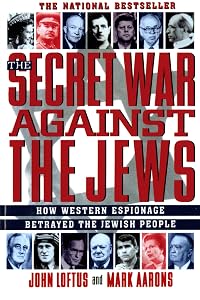
The Secret War Against the Jews: How Western Espionage Betrayed The Jewish People
by John Loftus, Mark Aarons
On This Page
Description
A hugely controversial work that exposes a series of scandals from Oliver North to the British royal family, The Secret War Against the Jews reveals as much about political corruption inside Western intelligence as it does about Israel. Using thousands of previously top-secret documents and interviews with hundreds of current and former spies, Loftus and Aarons, both veteran investigators, Nazi-hunters, and authors, present a compelling narrative.The authors demonstrate that numerous Western show more countries, especially the United States and Great Britain, have conducted repeated and willful spying missions on Palestine and later Israel over many decades. While on the surface these two countries and others profess to be ardent allies of Israel, they work, in fact, through their intelligence services to betray Israel's secrets to the Arabs. Their motive: oil and multinational profits, which must be attained at any price through international covert policies.The pageant of characters appearing in this narrative is vast and shocking. This is not only a compelling work of history, but also a volume whose grave allegations will be debated for years to come. show lessTags
Recommendations







































Member Reviews
This review is tentative, as is my decision on whether or not to finish reading the book. Let me explain.
The book is divided into three parts: 1) The Age of Bigotry, roughly through 1947; 2) The Age of Greed, roughly 1948 to 1973; and 3) The Age of Stupidity, roughly 1974-1993, when the book was written. The first two, as described by other reviewers, is "blow-away" material.
The final part, which I am reading now, covers recent history. As Barbara Tuchman explains in her brilliant introduction to Practicing History, writing about recent history is difficult. This part of the book graphically illustrates those difficulties since at the time of the writing, Jimmy Carter and George H.W. Bush were very much active in current events. Reagan show more was felled by dementia. The coverage of Carter and Bush I seem to be colored by the writers' political views. The effort to rehabilitate Carter's failed presidency and to demonize Bush I (who I happen not to have liked) are too obvious.
Another difficulty I have with the book is that it overemphasizes the importance of the secret activities of the CIA and British equivalents and underemphasizes the importance of other events. The book notes the decline, in most of the 1980's and 1990's of oil prices but gives none of the credit to Reagan's policies in its efforts to demonize Reagan as a puppet of the oil companies.
History is often often a mixed bag and the book fails to understand that. I am a few hours away from deciding whether to finish it or put it down.
Edited: I put the book down. The first two of the three sections were great. The third was rubbish. There was reference to "long gas lines" in 1977 when of course that did not happen until April 1979 in California, May 1979 elsewhere. Such factual errors shake confidence in the accusations based upon them. And holding out Jimmy Carter as a friend of the Jews and Israel was a bit much. The author needed to do some fact checking show less
The book is divided into three parts: 1) The Age of Bigotry, roughly through 1947; 2) The Age of Greed, roughly 1948 to 1973; and 3) The Age of Stupidity, roughly 1974-1993, when the book was written. The first two, as described by other reviewers, is "blow-away" material.
The final part, which I am reading now, covers recent history. As Barbara Tuchman explains in her brilliant introduction to Practicing History, writing about recent history is difficult. This part of the book graphically illustrates those difficulties since at the time of the writing, Jimmy Carter and George H.W. Bush were very much active in current events. Reagan show more was felled by dementia. The coverage of Carter and Bush I seem to be colored by the writers' political views. The effort to rehabilitate Carter's failed presidency and to demonize Bush I (who I happen not to have liked) are too obvious.
Another difficulty I have with the book is that it overemphasizes the importance of the secret activities of the CIA and British equivalents and underemphasizes the importance of other events. The book notes the decline, in most of the 1980's and 1990's of oil prices but gives none of the credit to Reagan's policies in its efforts to demonize Reagan as a puppet of the oil companies.
History is often often a mixed bag and the book fails to understand that. I am a few hours away from deciding whether to finish it or put it down.
Edited: I put the book down. The first two of the three sections were great. The third was rubbish. There was reference to "long gas lines" in 1977 when of course that did not happen until April 1979 in California, May 1979 elsewhere. Such factual errors shake confidence in the accusations based upon them. And holding out Jimmy Carter as a friend of the Jews and Israel was a bit much. The author needed to do some fact checking show less
NO OF PAGES: 658 SUB CAT I: Holocaust SUB CAT II: SUB CAT III: DESCRIPTION: The major powers of the world have repeatedly planned covert operations to bring about the partial or total destruction of Israel.NOTES: SUBTITLE: How Western Espionage Betrayed the Jewish People
Ratings
Members
- Recently Added By
Lists

Recommended histories of Israel/Palestine.
10 works; 1 member
Author Information
4 Works 454 Members

13 Works 488 Members
Common Knowledge
- Canonical title
- The Secret War Against the Jews: How Western Espionage Betrayed The Jewish People
- Original publication date
- 1994
Classifications
- Genres
- Nonfiction, History, General Nonfiction, Politics and Government, Religion & Spirituality
- DDC/MDS
- 327.7305694 — Society, government, & culture Political science International Relations: Spies North America United States U.S.-Asian Relations
- LCC
- E183.8 .I7 .L63 — History of the United States United States History Diplomatic history. Foreign and general relations. Relations with individual countries
- BISAC
Statistics
- Members
- 264
- Popularity
- 122,114
- Reviews
- 2
- Rating
- (2.50)
- Languages
- Czech, English
- Media
- Paper, Ebook
- ISBNs
- 7
- ASINs
- 2