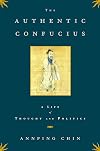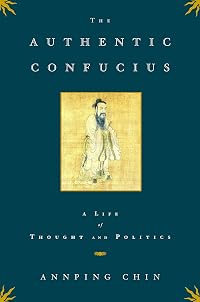
The Authentic Confucius: A Life of Thought and Politics
by Ann-Ping Chin
On This Page
Description
"For more than 2,000 years, Confucius has been an inseparable part of China's history. Yet despite this fame, Confusius the man has been elusive. In this book the author has worked through the most reliable Chinese texts on her quest to sort out what is really known about Confucius from the reconstructions and guesswork that muddled his memory. Here the author illuminates the political and social climate in which Confucius lived. She explains how Confucius made the transition from court show more advisor to wanderer, and how he reluctantly became a professional teacher as he refined his judgment of human character and composed his vision of a moral political order. The result is a book that shows how Confucius lived and thought: his habits and inclinations, his relation to the people of the time, his work as a teacher and as a counselor, his worries about the world and the generations to come."--Jacket. show lessTags
Recommendations










Member Reviews
With the ascendancy of New Age religion and metaphysics, if one can even bear to grace them those names, it has been increasingly difficult to discern the scholarly from the hogwash, the learned from the those whose aimless spirits are drawn to the next universal panacea. The problem is only compounded when we see the convergence of these ideas with those in Buddhism, Hinduism, and other Asian traditions. Thankfully, Annping Chin provides us with a carefully thought out perspective, a deep reverence for the history of both China and Confucius' life in particular, and the much-appreciated scholarly credentials. After studying mathematics, she received her Ph.D. in Chinese Thought from Columbia, and has taught at both Wesleyan and Yale. show more Her husband, renowned author and sinologist Jonathan Spence, who is also at Yale, wrote one of my favorite books, "The Memory Palace of Matteo Ricci." (Incidentally, Ricci, a sixteenth-century Italian Jesuit priest, was the first to Latinize Confucius' name from the original Chinese Kung Fuzi, and would also later translate much of the Confucian corpus into Latin.)
Chin does a sublime job at contextualizing Confucius' political thought. He was born in the time commonly referred to as the Spring and Autumn period, spanning some three-and-a-half centuries, when China was in a state of existential crisis, riven by familial conflict and discord. Matters came to such a head that he spent 14 years, from 497 to 484 B. C., in exile passing from feudal state to feudal state. Only later does he return to his home state of Lu as a reluctant political advisor. In such a mess, the principle concerns of Confucius' thought make much more sense. In emphasizing the rites, customs, and social mores that he saw as the fabric of Chinese society, he thought that he could restore order, propriety, and that piety that had been lost in all of the fighting. These inherently conservative ideas (in the purest sense of the word) were utterly essential to work one's way into Chinese civil service up until the end of the Qian Dynasty, which fell in 1912 (with a moribund resurgence five years later). While that is no longer the case, the ripples of his influence are still very noticeable Chinese culture.
Chin's ability to marshal the gaps in ancient Confucian historiography is just as remarkable. Her primary sources are small in number, almost wholly limited to the Analects, the Zuo Zhuan, and Sima Qian's biography, all of which date anywhere from one hundred to five hundred years after the Confucius' death. The hagiographic nature of a lot of these materials, especially those written by his students, makes painting an accurate portrait even more difficult. Ping uses these sources not only to create a biography, but to provide illustrative vignettes that shed a lot of insight into what Confucius considered the most important in both the individual and the state.
This is a highly reliable introduction to the history, thought, and influence of Confucius, all couched nicely within the political context he was continually at odds with, and should come highly recommended for anyone interested in the historical Confucius or the history of the Warring States period. show less
Chin does a sublime job at contextualizing Confucius' political thought. He was born in the time commonly referred to as the Spring and Autumn period, spanning some three-and-a-half centuries, when China was in a state of existential crisis, riven by familial conflict and discord. Matters came to such a head that he spent 14 years, from 497 to 484 B. C., in exile passing from feudal state to feudal state. Only later does he return to his home state of Lu as a reluctant political advisor. In such a mess, the principle concerns of Confucius' thought make much more sense. In emphasizing the rites, customs, and social mores that he saw as the fabric of Chinese society, he thought that he could restore order, propriety, and that piety that had been lost in all of the fighting. These inherently conservative ideas (in the purest sense of the word) were utterly essential to work one's way into Chinese civil service up until the end of the Qian Dynasty, which fell in 1912 (with a moribund resurgence five years later). While that is no longer the case, the ripples of his influence are still very noticeable Chinese culture.
Chin's ability to marshal the gaps in ancient Confucian historiography is just as remarkable. Her primary sources are small in number, almost wholly limited to the Analects, the Zuo Zhuan, and Sima Qian's biography, all of which date anywhere from one hundred to five hundred years after the Confucius' death. The hagiographic nature of a lot of these materials, especially those written by his students, makes painting an accurate portrait even more difficult. Ping uses these sources not only to create a biography, but to provide illustrative vignettes that shed a lot of insight into what Confucius considered the most important in both the individual and the state.
This is a highly reliable introduction to the history, thought, and influence of Confucius, all couched nicely within the political context he was continually at odds with, and should come highly recommended for anyone interested in the historical Confucius or the history of the Warring States period. show less
I enjoyed parts of the book and many of her quotes from the Analects, but felt in the end only marginally closer to understanding who he was. Maybe that's actually closer to the truth anyway - how close can you get to understanding someone in a biography without oversimplifying. A good sign is that I want to read the Analects. Good read.
Confucius was a master of the rites and a gentleman counselor
Confucius was born in 552 BC, in Lu, a province in China’s central plain, during the “Spring and Autumn Period”. This was during a period of waning central power, the second half of the Zhou dynasty. The Duke of Zhou held a regency, and there were several states in the central plain, ruled by powerful dukes and entrenched families. Confucius was born a gentleman, but was not part of the ruling families. He spent most of his early life studying literature, music, the “rites” and good conduct, seeking an office in government. In 497 he was the Minister of Crime (justice) in Lu, and by repute formidably effective, but he abruptly left his post and wandered through the show more states vying for leadership, before returning to Lu. This is when he acquired followers and students, becoming revered for his righteous conduct and mastery of the “rites”, the rites being the appropriate rituals and attitudes for all occasions. The rites were primarily concerned with filial piety.
The author assembled the facts of Confucius’ life from the Analects, a collection of stories and debates among his students, and from histories by Mencius and others. The later parts of the book are historiography, and concern how Confucius became the center of Chinese life.
The author was born and raised in Taiwan, and her prose is serviceable but sometimes inelegant. She repeats quotes and stories, and I was often uncertain where the narrative was going. The history of the period was generally interesting.
I bought this volume new in 2007, and I am disappointed at the yellowing of the paper edges. show less
Confucius was born in 552 BC, in Lu, a province in China’s central plain, during the “Spring and Autumn Period”. This was during a period of waning central power, the second half of the Zhou dynasty. The Duke of Zhou held a regency, and there were several states in the central plain, ruled by powerful dukes and entrenched families. Confucius was born a gentleman, but was not part of the ruling families. He spent most of his early life studying literature, music, the “rites” and good conduct, seeking an office in government. In 497 he was the Minister of Crime (justice) in Lu, and by repute formidably effective, but he abruptly left his post and wandered through the show more states vying for leadership, before returning to Lu. This is when he acquired followers and students, becoming revered for his righteous conduct and mastery of the “rites”, the rites being the appropriate rituals and attitudes for all occasions. The rites were primarily concerned with filial piety.
The author assembled the facts of Confucius’ life from the Analects, a collection of stories and debates among his students, and from histories by Mencius and others. The later parts of the book are historiography, and concern how Confucius became the center of Chinese life.
The author was born and raised in Taiwan, and her prose is serviceable but sometimes inelegant. She repeats quotes and stories, and I was often uncertain where the narrative was going. The history of the period was generally interesting.
I bought this volume new in 2007, and I am disappointed at the yellowing of the paper edges. show less
Ratings
Members
- Recently Added By
Author Information

3+ Works 239 Members
Some Editions
Series
Belongs to Publisher Series
Common Knowledge
- Original title
- The Authentic Confucius. A Life of Thought and Poltics
- Original publication date
- 2007
- Epigraph
- ...and Brutus, with heaven and earth conspiring against him and Roman liberty, stealing some hour of night from his rounds to read and annotate Polybius with complete assurance.
MICHEL DE MONTAIGNE, “OF EXPERIENCE” - Dedication
- To Jonathan, Meimei, and Yar
- First words
- CONFUCIUS CONCENTRATED ON LIVING LIFE AS WELL AS he knew how.
- Quotations
- CONFUCIUS WAS NOT ON HIS OWN DURING HIS FOURTEEN years of wandering. A handful of students and admirers followed him. It was rightly so that it should happen this way, for Confucius was on a quest to understand himself and hi... (show all)s true calling, though, as with most quests of this sort, he did not plunge into it with that purpose in mind. Without his companions, it would seem, he would not have been as keen and lucid as he was to become in his later years. Without them, he could have been dead on the road, long before his work was coming to completion.
During his years of wandering, Confucius never considered his followers part of a school, certainly not of his school, for he had none. He put himself on the road without the nudging of gods or visions. He needed a proper job... (show all) and did not think he had much to preach about. Zigong, Yan Hui, and possibly Zaiwo followed him because they loved learning as much as he and thought that he had a deft hand at leading them forward, not by the nose but like a master driver, spurring them on and reining them in, down the path of human life. Zilu followed him as a retainer would—loyal and loving and learning a little about refinement whenever he was willing. Ran Qiu was probably going along for the ride, looking for opportunities in case Confucius landed a prime spot. Thus when the Jisuns summoned him, he headed home. Zhonggong is a
mystery, so we cannot even surmise. He could be the sixth man, and there could be more.
[…] the person who understood his peripatetic leanings better than even Confucius himself was a border warden from Wei. Being a minor official, this man had to ask for an interview when he learned that Confucius was passing... (show all) through his district. After their meeting, he said to the two or three disciples who accompanied Confucius on this trip: “Why do you worry about him not having an office? The world has long been without a moral way. Heaven is about to use your master as the wooden tongue for a bronze bell.” What this border warden realized was more than what Confucius at the time could have grasped about himself. He said that it was Heaven’s wish to have Confucius travel the empire and arouse people like the tongue of a bell—that Confucius was destined to be a teacher, not an official.
Contemporaries observed that “when he was singing in the company of others and liked someone’s singing in particular, he always asked to hear it again before
joining in.” Confucius learned without the... (show all) burden of intent and without the need for specificity, which so consumed his disciple Zixia. Yet when he heard a beautiful voice or a beautiful interpretation of a note or stanza, he wanted to listen to it again so that he could take in every note. Confucius might not have been thinking of the ultimate good when learning from this voice, but some elevation must have been gained as he found himself soaring.
There is no doubt that Confucius loved learning for its own sake and encouraged it in disciples who were inclined toward scholarship. Yet he also showed a strong resistance to placing knowledge outside the self... (show all). This was especially true toward the end of his life when he decided to plunge into teaching just a few good men. And here is the paradox: just as he was leaving the world of practical affairs—giving up politics for good—he was teaching most forcefully his belief that the proof of a true education may be found in the adroitness—in the ease and fluency—with which one can translate knowledge into action, ideals into policies, and poems into the language of one’s own thought.
Confucius relied on his awareness of the people around him to get him-
self anchored in a community or at court, in a temple or on the street. He
was not, however, looking for social approval or political di... (show all)vidends; nor was
he aiming at any conspicuous end. Confucius put himself in the world of
men, allowing himself the experience of being a neighbor, a friend, or a
subject, because he wanted to understand what was appropriate and right
in human relationships. Thus he could seem “too clumsy to speak” when
he was among his kin and men from his own village but could carry him-
self “lithely” in the presence of a ruler. The agility of his conduct—knowing
when to be silent and when to be fluent, how far to stoop to receive a gift
and how far to extend himself to help a friend in need—is proof of his mas-
tery of the rites. Yet his subtle moves and deft performance also betray a
compassionate heart and a keen knowledge of the human lot.
As for other kinds of phenomena—“a clap of thunder,” “a fierce wind,” chaos,
prodigies, or extreme violence—Confucius “did not speak about them.” He did not
talk about things he did not understand, and he did not talk about death. - Last words*
- (Click to show. Warning: May contain spoilers.)Un paleografo cinese che ho avuto occasione di conoscere mi ha parlato dei rischi connessi alla rimozione dal bambù del fango in cui era contenuto. Quando le strisce si trovano nella soluzione di pulizia, mi ha detto, e le parole cominciano ad apparire, alcune di esse si sollevano letteralmente dalla superficie del bambù, e cercano la fuga o la libertà scomparendo. Mai sono arrivata tanto vicino a pensare alle parole come a cose vive. Qualche tempo dopo ho formulato un desiderio. Anche se accetto la transitorietà della vita, mi sono detta, voglio che le parole siano un'eccezione - non tutte le parole, ma certamente quelle dei classici e delle storie, le parole delle poesie più antiche, quelle dei filosofi e quelle di Confucio. Voglio che rimangano tra noi per poterle riassaporare e per giocare mentalmente con le loro fragranze.
PROLOGO
(Click to show. Warning: May contain spoilers.)[in occasione della Conferenza Internazionale sul pensiero di Mencio e i valori contemporanei, Zoucheng, Shandong, aprile 2006]
Se ci fosse stato anche Confucio, avrebbe riconosciuto i vari giochi politici. Sarebbe rimasto ad ascoltare i funzionari che parlavano un linguaggio tutto loro e li avrebbe guardati di traverso, avrebbe bevuto qualcosa con i soldati in uniforme ed evitato del tutto i ritualisti. Si sarebbe seduto accanto a uno studioso, avrebbe chiacchierato con gli studenti e ne sarebbe stato soddisfatto.
INTRODUZIONE - Original language
- Inglese
*Some information comes from Common Knowledge in other languages. Click "Edit" for more information.
Classifications
- Genres
- Philosophy, Nonfiction, History, Biography & Memoir, General Nonfiction, Religion & Spirituality
- DDC/MDS
- 181.112 — Philosophy & psychology Ancient, medieval & eastern philosophy Eastern philosophy Far East and South Asia China & Korea Confucianism and Neo-Confucianism
- LCC
- B128 .C8 .C4927 — Philosophy, Psychology and Religion Philosophy (General) By period Ancient
- BISAC
Statistics
- Members
- 103
- Popularity
- 312,936
- Reviews
- 3
- Rating
- (3.44)
- Languages
- 6 — Dutch, English, Italian, Latvian, Portuguese, Spanish
- Media
- Paper, Ebook
- ISBNs
- 12
- ASINs
- 2