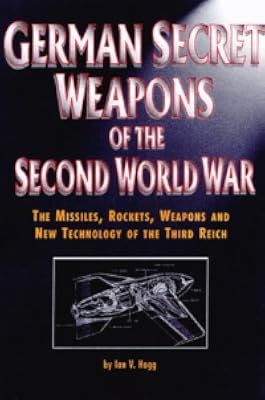
German Secret Weapons of the Second World War
by Ian V. Hogg
On This Page
Description
The phrase 'German Secret Weapons' immediately conjures up images of the V-1 and V-2 missiles which bombarded London in 1944. But what of the V-3 and V-4? What of Schmetterling, the Rochling shell, the Kurt bomb, the Hs293? These, and many other devices, were all part of the German secret armoury but are relatively unknown except to a handful of specialists. What of the German nuclear bomb? And the question of chemical warfare? The sheer magnitude of the secret weapon projects of the Third show more Reich is revealed in this comprehensive study written by one of the world's great experts on weaponry. The book explores the various fields in which the Germans concentrated their weapon development and discusses the multiplicity of ideas, the difficulties, and, in several cases, how these ideas were subsequently exploited by the victors. Although much of the German wartime development was not completed before the war's end, it nevertheless provided a foundation for a great deal of the munitions development which has since taken place. Comparisons with Allied projects are also drawn. This book explodes some of the myths surrounding Hitler's secret weapons to reveal a truth all the stranger for being fact. show lessTags
Recommendations





































Member Reviews
In January 1941 staff officers of the U.S., British, and Canadian militaries met in Washington D.C.. Though the United States was still a year from declaring war, planning was already underway in anticipation of that prospect, and the decisions they reached shaped much of the war that followed. Among the most important of these was that Germany was the primary opponent in any war involving the Axis powers. While there were several excellent reasons for this, one of them was that the Germans possessed the greatest capacity for developing weapons which might radically transform the war, and thus needed to be defeated before they did.
Ian Hogg's book provides evidence of the wisdom of this decision. In it he provides an overview of the show more major weapons research bring undertaken by the Third Reich before and during the war. Diving his examination into categories, he summarizes the major projects to design new aircraft and air-launched weapons, air defense weapons, naval weapons, and the Wunderwaffen and nuclear and chemical weapons programs. His focus throughout is on their development, providing technical details and accounts of the decisions whether to undertake or abandon them and avoiding more than a brief mention of their deployment in the cases where the weapons were introduced. As befits a former artilleryman in the Royal Army, his section discussing the "big guns" is the best, but he provides interesting details throughout about the technical and bureaucratic challenges that slowed or stopped the development of weapons that might have changed the course of the war. The result is a work that is an excellent introduction to Germany's secret weapons programs, one best suited for the reader familiar with military technology but an informative read for anyone interested in an overview of the topic. show less
Ian Hogg's book provides evidence of the wisdom of this decision. In it he provides an overview of the show more major weapons research bring undertaken by the Third Reich before and during the war. Diving his examination into categories, he summarizes the major projects to design new aircraft and air-launched weapons, air defense weapons, naval weapons, and the Wunderwaffen and nuclear and chemical weapons programs. His focus throughout is on their development, providing technical details and accounts of the decisions whether to undertake or abandon them and avoiding more than a brief mention of their deployment in the cases where the weapons were introduced. As befits a former artilleryman in the Royal Army, his section discussing the "big guns" is the best, but he provides interesting details throughout about the technical and bureaucratic challenges that slowed or stopped the development of weapons that might have changed the course of the war. The result is a work that is an excellent introduction to Germany's secret weapons programs, one best suited for the reader familiar with military technology but an informative read for anyone interested in an overview of the topic. show less
Hitler’s regime was notorious for its many experiments and its various secret ploys, weapons, and technological developments. But typically, the term “secret German weapons” only turns up images of the V-1 and V-2 missiles that played a part in bombing London in 1944. But truth be told, there were many more unheard of weapons behind the Third Reich. Many of these weapons have been unknown to the general public.
Here, Ian V. Hogg, one of the world’s leading experts on weaponry, reveals the sheer magnitude of Hitler’s secret weapon projects, from the V-3 and the V-4 missiles, to the Schmetterling, to the German nuclear bomb, to the question of nuclear war and more. This detailed account of the myths surrounding secret German show more weapons examines the various fields the Germans concentrated on during their weapon development process and discusses difficulties that arrived in the process and how, in many cases, the ideas were exploited by other nations.
German Secret Weapons of the Second World War draws comparisons between similar Allied projects and narrates the deeper purpose behind many of these projects. Many of these developments were not completed before the end of the war, but have created a solid foundation for many of today’s great military developments.
The phrase 'German Secret Weapons' immediately conjures up images of the V-1 and V-2 missiles which bombarded London in 1944. But what of the V-3 and V-4? What of Schmetterling, the Rochling shell, the Kurt bomb, the Hs293? These, and many other devices, were all part of the German secret armoury but are relatively unknown except to a handful of specialists. What of the German nuclear bomb? And the question of chemical warfare? The sheer magnitude of the secret weapon projects of the Third Reich is revealed in this comprehensive study written by one of the world's great experts on weaponry, which captures both the reality behind the weapons actually produced and the intentions behind projects still in their infancy when the war ended. German Secret Weapons of the Second World War examines the various fields in which the Germans concentrated their weapon development and discusses the multiplicity of ideas, the difficulties, and, in several cases, how these ideas were subsequently exploited by the victors. Comparisons with Allied projects are also drawn. Although much of the German wartime development was not completed before the war's end, it nevertheless provided a foundation for a great deal of the munitions development which has since taken place. This book explodes some of the myths surrounding Hitler's secret weapons to reveal a truth all the stranger for being fact. show less
Here, Ian V. Hogg, one of the world’s leading experts on weaponry, reveals the sheer magnitude of Hitler’s secret weapon projects, from the V-3 and the V-4 missiles, to the Schmetterling, to the German nuclear bomb, to the question of nuclear war and more. This detailed account of the myths surrounding secret German show more weapons examines the various fields the Germans concentrated on during their weapon development process and discusses difficulties that arrived in the process and how, in many cases, the ideas were exploited by other nations.
German Secret Weapons of the Second World War draws comparisons between similar Allied projects and narrates the deeper purpose behind many of these projects. Many of these developments were not completed before the end of the war, but have created a solid foundation for many of today’s great military developments.
The phrase 'German Secret Weapons' immediately conjures up images of the V-1 and V-2 missiles which bombarded London in 1944. But what of the V-3 and V-4? What of Schmetterling, the Rochling shell, the Kurt bomb, the Hs293? These, and many other devices, were all part of the German secret armoury but are relatively unknown except to a handful of specialists. What of the German nuclear bomb? And the question of chemical warfare? The sheer magnitude of the secret weapon projects of the Third Reich is revealed in this comprehensive study written by one of the world's great experts on weaponry, which captures both the reality behind the weapons actually produced and the intentions behind projects still in their infancy when the war ended. German Secret Weapons of the Second World War examines the various fields in which the Germans concentrated their weapon development and discusses the multiplicity of ideas, the difficulties, and, in several cases, how these ideas were subsequently exploited by the victors. Comparisons with Allied projects are also drawn. Although much of the German wartime development was not completed before the war's end, it nevertheless provided a foundation for a great deal of the munitions development which has since taken place. This book explodes some of the myths surrounding Hitler's secret weapons to reveal a truth all the stranger for being fact. show less
Ratings
Members
- Recently Added By
Lists

All Things Germany
321 works; 4 members
Author Information

128+ Works 3,058 Members
Ian Hogg is one of the world's leading experts on small arms, artillery systems, ammunition and defence systems in general. He is the author of numerous books on these subjects including The Big Guns 1939-45, A History of Artillery and Military Small Arms of the 20th Century.
Classifications
Statistics
- Members
- 113
- Popularity
- 289,416
- Reviews
- 2
- Rating
- (3.79)
- Languages
- English, Hungarian
- Media
- Paper, Ebook
- ISBNs
- 10
- ASINs
- 3