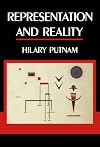
Representation and Reality
by Hilary Putnam
182 Members (3.88)
On This Page
Description
Hilary Putnam, who may have been the first philosopher to advance the notion that the computer is an apt model for the mind, takes a radically new view of his own theory of functionalism in this book. Putnam argues that in fact the computational analogy cannot answer the important questions about the nature of such mental states as belief, reasoning, rationality, and knowledge that lie at the heart of the philosophy of mind.Tags
Recommendations

































Member Reviews
Members
- Recently Added By
Author Information

59+ Works 2,422 Members
According to John Passmore, Hilary Putnam's work is a "history of recent philosophy in outline" (Recent Philosophers). He adds that writing "about "Putnam's philosophy' is like trying to capture the wind with a fishing-net." Born in Chicago and educated at the University of Pennsylvania and the University of California at Los Angeles, Putnam show more taught at Northwestern University, Princeton University, and the Massachusetts Institute of Technology before moving to Harvard University in 1965. In his early years at Harvard, he was an outspoken opponent of the war in Vietnam. Although he writes in the idiom of analytic philosophy, Putnam addresses major themes relating science to ethics and epistemology. If these themes are reminiscent of David Hume---as, for that matter, is much of analytic philosophy---his treatment of them is not. Putnam's work is far more profoundly shaped by recent work in logic, foundations of mathematics, and science than would have been possible for Hume; Putnam has contributed to each. He differs from Hume and stands more in the tradition of Willard Quine and American pragmatism in his treatment of the crucial distinctions between analytic and synthetic statements and between facts and values. Both distinctions, sharply made by Hume, are claimed by Putnam not to be absolute. He attempts to show, for example, that basic concepts of philosophy, science, and mathematics all are interrelated, so that mathematics bears more similarity to empirical reasoning than is customarily acknowledged. (Bowker Author Biography) show less
Series
Belongs to Publisher Series
Common Knowledge
- Canonical title
- Representation and Reality
- Original title
- Representation and Reality
- Original publication date
- 1988
Classifications
Statistics
- Members
- 182
- Popularity
- 178,396
- Rating
- (3.88)
- Languages
- 5 — English, French, German, Italian, Spanish
- Media
- Paper, Ebook
- ISBNs
- 9