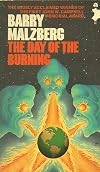
The Day of the Burning
by Barry N. Malzberg
On This Page
Description
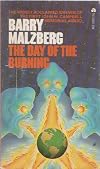
The Earth is blissfully unaware that the fate of the entire human race lay in the shaking hands of George Mercer, an insignificant and slightly neurotic employee of New York's Department of Welfare. He has only 12 hours to prove to the Galactic Overlords that Earth is worthy!Tags
Recommendations














Member Reviews
This short 1974 novel is a sequel to the author’s first novel published under his own name, 1972’s Beyond Apollo. It is far, far better, in my opinion. Maybe I should have given this five stars.
The narrator, a caseworker (“investigator”) for The Center — New York City’s welfare bureau — is given a problem file, a family on assistance who may or may not qualify for said assistance, since there are questions about “past maintenance.” Mercer, the narrator, hates the supervisor who wants him to deny the family’s claims, but has bigger problems on his mind: he is haunted by an annoying being he calls “Lucas,” someone that only he can see and hear. And it turns out this Lucas is — “he” “says” — a show more representatives for the Galactic Overlords, and they have randomly selected our narrator to be given a test, upon which the fate of our planet rests. Should he succeed, humanity becomes part of the galactic community in good standing; should he fail, well, then comes the event of the title, The Day of the Burning.
Meanwhile, there are regular reports about a problematic mission to Venus, events of which are told by the similarly hapless sexual lunatic, the ultra-unreliable narrator of Beyond Apollo. These reports are the best part of the novel, providing regular comic intermezzi in the continuing story of our guide through 1981 New York.
Written in the mid-70s, 1981 was the future, then. It’s the past now, and very different a past it is. Thus does futuristic sf become alternative history. Time transmogrifies genres.
What makes this book work better than the earlier — I insist it is, though no one else appears to agree — is that it is easier to follow, funnier, and its premises are set up to greater effect. It works better as satire, because the focus is on two State endeavors, one lofty (the space program) and the other lowly (welfare assistance). Both are probed and pilloried.
And the nut-case at the center of the story, Mr. Mercer, is somewhat more mildly nutty than the mad astronaut of the earlier effort, and the setting — a city bureaucracy — is more easily relatable and all-too-humanly dysfunctional.
A comparison with Philip K. Dick is inevitable. Malzberg is quite obviously the better writer qua writer, though his sticking to a first person technique gives him an easy up: Dick almost invariably chose the tougher task of multiple-character third person narrative, too often failing. The Day of the Burning, on the other hand, is classically proportioned and thematically tight. Mercer, like a Dick anti-hero, is a professional and social failure with sexual problems, including a psychologically repellent (nagging) lover, as he fully confesses. But his narration raises him in the reader’s sympathies — at least it did mine — despite the obvious interpretation: he is as mad as a helmeted hatter.
In the end, he is murderous. Indeed, as I finished reading the book, another author’s work came to mind: Vladimir Nabokov. This I liken unto the cheery dark comedy of Despair, a wildly under-rated work, while the more complicated and vexing novel Beyond Apollo strikes me as thematically more like Lolita but technically in Pale Fire territory, sans the poetry and commentary, of course. But perhaps I stretch.
I suspect that the reason this novel is not well known is that it too effectively took on the welfare state. Few sf enthusiasts who glory in New Wave literature would likely accept a double critique of both high and low statism. For me, of course, this is as natural as a Stoic ideal or an Epicurean evasion. Malzberg is in danger of becoming my favorite sf writer. show less
The narrator, a caseworker (“investigator”) for The Center — New York City’s welfare bureau — is given a problem file, a family on assistance who may or may not qualify for said assistance, since there are questions about “past maintenance.” Mercer, the narrator, hates the supervisor who wants him to deny the family’s claims, but has bigger problems on his mind: he is haunted by an annoying being he calls “Lucas,” someone that only he can see and hear. And it turns out this Lucas is — “he” “says” — a show more representatives for the Galactic Overlords, and they have randomly selected our narrator to be given a test, upon which the fate of our planet rests. Should he succeed, humanity becomes part of the galactic community in good standing; should he fail, well, then comes the event of the title, The Day of the Burning.
Meanwhile, there are regular reports about a problematic mission to Venus, events of which are told by the similarly hapless sexual lunatic, the ultra-unreliable narrator of Beyond Apollo. These reports are the best part of the novel, providing regular comic intermezzi in the continuing story of our guide through 1981 New York.
Written in the mid-70s, 1981 was the future, then. It’s the past now, and very different a past it is. Thus does futuristic sf become alternative history. Time transmogrifies genres.
What makes this book work better than the earlier — I insist it is, though no one else appears to agree — is that it is easier to follow, funnier, and its premises are set up to greater effect. It works better as satire, because the focus is on two State endeavors, one lofty (the space program) and the other lowly (welfare assistance). Both are probed and pilloried.
And the nut-case at the center of the story, Mr. Mercer, is somewhat more mildly nutty than the mad astronaut of the earlier effort, and the setting — a city bureaucracy — is more easily relatable and all-too-humanly dysfunctional.
A comparison with Philip K. Dick is inevitable. Malzberg is quite obviously the better writer qua writer, though his sticking to a first person technique gives him an easy up: Dick almost invariably chose the tougher task of multiple-character third person narrative, too often failing. The Day of the Burning, on the other hand, is classically proportioned and thematically tight. Mercer, like a Dick anti-hero, is a professional and social failure with sexual problems, including a psychologically repellent (nagging) lover, as he fully confesses. But his narration raises him in the reader’s sympathies — at least it did mine — despite the obvious interpretation: he is as mad as a helmeted hatter.
In the end, he is murderous. Indeed, as I finished reading the book, another author’s work came to mind: Vladimir Nabokov. This I liken unto the cheery dark comedy of Despair, a wildly under-rated work, while the more complicated and vexing novel Beyond Apollo strikes me as thematically more like Lolita but technically in Pale Fire territory, sans the poetry and commentary, of course. But perhaps I stretch.
I suspect that the reason this novel is not well known is that it too effectively took on the welfare state. Few sf enthusiasts who glory in New Wave literature would likely accept a double critique of both high and low statism. For me, of course, this is as natural as a Stoic ideal or an Epicurean evasion. Malzberg is in danger of becoming my favorite sf writer. show less
Ratings
Members
- Recently Added By
Author Information

265+ Works 4,521 Members
Some Editions
Common Knowledge
- Original publication date
- 1974
Classifications
Statistics
- Members
- 68
- Popularity
- 446,488
- Reviews
- 1
- Rating
- (4.00)
- Languages
- English, German
- Media
- Paper, Ebook
- ISBNs
- 4
- ASINs
- 5