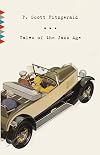
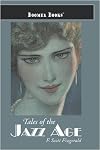
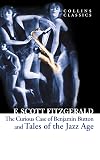
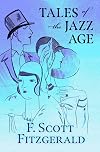
Tales of the Jazz Age
by F. Scott Fitzgerald
On This Page
Description
Tales of the Jazz Age is a collection of eleven short stories by F. Scott Fitzgerald. Divided into three separate parts, according to subject matter, it includes one of his better-known short stories, "The Curious Case of Benjamin Button". Several of the stories had also been published earlier, independently, in either The Metropolitan, Saturday Evening Post, Smart Set, Collier's, Chicago Tribune, or Vanity Fair.Tags
Recommendations
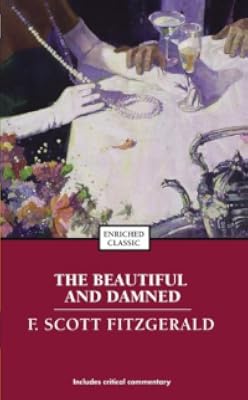

















Member Reviews
I have often wondered what it must be like to sing—to let loose a voice that moves others. To not just sing along but cast your voice alone upon the air unsupported to fly and land on it’s own. Maybe it is like flying. Just you--clear of obstacles and free of weight, all directions and distances available and possible. Beautiful. That’s how I feel reading F. Scott Fitzgerald. He writes so beautifully, his sentences often sing and seem to fly. There are times where I have sat startled by his prose. He is often romanticized as a writer partly because of this skill, but also because of the flapper age he was immersed in and the age of his death—44. (And then there’s Zelda). More famous now for his novels, it was short stories show more that made his living. They aren’t as well remembered but still show that Fitzgerald could write but also write whatever he wanted. I started this thinking it would be one flapper tale after another. The ease and fashion of the roaring 20’s does permeate much of this collection, but there is more to see. He touches on fantasy (The Curious Case of Benjamin Button), adventure (The Diamond as Big as the Ritz), mock playwriting (Mr. Icky), being Henry James (The Lees of Happiness) and fun with hillbillies (Jemina, the Mountain Girl) all with equal skill. Had he been able to fly in real life, free of money worries, worry over Zelda’s decline in health and the scourge of alcohol, who knows what he might have produced. But that always begs the question, how much did he produce because of enduring those liabilities. All that being said, this is obviously worth a look—not everything ages well (Mr Icky & Porcelain and Pink). My favorites are probably O Russet Witch & The Camel’s Back but there is plenty to enjoy. show less
Summary: A collection of eleven short stories, the most famous of which is “The Curious Case of Benjamin Button.”
For those who only know F. Scott Fitzgerald, this collection of short stories reveals other sides of the mind of Fitzgerald. Personally, I found this collection uneven. Only one seems to be truly profound, “O Russet Witch!,” a reflection on the choice between safe conventionality, and the risky, unconstrained life.
The most famous in the set was “The Curious Case of Benjamin Button.” Fitzgerald turns a thought exercise about being born old and growing backward into a story.
“The Diamond as Big as the Ritz” is kind of a grown up fantasy in which a school friend is invited to spend a holiday in an off-the-map show more Shangri-la, complete with an attractive sister, until he learns of the secret of the place, and its sinister impliction.
Two in the collection were amusing. “The Camel’s Back” revolves around a costume party and a camel costume for two. “Porcelain and Pink” is a one act play set in a suds-filled bath-tub.
Then there is the pathetic in “May Day” in which old classmates from Yale meet up, one down on his luck, and full of self-pity. Not an attractive figure, and his friends are no better.
To be honest, the other stories in this collection seemed to me to be caricatures, or just plain strange. The only virtue in some of these stories was that they were short. For those who are Fitzgerald fans, of course you will want to read these. For the rest of us, I felt there were a few good stories and the rest were mere padding. show less
For those who only know F. Scott Fitzgerald, this collection of short stories reveals other sides of the mind of Fitzgerald. Personally, I found this collection uneven. Only one seems to be truly profound, “O Russet Witch!,” a reflection on the choice between safe conventionality, and the risky, unconstrained life.
The most famous in the set was “The Curious Case of Benjamin Button.” Fitzgerald turns a thought exercise about being born old and growing backward into a story.
“The Diamond as Big as the Ritz” is kind of a grown up fantasy in which a school friend is invited to spend a holiday in an off-the-map show more Shangri-la, complete with an attractive sister, until he learns of the secret of the place, and its sinister impliction.
Two in the collection were amusing. “The Camel’s Back” revolves around a costume party and a camel costume for two. “Porcelain and Pink” is a one act play set in a suds-filled bath-tub.
Then there is the pathetic in “May Day” in which old classmates from Yale meet up, one down on his luck, and full of self-pity. Not an attractive figure, and his friends are no better.
To be honest, the other stories in this collection seemed to me to be caricatures, or just plain strange. The only virtue in some of these stories was that they were short. For those who are Fitzgerald fans, of course you will want to read these. For the rest of us, I felt there were a few good stories and the rest were mere padding. show less
As is often the case with Fitzgerald, these stories were hit and miss for me. I enjoyed some of the stories, such as "The Lees of Happiness" and "The Camel's Back". Others, such as "Porcelain and Pink", I just did not get. However, it was worth the read, and it was a fine first book for my Kindle.
The more I learn about Fitzgerald the more I am sad that he did not realise his impact during his own lifetime. I guess that those who contribute the most never do. I enjoyed the author's little introductions to each story which give a nice little preface. Every story in this is a gem, even if some of them are repeats from other FSF collations. I am still unable to comprehend how FSF could fathom, in his early twenties, what it was like to be an age he never reached. Overall, brilliant.
This short story collection was written very early in Fitzgerald's career (1922), and you can tell. there are moments of brilliance, such as "Oh Russet Witch" and "The Curious Case of Benjamin Button." There are moments of great comedy, such as "The Camel's Back," and there are moments of Hollywood blockbuster type action, such as "The Diamond as Big as the Ritz." There is also "May Day," which is on the verge of greatness but could have used some fine tuning. Unfortunately, there are also several stories that a more mature author would have never allowed to see the light of day. These are stories that were over-indulgent moments from a young author who admits in the introduction of the book that they were written more to entertain show more himself than anything else. You can see the burgeoning brilliance that will write The Great Gatsby and Tender Is the Night, but it isn't quite here yet with the exception of a few stories. show less
Over the last 10 minutes I must have switched between 3 and 4 stars about 20 times - but I did really like most of the short stories.
Fitzgerald has a way of creating the not always endearing but nevertheless interesting characters in his short stories that are sadly missing in his novels (The Great Gatsby excepted).
Fitzgerald has a way of creating the not always endearing but nevertheless interesting characters in his short stories that are sadly missing in his novels (The Great Gatsby excepted).
I really like Fitzgerald's writing, and his short stories were very interesting. The last few were a little repetitive, I thought, concerning as they did sad young couples with young children falling apart, but overall there was a very interesting mix of New York socialite stories, stories with some very strange, almost fantastical events (such as "The Curious Case of Benjamin Button" and "O Russet Witch"). My favorite of the collection is probably "The Lees of Happiness", which I found very moving and interesting. I'll definitely keep reading Fitzgerald's short stories after this.
Members
- Recently Added By
Published Reviews
ThingScore 100
"If ever a writer was born with a gold pen in his mouth, surely Fitzgerald is that man. The more you read him, the more he convinces you that here is the destined artist. . . . These stories are announced as beginning in the writer's second manner. They certainly show a development in his art, a new turn."
added by GYKM
Lists

1920s
141 works; 6 members
Author Information

636+ Works 143,462 Members
F(rancis) Scott Fitzgerald was born in St. Paul, Minnesota, on September 24, 1896. He was educated at Princeton University and served in the U.S. Army from 1917 to 1919, attaining the rank of second lieutenant. In 1920 Fitzgerald married Zelda Sayre, a young woman of the upper class, and they had a daughter, Frances. Fitzgerald is regarded as one show more of the finest American writers of the 20th Century. His most notable work was the novel, The Great Gatsby (1925). The novel focused on the themes of the Roaring Twenties and of the loss of innocence and ethics among the nouveau riche. He also made many contributions to American literature in the form of short stories, plays, poetry, music, and letters. Ernest Hemingway, who was greatly influenced by Fitzgerald's short stories, wrote that Fitzgerald's talent was "as fine as the dust on a butterfly's wing." Yet during his lifetime Fitzgerald never had a bestselling novel and, toward the end of his life, he worked sporadically as a screenwriter at motion picture studios in Los Angeles. There he contributed to scripts for such popular films as Winter Carnival and Gone with the Wind. Fitzgerald's work is inseparable from the Roaring 20s. Berenice Bobs Her Hair and A Diamond As Big As The Ritz, are two short stories included in his collections, Tales of the Jazz Age and Flappers and Philosophers. His first novel The Beautiful and Damned was flawed but set up Fitzgerald's major themes of the fleeting nature of youthfulness and innocence, unattainable love, and middle-class aspiration for wealth and respectability, derived from his own courtship of Zelda. This Side of Paradise (1920) was Fitzgerald's first unqualified success. Tender Is the Night, a mature look at the excesses of the exuberant 20s, was published in 1934. Much of Fitzgerald's work has been adapted for film, including Tender is the Night , The Great Gatsby, and Babylon Revisited which was adapted as The Last Time I Saw Paris by Metro-Goldwyn-Mayer in 1954. The Last Tycoon, adapted by Paramount in 1976, was a work in progress when Fitzgerald died of a heart attack on December 21, 1940, in Hollywood, California. Fitzgerald is buried in the historic St. Mary's Cemetery in Rockville, Maryland. (Bowker Author Biography) show less
Some Editions
Awards and Honors
Notable Lists
Series
Belongs to Publisher Series
Salamanderpockets (397)
Work Relationships
Common Knowledge
- Canonical title
- Tales of the Jazz Age {11 stories}; Tales of the Jazz Age
- Original title
- Tales of the Jazz Age
- Alternate titles
- Six Tales of the Jazz Age, and Other Stories (1960) (1960)
- Original publication date
- 1922
- People/Characters
- Benjamin Button
- Important events
- Jazz Age (1922)
- Related movies
- The Curious Case of Benjamin Button (2008 | IMDb)
- Dedication
- Quite Inappropriately:
To My Mother - First words
- Jim Powell as a Jelly-bean.
- Last words
- (Click to show. Warning: May contain spoilers.)So they threw them together into the sream and the two splashes they made were as one.
- Original language
- English
- Disambiguation notice
- This work contains:
"The Jelly-Bean"
"The Camel's Back"
"May Day"
"Porcelain and Pink"
"The Diamond as Big as the Ritz"
"The Curious Case of Benjamin Button"
"Tarquin of Cheapside"
"O Russet Witch"
... (show all)"The Lees of Happiness"
"Mr. Icky"
"Jemina"
Classifications
Statistics
- Members
- 975
- Popularity
- 27,104
- Reviews
- 11
- Rating
- (3.65)
- Languages
- 6 — Dutch, English, French, Galician, Italian, Portuguese
- Media
- Paper, Audiobook, Ebook
- ISBNs
- 130
- ASINs
- 47