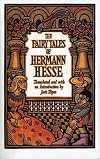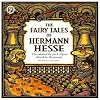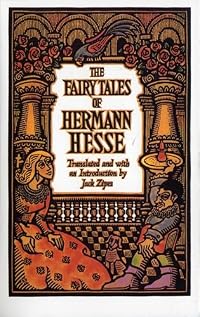
The Fairy Tales of Hermann Hesse
by Hermann Hesse
On This Page
Description
Twenty-two fairy tales for adults by a German writer (1877-1962). In A Man by the Name of Ziegler, the protagonist can talk to animals and finds them just as wicked as humans, Augustus is on a man who loses a fortune but gains happiness, and A Dream of the Gods contrasts the hopes and the reality of World War I. By the author of Steppenwolf.Tags
Recommendations















Member Reviews
This is really an abridgment of the main collection translated by Jack Zipes. This is a two cassette audio edition of narration with incidental guitar by Donovan. In order, the tales presented are "A Man By The Name Of Ziegler" (1908), "A Dream About The Gods" (1914), "Faldum" (1916), "The Poet" (1913) and "Flute Dream" (1914). This is the first time I ever dived into this material and I must say I much prefer the novels from Hesse, such as Steppenwolf, and Siddhartha. These just don't work for me, they seem somehow pained in their efforts to be poignant, poetic, and moralistic. The rather deep plots of an alchemist's seed, regretted wishes, and the urge to craft a perfect poem (shades of Goldmund here), are all for rather mature minds show more and not as plain as the category "fairy tale" suggests. These are more like long parables.
It almost feels - as much as I like an admire Donovan's vocal gifts - that is cooing, monotone deliver may have negatively affected these stories. I feel as I should read them or at least some of them myself some time. show less
It almost feels - as much as I like an admire Donovan's vocal gifts - that is cooing, monotone deliver may have negatively affected these stories. I feel as I should read them or at least some of them myself some time. show less
Unlike the title suggests, this book is unlike a collection of conventional fairy tales with on the nose moral lessons, but it is a collection of subtle tales which explore human psyche and anguish. An assortment of 22 fairy-tales echo the wide ranging themes of longing, desire, inner conflict, identity, meaning of beauty, and so much more. Must read tales are Augustus, The Poet, Iris, Flute Dream. This book stands as a beautiful testimony of Hesse’s lyrical genius of exploring human sentimentality with such simplicity and heart
Interesting collection, the more fairy-tale like ones can be lovely and certainly show his developing philosophy; I found myself also interested in the ones that don't work so well as tales, which delve more into politics and culture and the troubles of the mid 20th-century in an also modern way.
To read Hermann Hesse's fairy tales is to enter a fabulous world of dreams and visions, philosophy and passion. This landmark collection contains twenty-two of Hesse's finest stories in this genre, most translated into English here for the first time. Full of visionaries and seekers, princesses and wandering poets, his fairy tales speak to the place in our psyche that inspires us with deep spiritual longing; that compels us to leave home, and inevitably to return; and that harbors the greatest joys and most devastating wounds of our heart. Containing all the themes common in Hesse's great novels Siddhartha, Steppenwolf, and Demian—and mirroring events in his own life, these exquisite short pieces exhibit the same mystical and romantic show more impulses that contribute to the haunting brilliance of his major works. Several stories, including "The Poet," "The Fairy Tale About the Wicker Chair," and "The Painter," examine the dilemma of the artist, torn between the drive for perfection and the temptations of pleasure and social success. Other tales reflect changes and struggles within society: in "Faldum," a city is irrevocably transformed when each resident is granted his or her fondest wish; in "Strange News from Another Planet," "If the War Continues," and "The European," nightmarish landscapes convey Hesse's devastating critiques of nationalism, barbarism, and war. Illuminating and inspiring, The Fairy Tales of Hermann Hesse will challenge and enchant readers of all ages. A distinguished and historic publication, this fine translation by Jack Zipes captures their subtlety and elegance for decades nto come. show less
More of morality tales or fables than fairy tales, I think. As such, the authors exploration of those points of the human condition and the aspects of human relationships and foibles was fascinating and somewhat enlightening and socially astute... even now 75 years after their composition.
I have read a lot of, if not most of Hesse's work as I have always been drawn to his style and mystical nature. When I came across his fairy tales I was most interested to see how these would unfold. I was not disappointed as he delivered with all that I would have hoped for and expected from this man.
Hesse has a way of weaving a magical message into his work that is at times strange and at times profound. There are many messages in and lessons in which to partake here and enrich our lives. The kind of book with which you just let your mind go and flow.
Hesse has a way of weaving a magical message into his work that is at times strange and at times profound. There are many messages in and lessons in which to partake here and enrich our lives. The kind of book with which you just let your mind go and flow.
He uses a concise style and manages to create so much meaning with so few words
Members
- Recently Added By
Lists

Speculative Fiction from around the World
610 works; 17 members

Books talked about in Pamela Dean's Tam Lin
74 works; 1 member
Author Information

Hermann Hesse (July 2, 1877 -- August 9, 1962) was a German poet, novelist, essayist and painter. His best-known works included Steppenwolf, Siddhartha, and The Glass Bead Game, each of which explores an individual's search for authenticity, self-knowledge and spirituality. In 1946, he received the Nobel Prize in Literature. Hess publicly show more announced his views on the savagery of World War I, and was considered a traitor. He moved to Switzerland where he eventually became a naturalized citizen. He warned of the advent of World War II, predicting that cultureless efficiency would destroy the modern world. His theme was usually the conflict between the elements of a person's dual nature and the problem of spiritual loneliness. His first novel, Peter Camenzind, was published in 1904. His masterpiece, Death and the Lover (1930), contrasts a scholarly abbot and his beloved pupil, who leaves the monastery for the adventurous world. Steppenwolf (1927), a European bestseller, was published when defeated Germany had begun to plan for another war. It is the story of Haller, who recognizes in himself the blend of the human and wolfish traits of the completely sterile scholarly project. During the 1960s Hesse became a favorite writer of the counter culture, especially in the United States, though his critical reputation has never equaled his popularity. Hermann Hesse died in 1962. (Bowker Author Biography) show less
Some Editions
Series
Belongs to Publisher Series
Work Relationships
Common Knowledge
- Original publication date
- 1918; 1995 (collected and translated) (collected and translated)
- People/Characters
- Emil Sinclair
- Dedication*
- Opgedragen aan Peter Suhrkamp
- First words*
- In de Appelboomstraat woonde een jong vrouwtje, dat het ongeluk gehad had vlak na haar huwelijk haar man te verliezen.
- Last words*
- (Click to show. Warning: May contain spoilers.)Maar in elk zijner gedaanten was hij een geheel, was hij een paar, beschikte over zon en maan, had man zowel als vrouw in zich, stroomde als tweelingstroom door het land en stond als een dubbele ster aan de hemel.
- Disambiguation notice
- A collection of 22 fairy tales. Please don't combine with works containing a different selection of stories!
*Some information comes from Common Knowledge in other languages. Click "Edit" for more information.
Classifications
- Genres
- Fiction and Literature, General Fiction, Fantasy
- DDC/MDS
- 833.912 — Literature & rhetoric German & related literatures German fiction 1900- 1900-1990 1900-1945
- LCC
- PT2617 .E85 .A287 — Language and Literature German, Dutch and Scandinavian literatures German literature Individual authors or works 1860/70-1960
- BISAC
Statistics
- Members
- 855
- Popularity
- 31,774
- Reviews
- 11
- Rating
- (3.88)
- Languages
- English, Latvian, Portuguese
- Media
- Paper, Audiobook, Ebook
- ISBNs
- 7
- ASINs
- 6