On This Page
Tags
Recommendations



















Member Reviews
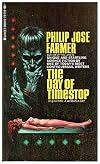
I had it in my mind Farmer was one of those off-beat sf authors of the 1960s and 1970s who never scored big but produced interesting work nonetheless. We’ve all heard of Riverworld, and despite a reread a few years ago of To Your Scattered Bodies Go not exactly impressing, the concept seems to be “high” enough to keep interest in Farmer’s works alive. Sadly, his reputation doesn’t seem to stand up to scrutiny. I’d previously read The Day of Timestop under the title A Woman a Day, because it was also republished by Beacon Books under that title, and I have the Beacon Books edition. Which I’ve not actually read yet – and, of course, it’s currently in storage. So, anyway, I bought the SF Gateway edition as it was cheap, show more but I was still robbed because this book is really bad. More than a thousand years in the future, after much of humanity was wiped out, the world has split into three main blocs – the religious Haijac Union, the Israeli Republics (because a US author has to promote Israel, even if he’s not Jewish) and I forget what the third one was. Oh, and Marcher, a neutral state in west Europe. The story takes place in the Haijac Union, specifically in Paris, where a Marcher agent has infiltrated the Haijac Union to the highest level – he’s a lamech-man, ie, beyond reproach, beyond suspicion, incorruptible, so pretty much how Tories see themselves despite all evidence to the contrary, you know, like letting kids starve over Christmas – but then Tories are scum – and while Farmer sets up his world with economy, it makes zero sense, and the plot which follows on from it makes even less. There’s a woman who’s an alien because she has some sort of organic battery wired to her vagina (really!), but then it turns out she’s not an alien. And there are some Bantu who have been literally whitewashed – “depigmentized” (really!) – and they’re some weird sort of hippy Christians, and the initials “JC” seem to refer to half a dozen messiahs – and the title actually refers to one of them, who is supposed to return from his time-travelling on the “Day of Timestop” to trigger Rapture for everyone in the Haijac Union. Everything in this book is wrong – the ideas are complete nonsense, the sensibilities are all over the place and not in a good way, the prose is functional at best, and if the story doesn’t go where you expect it to that’s because Farmer probably didn’t know himself where he was going. A book to avoid. show less
The awful title was clearly intended to sell paperbacks, since it has nothing to do with the rather complicated story of a doctor/spy in a post-apocalyptic world where the only races that survived in large numbers were Hawaiians, Israelis, Icelanders, and Bantus! This is the second book of a series, and I didn't read the first one, so it was like stepping into a deep puddle. Farmer, however, manages to convey enough background information through his characters' conversations. In cases of obvious exposition one character even tells the other not to tell her things she already knows! In any case, this is all unusual and exotic enough that the story is engaging and quite readable, full of interesting scenes. This doesn't quite add up to a show more coherent whole, however, as the protagonist's actions don't always serve the purposes of his country, but rather his own desires. It's a fascinating view of a future variation on a theocracy, however. show less
There's not much to be said for The Day of Timestop (also published under the title "A Woman a Day") beyond its value as a sort of historical curiosity. There are moments of entertaining storytelling and a couple of suprising plot twists, but these are too few and far between to justify wading through everything else. At least the details of the plentiful sex are left to our imagination.
The story starts with our protagonist raping an enemy agent sent to entrap him (but don't worry, it's for a good cause and besides she enjoys it). The book then proceeds to give us a pedestrian and gently hippyesque "underground struggle against a repressive post-apocalyptic dystopia" story, replete with gaping plot holes and logical disconnects, and show more adds in a Playboy generation plot gimmick hinging on, I kid you not, bioengineered super vaginas (i.e., to gain control over the impotent yet horny leaders of said repressive dystopian government) .
I could rail about the coincidences, the characters, and how these characters interact, but I am not sure it's really worth the effort. You've got to wonder how this book got published; I can only suspect that a dare and alcohol were involved. show less
The story starts with our protagonist raping an enemy agent sent to entrap him (but don't worry, it's for a good cause and besides she enjoys it). The book then proceeds to give us a pedestrian and gently hippyesque "underground struggle against a repressive post-apocalyptic dystopia" story, replete with gaping plot holes and logical disconnects, and show more adds in a Playboy generation plot gimmick hinging on, I kid you not, bioengineered super vaginas (i.e., to gain control over the impotent yet horny leaders of said repressive dystopian government) .
I could rail about the coincidences, the characters, and how these characters interact, but I am not sure it's really worth the effort. You've got to wonder how this book got published; I can only suspect that a dare and alcohol were involved. show less
In a Cold War society rigidly controlled, Dr. Leif Barker fights a secretive war against the Haijac Union, a totalitarian regime with sex-focused Timestop tech. He uncovers deeper conspiracies, challenging notions of freedom, love, and tyranny, while the genetically engineered titular women are part of this dystopian, sexually repressed world.
Some fairly average speculation on post-apocalyptic nations and societies combines with a below-average adventure to produce an entertaining but easy, undemanding read. This book is quite a bit below Farmer's usual niveau and talent and more in line with mass-market spy novels.
Eind 28e eeuw: Het lot van de wereld ligt in de handen van slechts één man: de handen van chirurg Leif Barker.
Ratings
Members
- Recently Added By
Author Information

366+ Works 36,035 Members
Philip José Farmer was born in North Terre Haute, Indiana on January 26, 1918. He worked in a steel mill while attending Bradley University at night and writing in his spare time. In 1952, his story The Lovers, in which a human has sex with an alien, was published in a pulp magazine called Startling Stories and won him the Hugo Award in 1953 for show more most promising new author. He quit his job to become a full-time writer, but a string of misfortunes eventually forced him to take jobs as a manual laborer. He worked as a technical writer from 1956 to 1970, but continued writing science fiction. He finally found success in the 1960's with the Riverworld series. He wrote more than 75 books throughout his lifetime including the Dayworld series and the World of Tiers series. He also wrote short stories. He won the Hugo award for best novella in 1968 for Riders of the Purple Wage and for best novel in 1972 for To Your Scattered Bodies Go. In 1988, he was the recipient of the Writers of the Past Award and the Nova for best book for Riverworld. In 2001 he was awarded the Grand Master Award and the World Fantasy Life Achievement Award. He died on February 25, 2009 at the age of 91. (Bowker Author Biography) show less
Some Editions
Series

Belongs to Publisher Series
Galaxy SF Novel (43)
Work Relationships
Is contained in
Common Knowledge
- Original title
- A Woman a Day
- Alternate titles
- The Day of Timestop; Timestop!
- Original publication date
- 1960
- People/Characters
- Dr. Leif Barker
- Important places
- Paris, France
Classifications
Statistics
- Members
- 302
- Popularity
- 105,872
- Reviews
- 6
- Rating
- (2.75)
- Languages
- 5 — Dutch, English, French, Italian, Portuguese
- Media
- Paper
- ISBNs
- 6
- ASINs
- 15