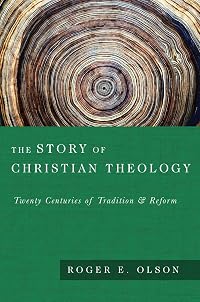
The Story of Christian Theology: Twenty Centuries of Tradition & Reform
by Roger E. Olson
On This Page
Description
"In this panoramic work of historical theology, theologian Roger Olson vividly recounts the deeds and words of the cultists and Apostolic Fathers of the second century, the clash between the monumental theological schools of Alexandria and Antioch, the epochal division between East and West, the revolutionary advent of the Reformation, and much more - right on up to the sometimes dazzling, sometimes dismaying fallout that has continued to shake Christians through the twentieth century. show more Through it all Olson detects and traces a common thread: a concern for salvation, God's redemptive activity in forgiving and transforming sinful human beings."--Jacket. show lessTags
Recommendations

Member Reviews
基督教神学思想史讲述的是上帝的救恩故事,这个故事充满了跌宕起伏的情节、趣味盎然的人物和激动人心的观念。奥尔森将两千年的神学思想史生动地呈现在读者的面前,在神学思想史领域立下了一块丰碑。该书荣获《今日基督教》杂志“2000年度好书奖”、2000年美国基督教出版联盟“神学图书金奖”、《基督教历史》杂志“基督教历史类好书奖”,成为历史神学的通用教材。
As in all the books I've read so far by Olson, he is consistently precise while at the same time concise and clear. This book maintains that consistency and offers readers interested in the story of how we attained to our present and varied theological systems. He doesn't waste words or jumble around his take on history. The line of the development of Christian theology is easy to follow amid it's own tangles. This book maintains that consistency and offers readers an interesting story of how we attained to our present and varied theological systems.
In his introduction, Olson lays out an interesting fact that I have never even realized were he reminds us that, "What people in North America today call ethnic minorities were well show more represented in the early church and its theology...Anthanasius, for example, was known to his contemporaries without insult as 'the black dark' due to his stature and skin color. He was African, as were many other great thinkers in the early church. Many others were Semitic - of Arabic or Jewish ancestry and ethnic identity...most formative and influential thinkers of early Christianity - both heretical and orthodox - lived and worked in Egypt and other parts ofNorth Africa. They certainly could not rightly be considered 'dead white males'!" (p.19).
Olson begins by lining up the "troublers of Apostolic Christianity in the second century"; that is, the heretical notions that prompted the Church Fathers to provide a theological understanding of the Christian faith that would dispel erroneous notion of God, Christ, and salvation. He continues on with the story up to the present time (at least, until 1999 when the book was published) noting the historical development of Christian theology, the divisions and schisms it produced by competing theologies, and the main players, along with a few minor notables, whose influence continues to affect how we view the Christian faith today.
What I found helpful was that there were some Christians and lines of thought that I hardly knew about or had an erroneous notion of, e.g. the Pietists, of whom I've heard very little about and had no exposure. Reading Olson's book brought to light a better understanding of not only their theology but also its influence in Christian thought today, which gives me a better grasp of where others are coming from who think a bit differently and, at the same time, also helps to see where our similarities lie.
This is a read that not only helps me understand how we got to where we are today in Christian theology, but also helps me to identify and understand the influences of what and why I think theology the way I do. show less
In his introduction, Olson lays out an interesting fact that I have never even realized were he reminds us that, "What people in North America today call ethnic minorities were well show more represented in the early church and its theology...Anthanasius, for example, was known to his contemporaries without insult as 'the black dark' due to his stature and skin color. He was African, as were many other great thinkers in the early church. Many others were Semitic - of Arabic or Jewish ancestry and ethnic identity...most formative and influential thinkers of early Christianity - both heretical and orthodox - lived and worked in Egypt and other parts ofNorth Africa. They certainly could not rightly be considered 'dead white males'!" (p.19).
Olson begins by lining up the "troublers of Apostolic Christianity in the second century"; that is, the heretical notions that prompted the Church Fathers to provide a theological understanding of the Christian faith that would dispel erroneous notion of God, Christ, and salvation. He continues on with the story up to the present time (at least, until 1999 when the book was published) noting the historical development of Christian theology, the divisions and schisms it produced by competing theologies, and the main players, along with a few minor notables, whose influence continues to affect how we view the Christian faith today.
What I found helpful was that there were some Christians and lines of thought that I hardly knew about or had an erroneous notion of, e.g. the Pietists, of whom I've heard very little about and had no exposure. Reading Olson's book brought to light a better understanding of not only their theology but also its influence in Christian thought today, which gives me a better grasp of where others are coming from who think a bit differently and, at the same time, also helps to see where our similarities lie.
This is a read that not only helps me understand how we got to where we are today in Christian theology, but also helps me to identify and understand the influences of what and why I think theology the way I do. show less
At first glance this appears to be a balanced and well written history of the development of Christian Theology. Unfortunately like most written histories of christian doctrine it is written entirely from
a western point of view with very little coverage of the the east. In fact the east is forgotten after 6th or 7th century. if you are looking
for the history of christian doctrine go to Pelikan, McGrath, or Gonzalez.
a western point of view with very little coverage of the the east. In fact the east is forgotten after 6th or 7th century. if you are looking
for the history of christian doctrine go to Pelikan, McGrath, or Gonzalez.
In his book, poised to become a standard historical theology textbook, Roger Olson takes us on a journey of events ranging from the apostolic fathers to the Reformation to the present.
Doctrinal Theology
Includes bibliographical references (p. [615]-641) and indexes.
Ratings
Members
- Recently Added By
Author Information

49+ Works 3,988 Members
Roger E. Olson (PhD, Rice University) is emeritus professor of Christian theology at Baylor University's Truett Theological Seminary. He is the author of many books, including Questions to All Your Answers; Reformed and Always Reforming; How to Be Evanqelical without Being Conservative; and Aqainst Calvinism.
Awards and Honors
Common Knowledge
- Original publication date
- 1999
Classifications
Statistics
- Members
- 857
- Popularity
- 31,840
- Reviews
- 6
- Rating
- (4.13)
- Languages
- Chinese, English
- Media
- Paper, Ebook
- ISBNs
- 4
- ASINs
- 1