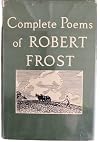
Complete Poems of Robert Frost
by Robert Frost
On This Page
Description
Time out -- Time out; To a moth seen in winter; A considerable speck (microscopic); The lost follower; November; The rabbit hunter; A loose mountain (telescopic); It is almost the year two thousand -- Quantula -- In a poem; On our sympathy with the under dog; A question; Boeotian; The secret sits; An equalizer; A semi-revolution; Assurance; An answer -- Over back -- Trespass; A nature note; Of the stones of the place; Not of school age; A serious step lightly taken; The literate farmer and show more the planet Venus -- Steeple bush -- A young birch; Something for hope; One step backward taken; Directive; Too anxious for rivers; An unstamped letter in our rural letter box; To an ancient -- Five nocturnes -- The night light; Were I in trouble; Bravado; On making certain anything has happened; In the long night -- A spire and belfry --A mood apart; The fear of God; The fear of man; A steeple on the house; Innate helium; The courage to be new; Iota subscript -- Out and away -- The middleness of the road; Astrometaphysical; Skeptic; Two leading lights; A Rogers group; On being idolized; A wish to comply; A cliff dwelling; It bids pretty fair; Beyond words; A case for Jefferson; Lucretius versus the lake poets -- Editorials -- Haec fabula docet; Etherealizing; Why wait for science; Any size we please; An importer; The planners; No holy wars for them; Bursting rapture; U.S. 1946 King's X; The ingenuities of debt; The broken drought; To the right person -- An afterword -- Take something like a star; Closed for good; From plane to plane -- A masque of reason -- A masque of reason -- A mask of mercy -- A mask of mercy; Index of first lines; Index of titles. show lessTags
Recommendations



















Member Reviews
Spent my morning with these trying to find RF's critical assessment of fame, how his neighbors come last to recognize him. Turns out, it's not in the Complete, since he was elected Poet Laureate of Vermont (where he'd moved from N.H. forty years before) in 1961, at age 85. Year after he recited from memory at JFK's Inauguration. Wryly, Frost responds "On Being Chosen Poet of Vermont," "Breathes there a bard who isn't moved/ When he finds his verse is understood…By his country and his neighborhood." And that IS the order, friends: The Country will recognize you before your neighbors do, especially yankees, mebbe.
I found this stunning, despite almost five decades of familiarity, many of them teaching certain poems like "Home Burial" and show more "A Servant to Servants," and of course property feeling in "Stopping by Woods", as well as the role of Edward Thomas and England in the universally misunderstood and admired "Road not Taken," with the most famous aposiopesis in English and American lit, "and I--/ …I took…."
My perusal this morning suggested I had neglected a dozen bird poems I should have noted in my "Birdtalk", like "Never again would Birds' Sounds be the Same," "Directive" about the Phoebes weeping to those not versed in country things, "Minor Bird" possibly about Titmouses or Phoebes, and others. Then, for this Amtrak rider, Boston to Colorado six times, some poems start from trains, "A Passing Glimpse," "Figure in the Doorway," and "On the Heart's Beginning to Cloud the Mind."(One, a train in Utah.) And several on wells, from the prolog "Pasture" to "For Once, then, Something." And even old shoes, "A Record Stride."
Above these subjects looms the writer's flexible, ironic, undercutting voice and tone, still uncommon in American poetry, so often elevated, sublime, the "I" growing as s/he speaks.
And may I say, as a lifelong "liberal," community college teacher, supporter of the American Dream and fulfillment thereof, I was amused at RF's parodic political satire mostly from the R--Rep or Right. His "Departmental" could be a satire on Hillary anthill: "Death's come to Jerry McCormick,/ Our selfless forager Jerry" (372); as could "A Roadside Stand" be a satire on my whole political and professional life, "Where they won't have to think for themselves anymore;/ While greedy good-doers, beneficent beasts of prey,/ Swarm over their lives enforcing benefits/ That are calculated to soothe them out of their wits…"(370).
Frost famously conflicted with the Amherst College liberal President Meiklejohn, whose policies RF termed at the time, "Micklejaundice." But later in life, Frost conceded, "Meiklejohn was right."
Well…I find Frost's poetry filled with nuggets, turns of phrase, sometimes parodic turns, and especially quick changes in tone--rare in any but cummings and Dickinson, who lived down the street from where Frost taught in 1919, and whose life overlapped his by eleven years. Bill Pritchard's literary biography is unsurpassed as a poetic reading, and it contains a photo of Frost regaling my two great, witty Amherst College teachers, Baird (Shakespeare) and Craig (In Freshman Comp, he asked my class, staring out the window, if any of us saw drumlins out there? No-one did. Craig, "You can't see them if you don't know the word." See RF, "Drumlin Woodcock.") and Craig's upperclass Seminar on Dickens and James). Both Baird and Craig endorsed my senior honors thesis on Renaissance prosody and tone, directed by the learned and witty Richard Cody.
I rejoice in having had such teachers, but I do wonder at all that I have missed through decades of familiarity. As Baird once wrote me of my grad subject, Andrew Marvell, his "To His Coy Mistress' is much better than familiarity suggests. I would say, this goes for most of Frost--though may I add, his neighbor down the street, of another gender, surpasses him…and all but one or two poets. But both ED and RF expand our New England dialect vocabulary, like "aftermath" for the second mowing. show less
I found this stunning, despite almost five decades of familiarity, many of them teaching certain poems like "Home Burial" and show more "A Servant to Servants," and of course property feeling in "Stopping by Woods", as well as the role of Edward Thomas and England in the universally misunderstood and admired "Road not Taken," with the most famous aposiopesis in English and American lit, "and I--/ …I took…."
My perusal this morning suggested I had neglected a dozen bird poems I should have noted in my "Birdtalk", like "Never again would Birds' Sounds be the Same," "Directive" about the Phoebes weeping to those not versed in country things, "Minor Bird" possibly about Titmouses or Phoebes, and others. Then, for this Amtrak rider, Boston to Colorado six times, some poems start from trains, "A Passing Glimpse," "Figure in the Doorway," and "On the Heart's Beginning to Cloud the Mind."(One, a train in Utah.) And several on wells, from the prolog "Pasture" to "For Once, then, Something." And even old shoes, "A Record Stride."
Above these subjects looms the writer's flexible, ironic, undercutting voice and tone, still uncommon in American poetry, so often elevated, sublime, the "I" growing as s/he speaks.
And may I say, as a lifelong "liberal," community college teacher, supporter of the American Dream and fulfillment thereof, I was amused at RF's parodic political satire mostly from the R--Rep or Right. His "Departmental" could be a satire on Hillary anthill: "Death's come to Jerry McCormick,/ Our selfless forager Jerry" (372); as could "A Roadside Stand" be a satire on my whole political and professional life, "Where they won't have to think for themselves anymore;/ While greedy good-doers, beneficent beasts of prey,/ Swarm over their lives enforcing benefits/ That are calculated to soothe them out of their wits…"(370).
Frost famously conflicted with the Amherst College liberal President Meiklejohn, whose policies RF termed at the time, "Micklejaundice." But later in life, Frost conceded, "Meiklejohn was right."
Well…I find Frost's poetry filled with nuggets, turns of phrase, sometimes parodic turns, and especially quick changes in tone--rare in any but cummings and Dickinson, who lived down the street from where Frost taught in 1919, and whose life overlapped his by eleven years. Bill Pritchard's literary biography is unsurpassed as a poetic reading, and it contains a photo of Frost regaling my two great, witty Amherst College teachers, Baird (Shakespeare) and Craig (In Freshman Comp, he asked my class, staring out the window, if any of us saw drumlins out there? No-one did. Craig, "You can't see them if you don't know the word." See RF, "Drumlin Woodcock.") and Craig's upperclass Seminar on Dickens and James). Both Baird and Craig endorsed my senior honors thesis on Renaissance prosody and tone, directed by the learned and witty Richard Cody.
I rejoice in having had such teachers, but I do wonder at all that I have missed through decades of familiarity. As Baird once wrote me of my grad subject, Andrew Marvell, his "To His Coy Mistress' is much better than familiarity suggests. I would say, this goes for most of Frost--though may I add, his neighbor down the street, of another gender, surpasses him…and all but one or two poets. But both ED and RF expand our New England dialect vocabulary, like "aftermath" for the second mowing. show less
Master poet. The art of seeming to tell a simple homespun story on one level and speaking to much deeper issues at the same time is an incredible gift. In his later years the poetry flagged in volume and quality, but there are still gems in the last of his work.
Book Description: New York/Chicago/San Francisco: Holt, Rinehart and Winston, 1964. Cloth. Fine/No Jacket. 17th Printing. Private Use. 8vo - over 7¾" - 9¾" tall. 666pp.
INDEX OF FIRST LINES; INDEX OF TITLES; FRONTISPIECE
Ratings
Members
- Recently Added By
Lists

Poetry Corner
187 works; 15 members

.
396 works; 1 member
Author Information

292+ Works 26,571 Members
Robert Frost, the quintessential poet of New England, was born in San Francisco in 1874. He was educated at Dartmouth College and Harvard University. Although he managed to support himself working solely as a poet for most of his life and holding various posts with a number of universities, as a young man he was employed as a bobbin boy in a mill, show more a cobbler, a schoolteacher, and a farmer. Frost, whose poetry focuses on natural images of New England, received the Pulitzer Prize for Poetry four times for: New Hampshire, Collected Poems, A Further Range, and A Witness Tree. His works are noted for combining characteristics of both romanticism and modernism. He also wrote A Boy's Will, North of Boston, Mountain Interval, and The Gift Outright, among others. Frost married Elinor Miriam White in 1895, and they had six children--Elliott, Lesley, Carol, Irma, Marjorie, and Elinor Bettina. He died in Boston in 1963. (Bowker Author Biography) show less
Awards and Honors
Distinctions
Work Relationships
Is abridged in
Common Knowledge
- Original publication date
- 1949
- First words
- Abstraction is an old story with the philosophers, but it has been like a new toy in the hands of the artists of our day.
Classifications
Statistics
- Members
- 728
- Popularity
- 38,894
- Reviews
- 5
- Rating
- (4.22)
- Languages
- English
- Media
- Paper, Ebook
- ISBNs
- 7
- ASINs
- 36