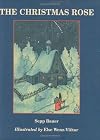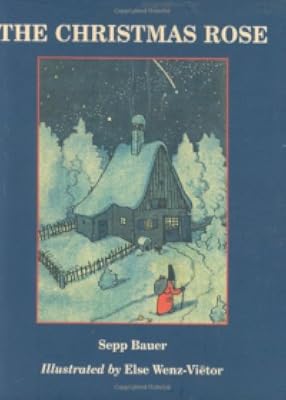
The Christmas Rose
by Sepp Bauer
On This Page
Description
With the aid of Saint Nikolaus and some helpful animals, the children of a poor, sick woodsman travel to the frozen north to get the one thing that will cure their father in time for Christmas.Tags
Recommendations





Member Reviews
Originally published as an advent calendar in the early 1920s, this charming holiday tale - illustrated by Else Wenz-Viëtor, one of Germany's most celebrated picture-book artists from the 1920s and 1930s - was largely forgotten for many decades, until it was rediscovered in a Swiss antiquarian bookseller's shop in 2006. It has now been recreated as a picture-book, both in the original German (Die Christrose - ein Weihnachtsmärchen), and in this new English translation. It's odd to think that, despite its long history, it is as "new" to most German readers, as to their English-language counterparts!
The story of Fritz and Gretl, the children of a poor woodcutter, who set out to find the Winter King's palace in the far north, and bring show more back one of his white Christmas roses, in order to cure their desperately ill father, The Christmas Rose reminds me a bit of Hans Christian Andersen's classic fairy-tale, The Snow Queen. Of course, Fritz and Gretl's quest - in which they are aided by everything from a squirrel to a polar bear, not to mention Saint Nikolaus - doesn't end at the Winter King's palace, as Gerda's does at the Snow Queen's, but continues on to the gates of Heaven itself, where they meet the Christ Child.
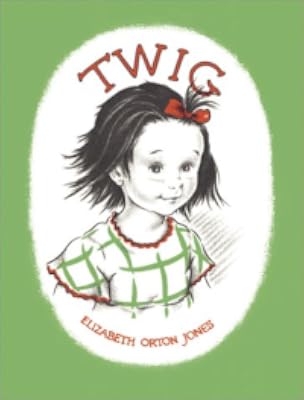
Although Sepp Bauer's story doesn't have the same power as Andersen's, it was still an enjoyable read, and the similarity between the two was pronounced enough that I found myself wondering whether Bauer had modeled his work upon the famous Danish fabulist's masterpiece. In any case, I think that young readers who enjoy magical holiday tales, or who are interested in German Christmas traditions - Saint Nikolaus visits the children on December 6th in this story - will want to take a look at The Christmas Rose. The illustrations have a sweet, old-fashioned charm - the angels reminded me of Elizabeth Orton Jones' work, in books like What Miranda Knew - that will only add to the appeal of this little book! show less
The story of Fritz and Gretl, the children of a poor woodcutter, who set out to find the Winter King's palace in the far north, and bring show more back one of his white Christmas roses, in order to cure their desperately ill father, The Christmas Rose reminds me a bit of Hans Christian Andersen's classic fairy-tale, The Snow Queen. Of course, Fritz and Gretl's quest - in which they are aided by everything from a squirrel to a polar bear, not to mention Saint Nikolaus - doesn't end at the Winter King's palace, as Gerda's does at the Snow Queen's, but continues on to the gates of Heaven itself, where they meet the Christ Child.
Although Sepp Bauer's story doesn't have the same power as Andersen's, it was still an enjoyable read, and the similarity between the two was pronounced enough that I found myself wondering whether Bauer had modeled his work upon the famous Danish fabulist's masterpiece. In any case, I think that young readers who enjoy magical holiday tales, or who are interested in German Christmas traditions - Saint Nikolaus visits the children on December 6th in this story - will want to take a look at The Christmas Rose. The illustrations have a sweet, old-fashioned charm - the angels reminded me of Elizabeth Orton Jones' work, in books like What Miranda Knew - that will only add to the appeal of this little book! show less
This wonderful book begins on December 6th, Saint Nicholas Day, and continues through to Christmas Eve. Created in 1920 as an advent calendar, the pictures by Else Wenz-Vietor bring back the simpler days of wide-eyed child adventures. There are polar bears, a snow giant, and the goose who flies the children to see the Winter King. The Winter King! He was Father Christmas when I was a child.
Saint Nicholas Day is the big winter holiday in my family, where we place our wooden clogs outside (I put old Belgian francs in mine in case Nicholas doesn't use Euros), hoping for chocolates and gingerbread men in return. Seven days later, on December 13th, we celebrate Santa Lucia Day with lemon meringue pies, buttery marble cakes, and hot pecan show more rolls. By the time December 25th rolls around, none of us can fit through a door.
This book brings together the origins of the Santa Claus legend (St. Nick) with the Christ Child portion of Christmas. Each day has its own adventure with a featured creature (Crookshanks the Hare!) and the reader will feel like a youngster again. Some of us never grow up.
Book Season = Winter (time to eat) show less
Saint Nicholas Day is the big winter holiday in my family, where we place our wooden clogs outside (I put old Belgian francs in mine in case Nicholas doesn't use Euros), hoping for chocolates and gingerbread men in return. Seven days later, on December 13th, we celebrate Santa Lucia Day with lemon meringue pies, buttery marble cakes, and hot pecan show more rolls. By the time December 25th rolls around, none of us can fit through a door.
This book brings together the origins of the Santa Claus legend (St. Nick) with the Christ Child portion of Christmas. Each day has its own adventure with a featured creature (Crookshanks the Hare!) and the reader will feel like a youngster again. Some of us never grow up.
Book Season = Winter (time to eat) show less
Ratings
Members
- Recently Added By
Lists

A Child's Book Tour of Germany
76 works; 5 members
Author Information
3 Works 45 Members
All Editions
Some Editions
Common Knowledge
- Important places
- Germany
Classifications
Statistics
- Members
- 43
- Popularity
- 689,339
- Reviews
- 2
- Rating
- (4.33)
- Languages
- English, German
- Media
- Paper
- ISBNs
- 3