On This Page
Description
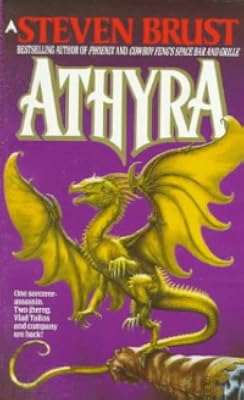
Steven Brust is the author of numerous fantasy novels, including Jhereg, Yendi, Teckla, and Orca. He lives in Minneapolis.Tags
Recommendations













Member Reviews
9/10
This book had a decidedly different feel to it than the earlier books in the Vlad Taltos, possibly because Vlad is not the narrator and the story although told in third person, is from the viewpoint of Savn, a rural youth. And that's the other main difference--no city of Adrilankha, no friends and colleagues. No voice of Loiosh--in fact, the sections written from the jhereg's perspective are all from Loiosh's mate, Rocza. So there is far less sardonic humor and far more introspection and struggle to understand by a maturing Savn who is confronted by things outside his experience. But this is an engrossing and satisfying tale, and it is not only Savn who has to wrestle with decisions and consequences.
This book had a decidedly different feel to it than the earlier books in the Vlad Taltos, possibly because Vlad is not the narrator and the story although told in third person, is from the viewpoint of Savn, a rural youth. And that's the other main difference--no city of Adrilankha, no friends and colleagues. No voice of Loiosh--in fact, the sections written from the jhereg's perspective are all from Loiosh's mate, Rocza. So there is far less sardonic humor and far more introspection and struggle to understand by a maturing Savn who is confronted by things outside his experience. But this is an engrossing and satisfying tale, and it is not only Savn who has to wrestle with decisions and consequences.
I was expecting that Athyra would be a book I just had to get through to reach the rest of the series on the other side. I was not expecting to like it so much.
(I'm not sure now of all the reasons I was so reluctant to read this. I certainly wasn't enthusiastic about a third-person narrative, from the perspective of a new character - half the appeal of these books is Vlad's first-person narration, and if you lose that, you also lose his sense of humour and his psionic conversation with his Jhereg familiar, Loiosh. And because Vlad had to leave the city of Adrilankha at the end of Phoenix, the chances of many, if any, of his friends turning up in Athyra, were remote. Possibly I'd also read a less-than-glowing review or two.)
Athyra is show more about Savn, a young Teckla (young by Dragearan standards, not human ones) who finds himself at odds with his community after he helps an outsider (Vlad). It's a really solid coming-of-age story, and focusing on Savn rather than Vlad makes a lot of sense - Savn is more of an active player, especially after Vlad is injured.
There's an interesting tension, too, in realising that what is best for Vlad is not necessarily what is best for Savn - and wanting what is best for both of them, simultaneously.
The ending of Athyra is a punch in the gut that I did not see coming… and it meant I had to read Orca immediately.
Why am I doing this? he wondered, and the answer came as quickly as he’d formed the question.
If he ignored Vlad, he’d never learn anything more, and what he’d learned felt like a door that had opened just enough to let him see that on the other side was a place he desperately wanted to visit, maybe even to live. And he knew he would always berate himself for cowardice if he let himself be driven away from the Easterner. show less
(I'm not sure now of all the reasons I was so reluctant to read this. I certainly wasn't enthusiastic about a third-person narrative, from the perspective of a new character - half the appeal of these books is Vlad's first-person narration, and if you lose that, you also lose his sense of humour and his psionic conversation with his Jhereg familiar, Loiosh. And because Vlad had to leave the city of Adrilankha at the end of Phoenix, the chances of many, if any, of his friends turning up in Athyra, were remote. Possibly I'd also read a less-than-glowing review or two.)
Athyra is show more about Savn, a young Teckla (young by Dragearan standards, not human ones) who finds himself at odds with his community after he helps an outsider (Vlad). It's a really solid coming-of-age story, and focusing on Savn rather than Vlad makes a lot of sense - Savn is more of an active player, especially after Vlad is injured.
There's an interesting tension, too, in realising that what is best for Vlad is not necessarily what is best for Savn - and wanting what is best for both of them, simultaneously.
The ending of Athyra is a punch in the gut that I did not see coming… and it meant I had to read Orca immediately.
Why am I doing this? he wondered, and the answer came as quickly as he’d formed the question.
If he ignored Vlad, he’d never learn anything more, and what he’d learned felt like a door that had opened just enough to let him see that on the other side was a place he desperately wanted to visit, maybe even to live. And he knew he would always berate himself for cowardice if he let himself be driven away from the Easterner. show less
I'm doing a re-read of all the novels in Steven Brust's Dragaeran Universe. This one so far is the most different of the books featuring Vlad Taltos. Written more of an actual fantasy novel, and in the point of view of a young Teckla, Sven, we see Vlad in a completely different light - a man of a different species, full of mystery and wonder, with an odd sense of honor that isn't quite trustworthy.
This is also the most heartbreaking of the novels. I'm not going to ruin the ending, but its the first book in this series where the horrors of the death and violence affected me personally.
This is also the most heartbreaking of the novels. I'm not going to ruin the ending, but its the first book in this series where the horrors of the death and violence affected me personally.
Now, that was a switch. The first five Vlad books were all told in the first person, from Vlad's own perspective. This one turns the series on its head by flipping to a third person account. What's more, it's using the point-of-view of a young Draegaran peasant boy.
We get to see Vlad Taltos as another sees him, as Savn becomes the central character. Vlad has wandered into his village, and strange things start occurring. While others think this strange "Easterner" is to blame, Savn isn't so sure. He's drawn to Vlad and is pulled towards a life outside the village.
It has elements of being the fantasy coming of age story, but this particular novel is more about Savn learning how to question things that he and his family have always show more assumed to be true. Vlad teaches him not to doubt, necessarily, but to not take everything at face value.
Vlad Taltos fans should really enjoy the flipped perspective. A nice added touch is end of chapter "thoughts" from the point of view of Rocza, the jhereg mate of Vlad's familiar, Loiosh. show less
We get to see Vlad Taltos as another sees him, as Savn becomes the central character. Vlad has wandered into his village, and strange things start occurring. While others think this strange "Easterner" is to blame, Savn isn't so sure. He's drawn to Vlad and is pulled towards a life outside the village.
It has elements of being the fantasy coming of age story, but this particular novel is more about Savn learning how to question things that he and his family have always show more assumed to be true. Vlad teaches him not to doubt, necessarily, but to not take everything at face value.
Vlad Taltos fans should really enjoy the flipped perspective. A nice added touch is end of chapter "thoughts" from the point of view of Rocza, the jhereg mate of Vlad's familiar, Loiosh. show less
This seems to be the Vlad Taltos book that many readers have trouble absorbing, since it is so very unlike the other books in the series. Written in the third person and entirely from the perspective of Savn, a young Dragaeran of the House of the Teckla, this is our first chance to see Vlad more or less as other characters in his world may see him. Whereas the other novels have all been filtered through Vlad's own consciousness, here the narrator can't make the sort of excuses or justifications for Vlad's actions that all of us make when we tell our own stories. The book deals with many themes, among them the way in which our actions now can shape what happens to us later in ways we don't expect. One of the ripples from something Vlad show more did years ago has spread forward to the present, and has become large enough to drown him unless he's lucky. Brust also gives us a look at the effects of Vlad's actions on other people, especially on innocent bystanders whose lives are forever altered simply because Vlad was where he was and did what he did. The picture isn't pretty, even though this is easily Vlad's most heroic action to this point in the series: this is one assassination that really does need to happen, that does remove a genuine menace and not just a Jhereg who's inconveniencing other Jheregs. As well as writing a damned fine story, Brust seems to be using this novel to make the point that all heroism is more or less tragic. For Savn, and for Vlad, the results are real, and they are painful, and they can't ever be made wholly right. A writer whose character is faced with this understanding must either allow that character to grow and become more fully realized, or make him reject the knowledge and become a puppet figure for the author to pose as he wishes. By the end of the novel, Brust's choice for Vlad is clear. show less
Book 6 in the Vlad Taltos series. For some reason, this book did not stick with me at all, which means it is one of the two or three in the middle of this series that get very philosophical, and sort of depressing, as Vlad loses his way a bit, and many of his friends, and spends a lot of time on the run away from Adrilankha. Its still a Vlad novel, but a sad, lack of action sort of Vlad.
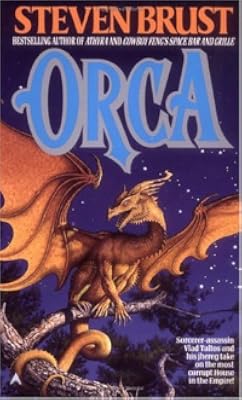
Vlad Taltos--sorceror, sometimes witch, and former assassin--and his faithful jhereg take on the biggest hitters of the House of the Jhereg.
Written from the eyes of a Teckla peasant, this is the first story following Vlad after he escapes Adrilankha. Getting an outside view of Vlad is interesting. It brought back one of the older villians, too, so despite the fact that everything is different, there's still the thread coming from the previous books. I didn't enjoy it as much as I did the first books - the dialogue/themes are less light, and since we're just getting the interpretation of someone who isn't too experienced with the assassin's art, there's a lot of the book that feels somewhat muddled. Better on the reread. 6/10
Written from the eyes of a Teckla peasant, this is the first story following Vlad after he escapes Adrilankha. Getting an outside view of Vlad is interesting. It brought back one of the older villians, too, so despite the fact that everything is different, there's still the thread coming from the previous books. I didn't enjoy it as much as I did the first books - the dialogue/themes are less light, and since we're just getting the interpretation of someone who isn't too experienced with the assassin's art, there's a lot of the book that feels somewhat muddled. Better on the reread. 6/10
Members
- Recently Added By
Lists

What Makes This Book So Great
102 works; 16 members
Author Information

Steven Karl Zoltan Brust is a writer and musician. He was born on November 23, 1955. Brust has worked as a systems programmer for a computer company and played guitar, drums, and banjo in such bands as Cats Laughing, Morrigan, and Boiled in Lead. Brust writes science fiction, including the Vlad Taltos series, The Pheonix Guards, 500 Years After, show more and Brokedown Palace. He has written "choose-your-own-adventure" books for Tor and published several short stories in a series. Brust also released a solo album, A Rose for Iconoclastes, on the SteelDragon label. (Bowker Author Biography) show less
Some Editions
Series


Work Relationships
Common Knowledge
- Canonical title
- Athyra
- Original publication date
- 1993-04
- People/Characters
- Vlad Taltos; Savn; Reins; Loraan; Loiosh; Rocza (show all 7); Ishtvan
- Dedication
- For Martin, and it's about time
- First words
- PROLOGUE
Woman, girl, man, and boy sat together, like good companions, around a fire in the woods.
Chapter One
Sayn was the first one to see him, and, come to that, the first to see the Harbingers, as well. - Last words
- (Click to show. Warning: May contain spoilers.)The girl said nothing, but held onto Sara's hand, tightly.
Classifications
Statistics
- Members
- 1,148
- Popularity
- 21,962
- Reviews
- 19
- Rating
- (3.68)
- Languages
- English, German, Turkish
- Media
- Paper, Audiobook
- ISBNs
- 4
- ASINs
- 1