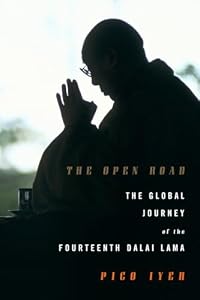
The Open Road: The Global Journey of the Fourteenth Dalai Lama
by Pico Iyer
On This Page
Description
This book is the first serious consideration of the Fourteenth Dalai Lama's work and ideas as a politician, scientist, and philosopher. Author Iyer has been engaged in conversation with the Dalai Lama (a friend of his father's) for three decades--an ongoing exploration of his message and its effectiveness. Now, Iyer captures the paradoxes of the Dalai Lama's position: though he has brought the ideas of Tibet to world attention, Tibet itself is being remade as a Chinese province; though he show more was born in one of the remotest, least developed places on earth, he has become a champion of globalism and technology. He is a religious leader who warns against being distracted by religion; a Tibetan head of state who suggests that exile from Tibet can be an opportunity; an incarnation of a Tibetan god who stresses his humanity. Iyer illuminates the hidden life, the transforming ideas, and the daily challenges of a global icon.--From publisher description. show lessTags
Recommendations









Member Reviews
Excellent anecdotal recounting of the author's travels with the Dalai Lama. One gets a sense for what kind of man he is and the challenges he faces. As a leader he is expected to champion freedom, as a monk he advocates patience. This is a balanced and intimate portrait.
Wonderfully informative book on the 14th Dalai Lama, the man and his beliefs, viewed alongside other explorers and ideas in history and in contemporary society. First meeting the Dalai Lama when quite young, Iyer offers us a close-up view of the Dalai Lama's life, touching on his life history as most books on the Dalai Lama do, but more on what's helped the Dalai Lama form his viewpoints and beliefs through the years on a wide range of topics, besides religion and spirituality, and why such b... (show more)The Dalai Lama's ideas and beliefs are also brought into the spotlight through the voices of others Iyer meets and knows in the Tibetan community -- like other residents of Dharamsala, Tibet's homeland in exile in northern India, show more close aides, and members of the Dalai Lama's family -- some of whom believe differently on how Tibetan culture can be (or should be) preserved without a true homeland. Explored in three main sections -- In Public, In Private, and In Practice -- Iyer brings us a view of the Dalai Lama few possibly could, sharing with us a personal yet global journey in learning to understand the essence of the man and Buddhism itself, in Iyer's words... whose "open road speaks for a perpetual becoming."Originally written on Nov 08, 2009 at 03:14AM show less
The author, having been introduced to the Dalai Lama as a teeneger, is compelled to maintain the relationship and the book tells of their encounters for the next thirty years. He delved in to many aspects of Buddhism but does not aim to give us a blow by blow account of the philosophy behind them but instead reminds us of the humanity of the Dalai Lama. He splits the book into the different aspects of the mantle that the Tibetan leader must be able to wear; philosopher, monk, globalist, politician. But in each case we see how the Dalai Lama changes the tenor of his message while maintaining the same fundamentals; heal yourself, be compassionate, practise. Well worth a read. Stimulating.
The author, Pico Iyer, has known the Dalia Lama since childhood, as Iyer's father was a friend of the Dalai Lama's. Iyer has seen him in formal settings and infomral, in his exile home of Dharamsala, and at functions around the world. That makes the book an excellent picture of the man who is considered a God by his countrymen. It is not just a picture of the man, but of Buddhism, and of Dharamsala, of the Tibetan exiles and small bits about those still in Tibet.
Most of all, it is a picture of a man who has great spiritual reserves tested to the max by the situation he is in. He must look on while his countrymen are tortured and their culture diluted by Chinese immigration into Tibet. He is a man who believes in democracy and keeps show more urging it on the Tibetan exiles, who in turn only want to leave governing all up to him. He is a man of an ancient spiritual discipline who urges others to follow their own traditions but to make space in their lives for the spirit, and yet is also fascinated by modern science and technology.
Fascinating book about a fascinating man. show less
Most of all, it is a picture of a man who has great spiritual reserves tested to the max by the situation he is in. He must look on while his countrymen are tortured and their culture diluted by Chinese immigration into Tibet. He is a man who believes in democracy and keeps show more urging it on the Tibetan exiles, who in turn only want to leave governing all up to him. He is a man of an ancient spiritual discipline who urges others to follow their own traditions but to make space in their lives for the spirit, and yet is also fascinated by modern science and technology.
Fascinating book about a fascinating man. show less
Pico Iyer's journalistic training comes through strongly in this book. The book reads more like a linked-set of NY Times magazine articles rather than a cohesive book with a story to tell.Iyer is also more focused on the tragic political situation in Tibet rather than on Tibetan Buddhism and that shows plainly throughout. This isn't a bad thing but it wasn't what I expected exactly.I also thought that since Iyer and his family have had a long-standing personal relationship with the XIVth Dalai Lama (for the past 40 years) that there would be more personal depth of the Dalai Lama and his character and person. Instead, it seems like a journalist interviewing the Dalai Lama at various intervals and linking the articles together. It doesn't show more read like a biography to me truly.Pet peeve: Iyer refers repeatedly to the XIVth Dalai Lama as "the Tibetan". I would have preferred anything other than that!It was worth reading but not a favorite; on the positive side it has made me interested in reading other books about the Dalai Lama. show less
This book was written in the early 21st century, after the 9/11 attacks and the Iraq War. The author describes the Dalai Lama's role as an ambassador for his Tibet in exile government, as the leader of Tibetan Buddhism, as a monk and as a person. It was interesting to me to learn about the Tibet exiles living in Dharamsala, India, their community there and the disagreements that some Tibetan's have to the Dalai Lama's approach to the Chinese occupation of Tibet. Also, some of the descriptions of the practices of the Tibetan brand of Buddhism were interesting, because I had never studied the subject and I was surprised to learn about some of the more seemingly strange beliefs and rituals.
Pico Iyer met the Dalai Lama when he was just seventeen and spent the next three decades sporadically following and meeting up with the Tibetan leader. Iyer is a fantastic writer, has his thumb on the pulse of world affairs, and is intimately interested in his subject. There could be no better author for this book. I was continuously captivated and learned an lot about the Dalai Lama and Tibetan culture. [ full review ]
Members
- Recently Added By
Author Information

34+ Works 5,306 Members
Pico Iyer was born in Oxford, England to Indian parents, who immigrated to California in 1957. He received a B.A. and M.A. from Oxford University and a second masters degree from Harvard University. From 1982 to 1985, he was a writer for Time magazine. Following a leave of absence to visit Asia, Iyer wrote Video Nights in Katmandu: And Other show more Reports from the Not-So-Far East. In 1986 he returned to Time as a contributor. He also contributes regularly to Conde Nast Traveler magazine. Pico Iyer has written several other travel books including The Lady and the Monk: Four Seasons in Kyoto; Falling Off the Map: Some Lonely Places in the World; and Tropical Classical: Essays from Several Directions. (Bowker Author Biography) show less
Awards and Honors
Distinctions
Common Knowledge
- People/Characters
- Dalai Lama
Classifications
- Genres
- Religion & Spirituality, Nonfiction, Biography & Memoir, General Nonfiction, Travel, Philosophy
- DDC/MDS
- 294.3923092 — Religion Other religions Buddhism/Hinduism Buddhism Buddhism - Branches and schools Mahayana Buddhism Tibetan Buddhism
- LCC
- BQ7935 .B777 .I94 — Philosophy, Psychology and Religion Buddhism Buddhism Modifications, schools, etc. Tibetan Buddhism (Lamaism)
- BISAC
Statistics
- Members
- 456
- Popularity
- 66,683
- Reviews
- 14
- Rating
- (3.78)
- Languages
- 6 — Danish, Dutch, English, French, Italian, Portuguese
- Media
- Paper, Ebook
- ISBNs
- 13
- UPCs
- 1
- ASINs
- 5