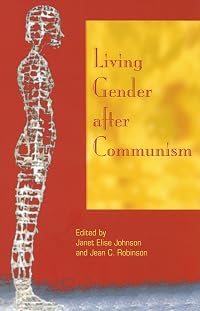
Living Gender after Communism
by Janet Elise Johnson
On This Page
Description
How has the collapse of communism across Europe and Eurasia changed gender? In addition to acknowledging the huge costs that fell heavily on women, Living Gender after Communism suggests that moving away from communism in Europe and Eurasia has provided an opportunity for gender to multiply, from varieties of neo-traditionalism to feminisms, from overt negotiation of femininity to denials of gender. This show more development,in turn, has enabled some women in the region to construct their own gendered ident show lessMembers
- Recently Added By
Author Information
3 Works 14 Members
Janet Elise Johnson is Associate Professor of Political Science and Women's Studies at Brooklyn College, City University of New York, and editor, with Jean C. Robinson, of Living Gender after Communism (Indiana University Press, 2007).
Classifications
- Genres
- Nonfiction, History, Sexuality and Gender Studies, General Nonfiction, Politics and Government
- DDC/MDS
- 305.40947 — Society, government, & culture Social sciences, sociology & anthropology Social group - Age, Gender, Ethnicity Women Standard subdivisions History, geographic treatment, biography Europe Russia and Eastern Europe
- LCC
- HQ1587 .L58 — Social sciences The family. Marriage, Women and Sexuality The Family. Marriage. Women Women. Feminism
- BISAC
Statistics
- Members
- 5
- Popularity
- 3,437,705
- Languages
- English
- Media
- Paper, Ebook
- ISBNs
- 2