
On This Page
Description
Tells magical tales of men who met fairies and elves.Tags
Recommendations




















Member Reviews
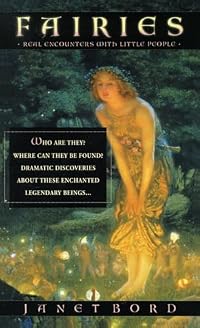
The book includes both actual tales and analysis of how such stories and beliefs arose, which I found interesting. For instance, it says that in the old days when people lacked understanding of how the physical world functions and found it rather chaotic, they tried to organize and control it by naming, classifying, and setting boundaries, both literally, by parceling up land, and more symbolically, by parceling up time into seasons or hours, as well as by dividing people into clans. This probably helped them cope psychologically, but it also apparently made them feel that the “in-between” times and places and newly met, unrelated people were necessarily suspect:
"Mortal time and mortal space were seamed with cracks that served as show more doorways to places where human rules were meaningless.... The streams that marked the territory, the shores of sea, the fords of rivers, the crossroads, the fences, walls and thresholds… being neither one place nor another, served as portals to the world of Faerie.... In Wales it was said that a ghost sat on every stile (sets of steps that allow people to climb over boundary fences....)."
And the times when such places were most dangerous – or alluring, depending on one’s nature – were, of course, the in-between times: dawn and dusk, noon and midnight which marked the middle of day or night, and “nights between the seasons – October 31, or Samhain Eve (later called Allhallows Eve), and April 30, Beltane Eve (later called May Day Eve),” as well as solstices. These were the times when “mortal rules” were believed to be suspended, the boundaries between “mortal” and “spirit” worlds were lifted, and chaos reigned: witches flew on their broomsticks, troops of fairies traveled freely, and the future was revealed.
Furthermore, according to this book, people used to divide the day into 24 hours, 12 of day and 12 of night, but since day and night are rarely of equal length, this meant that in winter an hour during the day could last only 30 minutes, measured by the local church’s bells. Since people then didn’t understand why the length of day and night changes with the seasons, they believed that time itself was far from solid and instead stretched and shrank continually. The authors of this book think that this could give rise to the belief that there could be places where time stops altogether or proceeds at a different rate than elsewhere, so that a person who had spent a day there could come back home and find that a century had passed.
This book also traces the development of the folklore associated with fairies. First, when there weren’t many people in Europe, fairies were believed to be tall, beautiful, accomplished and rich. However, as people spread, multiplied, and cleared away the forests for their fields, fairies were believed to have retreated underground, which – very gradually and over countless generations – led to their size being greatly diminished, till they became miniature. As their fortunes continued to dwindle further, they also lost their beauty and riches – they now had to trick humans into seeing them as glamorous – as well as their fecundity – the stories about changelings come from this time. Since people then didn’t understand the nature of internal diseases, it was easy for them to see illness as “wasting” resulting from an unfortunate encounter with a stranger who was really but a fairy in disguise, and even more unfortunate, if not downright imprudent, exchange of words or – the mother of all imprudences – food and drink with him. Of course, the most frequent victims of sudden illnesses were very small children who didn’t wander around and meet strangers, but who could have been stolen and exchanged for elderly fairies who were glad to be pampered by human mothers in their last days and willingly tricked people into seeing them as infants. What else could explain why the recently healthy child had become as rickety as an old person and seemed on the verge of death way ahead of his or her time? Unfortunately, the common “solutions” to make the fairy leave and get one’s child back often involved making the fairy’s existence as uncomfortable as possible, which could only worsen the poor child’s condition, if not downright kill him or her.
As for the morals of fairies, it seems to have differed a lot from story to story. In some tales recounted in this book, fairies are noble beings who live in an enchanted world in every sense of the word. They come to the help of the undefended, and an encounter with them is a boon for any mortal. In other stories, fairies treat different people according to their deserts. And in still others, they trick all and sundry for their amusement or use them for their purposes. I guess this illustrates the allure and also fear of the unfamiliar – a bit like we think today of sentient extra-terrestrials, if they exist. Then again, who says that fairies should be all of a kind? Perhaps, like people, they can use their powers very differently. All in all, I’ve found this an interesting book. show less
"Mortal time and mortal space were seamed with cracks that served as show more doorways to places where human rules were meaningless.... The streams that marked the territory, the shores of sea, the fords of rivers, the crossroads, the fences, walls and thresholds… being neither one place nor another, served as portals to the world of Faerie.... In Wales it was said that a ghost sat on every stile (sets of steps that allow people to climb over boundary fences....)."
And the times when such places were most dangerous – or alluring, depending on one’s nature – were, of course, the in-between times: dawn and dusk, noon and midnight which marked the middle of day or night, and “nights between the seasons – October 31, or Samhain Eve (later called Allhallows Eve), and April 30, Beltane Eve (later called May Day Eve),” as well as solstices. These were the times when “mortal rules” were believed to be suspended, the boundaries between “mortal” and “spirit” worlds were lifted, and chaos reigned: witches flew on their broomsticks, troops of fairies traveled freely, and the future was revealed.
Furthermore, according to this book, people used to divide the day into 24 hours, 12 of day and 12 of night, but since day and night are rarely of equal length, this meant that in winter an hour during the day could last only 30 minutes, measured by the local church’s bells. Since people then didn’t understand why the length of day and night changes with the seasons, they believed that time itself was far from solid and instead stretched and shrank continually. The authors of this book think that this could give rise to the belief that there could be places where time stops altogether or proceeds at a different rate than elsewhere, so that a person who had spent a day there could come back home and find that a century had passed.
This book also traces the development of the folklore associated with fairies. First, when there weren’t many people in Europe, fairies were believed to be tall, beautiful, accomplished and rich. However, as people spread, multiplied, and cleared away the forests for their fields, fairies were believed to have retreated underground, which – very gradually and over countless generations – led to their size being greatly diminished, till they became miniature. As their fortunes continued to dwindle further, they also lost their beauty and riches – they now had to trick humans into seeing them as glamorous – as well as their fecundity – the stories about changelings come from this time. Since people then didn’t understand the nature of internal diseases, it was easy for them to see illness as “wasting” resulting from an unfortunate encounter with a stranger who was really but a fairy in disguise, and even more unfortunate, if not downright imprudent, exchange of words or – the mother of all imprudences – food and drink with him. Of course, the most frequent victims of sudden illnesses were very small children who didn’t wander around and meet strangers, but who could have been stolen and exchanged for elderly fairies who were glad to be pampered by human mothers in their last days and willingly tricked people into seeing them as infants. What else could explain why the recently healthy child had become as rickety as an old person and seemed on the verge of death way ahead of his or her time? Unfortunately, the common “solutions” to make the fairy leave and get one’s child back often involved making the fairy’s existence as uncomfortable as possible, which could only worsen the poor child’s condition, if not downright kill him or her.
As for the morals of fairies, it seems to have differed a lot from story to story. In some tales recounted in this book, fairies are noble beings who live in an enchanted world in every sense of the word. They come to the help of the undefended, and an encounter with them is a boon for any mortal. In other stories, fairies treat different people according to their deserts. And in still others, they trick all and sundry for their amusement or use them for their purposes. I guess this illustrates the allure and also fear of the unfamiliar – a bit like we think today of sentient extra-terrestrials, if they exist. Then again, who says that fairies should be all of a kind? Perhaps, like people, they can use their powers very differently. All in all, I’ve found this an interesting book. show less
These type books are undoubtedly interesting, but I have always found the format used a bit distracting the way the boxed excerpts interfere with the chapter being read. One must finish reading the chapter before going back to read what is in the boxes, or read through those sections first & then go back to the beginning to read the chapter in full.
This is a wonderful series, beautifully illustrated, and selections fitting the subtitle. A Bibliography, Picture Credits, and Acknowledgements appear at the end of each book. There are far too many to enter singularly.
This book has 4 chapters with appropriate tales:
Chapter One: Lands Behind Enchantment's Veil
Chapter Two: Guardians of Field and Forest
Chapter Three: Of Fairy Raids and Mortal Missteps
Chapter Four: The Heart's Far-Carrying Call
This book has 4 chapters with appropriate tales:
Chapter One: Lands Behind Enchantment's Veil
Chapter Two: Guardians of Field and Forest
Chapter Three: Of Fairy Raids and Mortal Missteps
Chapter Four: The Heart's Far-Carrying Call
Ratings
Members
- Recently Added By
Author Information

31+ Works 6,924 Members
Colin Thubron is the prizewinning, bestselling author of several travel books.
Series

Common Knowledge
- Canonical title*
- Verzauberte Welten: Feen und Elfen
- Original publication date
- 1984
- First words
- On a Midsummer Eve in Ireland long ago, a traveler rode slowly across the meadows of Connacht, heading west toward the sea on a journey that would be like none other in his life.
- Last words
- (Click to show. Warning: May contain spoilers.)A shadowy figure in the fading light of dusk, he was mounted on a splendid charger, and he rode alone, a hint of longing on his face for the mortal world that he had forsaken.
*Some information comes from Common Knowledge in other languages. Click "Edit" for more information.
Classifications
Statistics
- Members
- 645
- Popularity
- 44,728
- Reviews
- 4
- Rating
- (4.04)
- Languages
- English, German, Spanish
- Media
- Paper
- ISBNs
- 7
- ASINs
- 6


