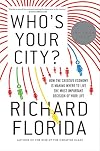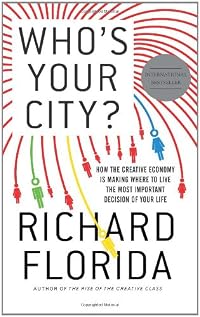
Who's Your City?: How the Creative Economy Is Making Where to Live the Most Important Decision of Your Life
by Richard Florida
On This Page
Description
Globalization is not flattening the world; in fact, place is increasingly relevant to the global economy and our individual lives. Who's Your City? offers the first available city rankings by life-stage, rating the best places for singles, families, and empty-nesters to reside.--From amazon.com.Tags
Recommendations






Member Reviews
I can barely claim to have read this book, since I skimmed the first two parts pretty mercilessly, slowed down a bit in the third part and then read a couple of the chapters in the fourth part properly. The trouble is that so much of the early parts of the book are just about laying out the empirical evidence of something that seems pretty obvious - place is important, certain types of economic activity take place in certain locations.
Part III is entitled "The Geography of Happiness" and despite the fact that I don't approve of the notion of "happiness" as it's defined in a lot of positive psychology and development economics, this section is where some new ideas emerge. The notion that cities have personalities is interesting, and the show more fact that the authors find evidence that people are happier when they live in places that match their personality is important if the reader is to take the self-help section of the book seriously.
Part IV offers some suggestions for people trying to decide where to live, and I found this very helpful. In the Australian context things are a bit simpler than they are in the US, since there are relatively few options when it comes to major cities, but nevertheless the criteria outlined are interesting and the process Richard Florida recommends is nicely set out.
If you think where you live might be making you unhappy, this book offers a way of deciding if it really is and a plan of action for deciding where you might want to go. show less
Part III is entitled "The Geography of Happiness" and despite the fact that I don't approve of the notion of "happiness" as it's defined in a lot of positive psychology and development economics, this section is where some new ideas emerge. The notion that cities have personalities is interesting, and the show more fact that the authors find evidence that people are happier when they live in places that match their personality is important if the reader is to take the self-help section of the book seriously.
Part IV offers some suggestions for people trying to decide where to live, and I found this very helpful. In the Australian context things are a bit simpler than they are in the US, since there are relatively few options when it comes to major cities, but nevertheless the criteria outlined are interesting and the process Richard Florida recommends is nicely set out.
If you think where you live might be making you unhappy, this book offers a way of deciding if it really is and a plan of action for deciding where you might want to go. show less
This terrific book looks at the importance of place and cities in our lives. Where do we need to be to succeed in our careers, personal lives? What places are best suited to our personalities, wants and needs? This book strives to look at the influences people have on cities and vice versa. It's written in a compelling and accessible way with plenty of maps, charts and data and a final chapter asking pointed questions to help the reader find a best-suited city. My only complaint: it's limited to North America. With Europe, Oceania, Latin America and Asia as world leaders in their own rights, it would have been great to have that global perspective.
I read an article in the Atlantic by this author who mentioned this book and how it argues that place is very important to people. So, I expected it to be a bit more psychological--how a sense of place impacts your well being, how being in the wrong place or right place for you can affect your life, and how to find the right balance. Instead it's a book that brings together different studies and expounds upon statistics. It looks at big trends, but doesn't really go down to a personal level at all. Sure, there are examples of people who found the perfect job in the perfect place and aren't they happy now! But it doesn't really address how to reconcile things when your/your spouse's job takes you to a place that you hate, or what to do show more if your job has a very niche market and you can't necessarily choose the perfect place to live. The very last chapter of the book was an advice chapter but it again just relied on trends and statistics and didn't provide much help for people dealing with tough decisions.
Also, it's hard to trust a book that repeatedly sings the praises of Austin. show less
Also, it's hard to trust a book that repeatedly sings the praises of Austin. show less
Many of us, having incorporated online communities into our professional and personal lives, reach the moment when we decide that the idea of place is dead--that geography no longer matters. But it doesn't take us long to realize we're wrong. And reading and thinking about Richard Florida's "Who's Your City?: How the Creative Economy Is Making Where to Live the Most Important Decision in Your Life" (2008) drives the point home. Florida, continuing to focus on the role creativity plays in making communities vital, vibrant social and economic centers, writes clearly and engagingly as he points out how "spiky" the world remains in terms of having peaks of social and economic centers that offer opportunities not to be as readily found in show more the valleys that exist elsewhere. "Today's key economic factors--talent, innovation, and creativity--are not distributed evenly across the global economy," he reminds us (p. 9). "They concentrate in specific locations" including centers of innovation such as Tokyo, Seoul, New York, and San Francisco (p. 25). The role of place in our lives is clearly evolving to accommodate that sense of place that includes onsite as well as online places. Which makes us embrace as well as go beyond what Florida writes. We find ourselves on terra firma and in terra virtual if we see place in a blended seamless way. The place we call home. The places we temporarily join when we travel in the course of our work. And the online places that facilitate the connections that matter most to us in terms of making us members of a variety of interconnected world-wide communities of learning, interest, and practice. show less
This book is the ultimate guide for anyone who is thinking about relocating - for whatever reasons. Several of it's chapters are very enlightening and the eventual "guide" in the last chapter gives you a good structure to work through your options of places you'd like to live.
The only thing I found a bit disappointing is that the book focuses mainly on the US, despite the growing globalization. But the general advise can be converted to any country or city in the world.
What the book also lacked for me was a chapter for "childless couples" - what is the best place for them?! The one for singles? Empty-Nesters?! Disappointing... I skipped all the stuff about singles and families, so I can't speak for that.
But as mentioned, if you're show more thinking about relocating, read this first. show less
The only thing I found a bit disappointing is that the book focuses mainly on the US, despite the growing globalization. But the general advise can be converted to any country or city in the world.
What the book also lacked for me was a chapter for "childless couples" - what is the best place for them?! The one for singles? Empty-Nesters?! Disappointing... I skipped all the stuff about singles and families, so I can't speak for that.
But as mentioned, if you're show more thinking about relocating, read this first. show less
Three decisions define our lives. Who, What and Where. The last of these has generally been considered the least important. Florida makes a very strong case that it should be the first decision we make. Full of fascinating statistics and trends, this book will either confirm your choice of location or make you think seriously about moving. Either way, Florida makes you consider place in a way you probably hadn't considered before.
I actually didn't finish this book and am returning it to the library. I'm not saying it was a bad book, just not for me -- too many statistics for someone who only took one semester of economics 40 years ago. It's also (if I read aright) not such good news for those of us in small towns who don't want to become part of a megalopolis. This is the guy who was news a while back because he posited that cities with higher proportions of gay people and "bohemians" would be more successful economically. This sounded good when I lived in the Twin Cities, and I would have thought it would be good for Brunswick, Maine as well but he seems to feel that the more crowded you are (as a city) the better.
Members
- Recently Added By
Lists

Unread books
1,063 works; 82 members
Author Information

22+ Works 2,692 Members
Richard Florida is university professor and the director of cities at the Martin Prosperity Institute at the University of Toronto, a distinguished visiting fellow at NYU's Shack Institute of Real Estate, and the cofounder and editor-at-large of The Atlantic's CityLab.
Common Knowledge
- Original publication date
- 2008-03-10
- Epigraph
- If everything that exists has a place, place too will have a place, and so on ad infinitum.
―Aristotle
How in the image of material man, at once his glory and his menace, is this thing we call a city.
―Frank Lloyd Wright
The large town and especially London absorb the very best blood from all the rest of England; the most enterprising, the most highly gifted, those with the highest physique and the strongest characters go there to find scope ... (show all)for their abilities.
―Alfred Marshall - Dedication
- For Rana
- First words
- "So, why did you decide to move to Toronto?"
I'm not easily shaken. - Last words
- (Click to show. Warning: May contain spoilers.)Choose wisely.
Classifications
- Genres
- Economics, Nonfiction, Sociology, General Nonfiction, Science & Nature, Business
- DDC/MDS
- 304.23 — Society, Government, and Culture Social sciences, sociology & anthropology Factors affecting social behavior Human ecology
- LCC
- GF21 .F56 — Geography, Anthropology and Recreation Human ecology. Anthropogeography Human ecology. Anthropogeography
- BISAC
Statistics
- Members
- 475
- Popularity
- 63,728
- Reviews
- 11
- Rating
- (3.27)
- Languages
- English, Spanish
- Media
- Paper, Ebook
- ISBNs
- 12
- ASINs
- 6