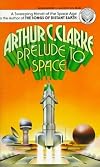
Prelude to Space
by Arthur C. Clarke
On This Page
Description
The world's first lunar spacecraft is about to launch. The ship, Prometheus, is built from two separate components-one designed to travel from Earth's atmosphere to the Moon and back, and the other to carry the first component through Earth's atmosphere and into orbit. Sound familiar? That's because it's the basic description of the first space shuttle-well before its launch in 1971. Prelude to Space was published in 1951-well before the first Sputnik expedition. Even so, the book is full of show more detailed technical descriptions and conversations regarding the possibility of spaceflight-many of which were actually included during the construction of the first spaceships-as well as telecommunications satellites. It's a fascinating read-from both a fictional and a historical perspective. show lessTags
Recommendations

















Member Reviews
This is the second time I've read this book (which has a lot of my notes, highlights, and underlining from when I first read it, and I remembered very little about it). For the first few pages, I was wondering, "why am I reading this book from the 1950 that speculates about the future of manned space flight, considering what was accomplished by the Apollo moon landings, especially 30 years after I first read this?" However, afterward Clarke's wry wit takes off and you are treated to a very realistic "what could have been" science fiction novel about mankind's first endeavor to take three astronauts to the moon and back, along with all the supporting characters. Perhaps not for everyone, but especially for one of his "lesser known" and show more truly under-appreciated novels, it's evident from this one alone why he was master of science fiction. show less
Writing in 1951, Arthur C. Clarke used Prelude to Space to explore ideas about the possibilities of travel to the moon and the solar system based on the predictions of technology at the time. In many areas he was right, such as his fictional scientists' statement, "We will take no frontiers into space" (p. 101), which hit upon the gist of the Outer Space Treaty of 1967. By his own acknowledgement in his post-Apollo introduction, Clarke was too conservative in his date estimates as the United States landed humans on the moon before the end of the 1960s. At one point, Clarke's characters discuss the historical field's development, saying, "When I was a kid their textbooks were nothing but limitary primers. Then the economic determinists show more held the field - until the neo-Freudians routed them with great slaughter" (p. 66). This commentary on the discipline shows great insight and the modern reader expects the conversation to continue into Focault and the linguistic turn. With this in mind, Clarke never intended to predict the future. He wished to promote scientific advancement and his inside knowledge of the early space programs gave him an advantage in his storytelling.
The story itself closely resembles The Right Stuff, though Clarke's explorers lack the humanizing character flaws of the Mercury 7. The same energy of doing something great for the first time pervades the story and Clarke's use of an historian as his main character allows him to explain his ideas to an educated layperson in a natural manner that does not interrupt the plot. The theme of exploration for its own sake pervades the novel, with the characters encountering Captain Scott's Discovery early on and reminiscing, "The line that stretched through Scott back to Drake and Raleigh and yet earlier voyagers was still unbroken; only the scale of things had changed" (p. 19). In yet another instance of life imitating art, much of the early materials promoting NASA's manned spaceflight programs drew upon this continuity of historical exploration.
The novel itself represents the hopes and dreams of the dawn of the Space Age. As a story, it continues to entertain, while it serves as an artifact of that time. show less
The story itself closely resembles The Right Stuff, though Clarke's explorers lack the humanizing character flaws of the Mercury 7. The same energy of doing something great for the first time pervades the story and Clarke's use of an historian as his main character allows him to explain his ideas to an educated layperson in a natural manner that does not interrupt the plot. The theme of exploration for its own sake pervades the novel, with the characters encountering Captain Scott's Discovery early on and reminiscing, "The line that stretched through Scott back to Drake and Raleigh and yet earlier voyagers was still unbroken; only the scale of things had changed" (p. 19). In yet another instance of life imitating art, much of the early materials promoting NASA's manned spaceflight programs drew upon this continuity of historical exploration.
The novel itself represents the hopes and dreams of the dawn of the Space Age. As a story, it continues to entertain, while it serves as an artifact of that time. show less
In 1976, historian Dirk Alexson is sent to England by the University of Chicago to document for posterity the first manned mission to the moon sponsored by a private company called Interplanetary. While in the UK, he interviews and befriends some of the scientists and administrators involved in the project and receives a number of lessons in astrophysics and engineering.
However, Alexson is given very little face time with the crew of the Prometheus until they fly to the deserts of Australia for the actual launch. In fact, of the five possible crew members, only three will be chosen for the mission and that choice is not even made until the entire team reaches Australia.
Prelude to Space reads more like a documentary than a novel. The show more only character development occurs when our skeptical historian slowly becomes convinced during his assignment that landing a man on the moon is, in fact, feasible and exciting.
There is almost no tension in the story save for one of the astronauts worrying about his pregnant wife. Any risk to the astronauts' lives is treated lightly. Instead, the narrative merely follows Alexson as he chronicles the events around him.
Much of the book is comprised of info dumps ranging from the backgrounds of some of the characters (as if Clarke just wanted to get that out of the way in order to focus on the technology) to engineering specifications about the Prometheus and space flight in general. Arthur C. Clarke's scientific prowess is evident in this book, to point where it eclipses what little story exists. For example, as if an afterthought or an attempt to manufacture tension near the end of the story, a religious zealot fatally fails in an attempt to sabotage the Prometheus a few days before its launch. The character was introduced and killed off within a few pages, all of which added nothing to the story.
If you're looking for an exhilarating fictional tale of man's first foray to the moon, Prelude to Space will likely be a verbose and tedious disappointment. show less
However, Alexson is given very little face time with the crew of the Prometheus until they fly to the deserts of Australia for the actual launch. In fact, of the five possible crew members, only three will be chosen for the mission and that choice is not even made until the entire team reaches Australia.
Prelude to Space reads more like a documentary than a novel. The show more only character development occurs when our skeptical historian slowly becomes convinced during his assignment that landing a man on the moon is, in fact, feasible and exciting.
There is almost no tension in the story save for one of the astronauts worrying about his pregnant wife. Any risk to the astronauts' lives is treated lightly. Instead, the narrative merely follows Alexson as he chronicles the events around him.
Much of the book is comprised of info dumps ranging from the backgrounds of some of the characters (as if Clarke just wanted to get that out of the way in order to focus on the technology) to engineering specifications about the Prometheus and space flight in general. Arthur C. Clarke's scientific prowess is evident in this book, to point where it eclipses what little story exists. For example, as if an afterthought or an attempt to manufacture tension near the end of the story, a religious zealot fatally fails in an attempt to sabotage the Prometheus a few days before its launch. The character was introduced and killed off within a few pages, all of which added nothing to the story.
If you're looking for an exhilarating fictional tale of man's first foray to the moon, Prelude to Space will likely be a verbose and tedious disappointment. show less
This novel published in 1951 seems to be a history of the first manned landing on the moon written by an American historian Dirk Alexson who documented the 6 months preparations for the eventful space flight. Dr Alexson tells us that these events took place in 1978. They were co-ordinated in London by an international company called Interplanetary. The rocket named Prometheus was launched from a desert in Australia using an atomic powered motor carrying three astronauts. It used rail tracks to get up initial speed and the rocket consisted of two parts Alpha and Beta. Alpha carries the crew and separates from Beta once in orbit around the earth giving Alpha enough fuel to get to the moon and back to earth's orbit.
Of course this is not show more what happened: Apollo 11 was launched by Nasa in 1969 from the Kennedy Space centre in Florida, carried by a Saturn IV rocket which was not atomic powered. The spacecraft consisted of three parts a command module which housed the thee astronauts, a service module providing propulsion and a lunar module for descending to the moon from lunar orbit. Arthur C. Clarke's look into the future was inaccurate on many counts, but he did know enough science to appreciate the problems of a manned flight to the moon, which makes his forecast believable. People unaware of those massive events in space travel in the 1960's-70's; and one could forgive them from not knowing any better, because the manned space flights to the moon have stopped since those times, might well think that Clarke's version is correct.
In Clarke's version Dirk Alexson is not a scientist or an engineer, which allows Clarke to dumb down the science. Dirk's main issues apart from a steep learning curve to absorb information is to negotiate the public relations department of Interplanetary and to get time with the astronauts and the Director General and top scientists. There are of course bureaucratic hurdles to jump through, but the bonhomie of the culture of Interplanetary is encouraging and this is the main fault when reading the book today its almost total lack of excitement. Nothing really happens, we get a glimpse of the characteristics of the astronauts, there is a half hearted attempt at sabotage and the narrative stops at the final countdown of the take off.
There is some discussion on the need or not, of a manned space flight to the moon and Clarke has one of his sceptics say:
"Since man had caused so much misery upon his own world, could he be trusted to behave on others? Above all, would the miserable story of conquest and enslavement of one race by another be repeated again, endlessly and forever as human culture spread from one world to the next."
The book has not aged well; a sense of wonder might well have been evoked in 1951 when one of the astronauts is allowed to talk effusively about the moon being a natural base to explore the other planets of the solar system, but today we cannot see this happening in the near future. This makes for a pedestrian read and a rather curious one at that 3 stars. show less
Of course this is not show more what happened: Apollo 11 was launched by Nasa in 1969 from the Kennedy Space centre in Florida, carried by a Saturn IV rocket which was not atomic powered. The spacecraft consisted of three parts a command module which housed the thee astronauts, a service module providing propulsion and a lunar module for descending to the moon from lunar orbit. Arthur C. Clarke's look into the future was inaccurate on many counts, but he did know enough science to appreciate the problems of a manned flight to the moon, which makes his forecast believable. People unaware of those massive events in space travel in the 1960's-70's; and one could forgive them from not knowing any better, because the manned space flights to the moon have stopped since those times, might well think that Clarke's version is correct.
In Clarke's version Dirk Alexson is not a scientist or an engineer, which allows Clarke to dumb down the science. Dirk's main issues apart from a steep learning curve to absorb information is to negotiate the public relations department of Interplanetary and to get time with the astronauts and the Director General and top scientists. There are of course bureaucratic hurdles to jump through, but the bonhomie of the culture of Interplanetary is encouraging and this is the main fault when reading the book today its almost total lack of excitement. Nothing really happens, we get a glimpse of the characteristics of the astronauts, there is a half hearted attempt at sabotage and the narrative stops at the final countdown of the take off.
There is some discussion on the need or not, of a manned space flight to the moon and Clarke has one of his sceptics say:
"Since man had caused so much misery upon his own world, could he be trusted to behave on others? Above all, would the miserable story of conquest and enslavement of one race by another be repeated again, endlessly and forever as human culture spread from one world to the next."
The book has not aged well; a sense of wonder might well have been evoked in 1951 when one of the astronauts is allowed to talk effusively about the moon being a natural base to explore the other planets of the solar system, but today we cannot see this happening in the near future. This makes for a pedestrian read and a rather curious one at that 3 stars. show less
From the early 1950's, Arthur C. Clarke's 'Prelude to Space' offers the story of the possible advances that would finally allow mankind to reach space. Brilliantly predictive, as science fiction, it emphasizes the technical aspects of that achievement. As a novel, certainly the characters and story feel propped up simply to facilitate all that in which Clarke was really interested. As a story, then, the book is pretty thin. As a picture of what might be able to happen, before mankind made it into space, though, it offers a fascinating picture of the technological aspirations of that time.
...Sixty-five years after it was written Prelude to Space is badly dated in just about every aspect of the story. From the technical developments to the blatant sexism that plagued science fiction in those days. On top of that, Clarke wrote a novel that reads like propaganda for a space program. It is very effective propaganda though. Despite all the novel's flaws, you can't help but be caught up in the excitement of the enterprise and the possibilities of space travel, many of which still haven't been realized. Clarke's optimism has been proven unfounded in some ways but the drive to explore space is still there. This novel might well have been an inspiration to some teenager in the 1950s to pursue a career in physics or astronomy. show more Clarke has gone on to write more challenging novels but for a debut, it's a decent read.
Full Random Comments review show less
Full Random Comments review show less
Space travel as imagined by ACC in the 50's was a far different thing than what actually occurred. For myself, I think I would prefer Clarke's "reality" to that of today.
Great Britain was a serious world power, particularly in space travel; there was no "space race" per se--countries actually cooperated. Five astronauts were considered for the first flight and the two who didn't make it took it well enough.
The Prometheus (space ship) seemed to me to be along the lines (very generally) of the soon to be late, lamented space shuttle program. There was genuine enthusiasm, interest, fascination with the future--all things that to me are now lacking in life, as well as the space program.
As to the book itself, it is of course dated. One of show more the most touted advantages to having a presence in space was the ability to manufacture vacuum tubes for computers and communications--and when was the last time that was an issue? But the other ideas--medical products, and so on--it's a pity I think that none of this has come to be even remotely to pass.
The book itself is written with Clarke's usual style and care--sometimes a little wordy, but always thoughtful.
As always, looking backward to what might have been is affected by a rose-colored filter, but the what-might-have-beens always make me wistful.
Then, I think of gynecology and dentistry and get over it, at least to a point. show less
Great Britain was a serious world power, particularly in space travel; there was no "space race" per se--countries actually cooperated. Five astronauts were considered for the first flight and the two who didn't make it took it well enough.
The Prometheus (space ship) seemed to me to be along the lines (very generally) of the soon to be late, lamented space shuttle program. There was genuine enthusiasm, interest, fascination with the future--all things that to me are now lacking in life, as well as the space program.
As to the book itself, it is of course dated. One of show more the most touted advantages to having a presence in space was the ability to manufacture vacuum tubes for computers and communications--and when was the last time that was an issue? But the other ideas--medical products, and so on--it's a pity I think that none of this has come to be even remotely to pass.
The book itself is written with Clarke's usual style and care--sometimes a little wordy, but always thoughtful.
As always, looking backward to what might have been is affected by a rose-colored filter, but the what-might-have-beens always make me wistful.
Then, I think of gynecology and dentistry and get over it, at least to a point. show less
Members
- Recently Added By
Lists

The Novels of Arthur C. Clarke
21 works; 2 members
Author Information

Arthur C. Clarke was born in Minehead, Somerset, England, on December 16, 1917. During World War II, he served as a radar specialist in the RAF. His first published piece of fiction was Rescue Party and appeared in Astounding Science, May 1946. He graduated from King's College in London with honors in physics and mathematics, and worked in show more scientific research before turning his attention to writing fiction. His first book, Prelude to Space, was published in 1951. He is best known for his book 2001: A Space Odyssey, which was later turned into a highly successful and controversial film under the direction of Stanley Kubrick. His other works include Childhood's End, Rendezvous with Rama, The Garden of Rama, The Snows of Olympus, 2010: A Space Odyssey II, 2062: Odyssey III, and 3001: The Final Odyssey. During his lifetime, he received at least three Hugo Awards and two Nebula Awards. He died of heart failure on March 19, 2008 at the age of 90. (Bowker Author Biography) show less
Some Editions
Awards and Honors
Notable Lists
Series
Belongs to Publisher Series
Work Relationships
Common Knowledge
- Canonical title
- Prelude to Space
- Original title
- Prelude to Space
- Alternate titles
- The Master of Space; The Space Dreamers
- Original publication date
- 1959
- Important places
- London, England, UK; Australia
- Dedication
- To my friends in the British Interplanetary Society--who by sharing this dream, helped to make it come true
- First words
- For five miles, straight as an arrow, the gleaming metal track lay along the face of the desert.
- Last words
- (Click to show. Warning: May contain spoilers.)The dawn that would burst above the Apennines at the end of the long lunar night would be no more brilliant than the age that had now been born.
- Disambiguation notice
- Prelude to Space was published in paperback with the title The Space Dreamers by Lancer books. In 1961, Lancer published Prelude to Space as Master of Space.
Classifications
Statistics
- Members
- 904
- Popularity
- 29,486
- Reviews
- 14
- Rating
- (3.49)
- Languages
- 6 — Danish, English, French, German, Italian, Spanish
- Media
- Paper, Audiobook, Ebook
- ISBNs
- 26
- ASINs
- 35