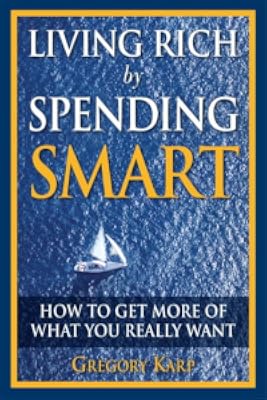
Living Rich by Spending Smart: How to Get More of What You Really Want
by Gregory Karp
On This Page
Description
As The Millionaire Next Door revealed, and millions of Americans now realize, building wealth isn't just about working harder or what you choose to invest in: it's about spending smarter. Now, award-winning Tribune Company personal finance columnist Gregory Karp shows how to do just that. This book isn't about depriving yourself: you don't have to become a "financial anorexic," and you won't have to start dumpster diving! Instead, Gregory Karp shows how to build real, long-lasting wealth by show more plugging the money leaks you're barely even aware of, and making sure you spend with a purpose. Drawing on everything he's learned writing his prize-winning weekly column, Karp reveals surprisingly painless, little-known techniques for eliminating wasteful spending in every area of your financial life. Karp shows how to spend on what you really care about, not what you don't... understand the real value of comparison shopping...save money in giving gifts without becoming a cheapskate. Karp shows how to slash your phone bill... spend less on food without changing what you like to eat... eliminate spending leaks in insurance, education, entertainment and beyond. From the clothes you wear to the cars you drive, Living Rich by Spending Smart will help you build a life that's truly rich, because it's truly financially secure. show lessTags
Recommendations











Member Reviews
I was pleased to receive this book as an Early Reviewer, because for my entire adult life I have been minimizing spending on so-called necessities to get more of what I really want. (Books, of course. Did you need to ask?)
"I like to think," says the author in the introduction, "that The Millionaire Next Door proved the philosophy and this book provides the details." Karp looks at the subject of money use from the inside (identifying attitudes that perpetuate self-defeating and self-impoverishing spending) and from the outside (specific actions that accomplish financial goals), and moves from the big picture (Food, Insurance, Telecommunications -- the biggest offenders) to a few micro-snapshots of spending pitfalls.
The book is up to the show more minute, with information on 21st century ways of cutting costs (skype, www.abebooks.com) and even has a number hints that I can actually put into practice -- which if you knew me, is saying quite a bit.
Some of the subtopics -- weddings comes to mind -- were not really very well covered. Speaking as someone who has participated in planning a recent wedding for under $2000 (150 guests, church wedding and reception) I thought the chapter a bit wimpy -- understandably so, as entire books have been written on this subject alone. It would have been helpful if the author had provided a bibliography to point readers to in-depth information. show less
"I like to think," says the author in the introduction, "that The Millionaire Next Door proved the philosophy and this book provides the details." Karp looks at the subject of money use from the inside (identifying attitudes that perpetuate self-defeating and self-impoverishing spending) and from the outside (specific actions that accomplish financial goals), and moves from the big picture (Food, Insurance, Telecommunications -- the biggest offenders) to a few micro-snapshots of spending pitfalls.
The book is up to the show more minute, with information on 21st century ways of cutting costs (skype, www.abebooks.com) and even has a number hints that I can actually put into practice -- which if you knew me, is saying quite a bit.
Some of the subtopics -- weddings comes to mind -- were not really very well covered. Speaking as someone who has participated in planning a recent wedding for under $2000 (150 guests, church wedding and reception) I thought the chapter a bit wimpy -- understandably so, as entire books have been written on this subject alone. It would have been helpful if the author had provided a bibliography to point readers to in-depth information. show less
 This review was written for LibraryThing Early Reviewers.
This is a useful book, though not the most exciting. As another reviewer has noted, it would be good for flipping through and reading in depth the parts that seem most interesting and relevant to your particular situation. I found that the beginning chapters were broadly useful, but that as the book progressed the specifics became a bit tedious and were sometimes just not applicable to me—for example, as a city-dweller in my early twenties, I don’t own a car and don’t plan to own one for at least another five years, but there were multiple sections about cars throughout the book.
There were a few times when I felt like the book was intended for a particular generation, and that generation just wasn’t mine. The author says, for show more example, that “young people don’t appreciate the near-magical power of compounding investment returns”, although the context provides absolutely no justification for the qualifier “young”. When, in a discussion of cell phones, he begins a sentence by saying “If your teen must have text messaging, which is basically like sending short emails over the phone….” I really felt like I was in the wrong book. I don’t object to unnecessary definitions in general, but if he wants to define “text messaging”, surely he could explain terms like “comprehensive coverage” and “non-liability coverage” in the insurance section. I occasionally even wondered whether the author himself was just not very familiar with technology and discussions thereof. Given the informal tone of the book (and the occasional poorly-constructed sentence), the mentions of technology stand out as a bit stiff. He speaks of “Web sites” with a capital W, and once even mentions his “Web log”, a term that seems almost archaic. The section on back-to-school shopping also seemed strange to me, as someone who has younger siblings still in high school. Karp laments that “Back to school shopping is different than it was a generation ago…. For some students, calculators, personal digital assistants, cell phones, and backpacks on wheels are standard gear.” I found the juxtaposition of calculators, which are basically a necessity, with personal digital assistants, which seem like a frivolous luxury, to be a bit jarring. Although he tells us to make sure our children know the difference between a need and a want, it seems that he’s been “living rich” for so long that he’s lost track of the distinction himself.
Still, the book was full of useful advice. There was only one case when I actually disagreed with what he said, on the subject of hybrid cars. His argument is that we shouldn’t buy them to save money, because according to a 2006 Consumer Reports survey it takes five years for the savings to make up for the higher purchase price. Beyond the obvious objection that someone might buy a car intending to keep it for more than five years, it seems disingenuous at best to use 2006 data without making a single mention of trends in gasoline prices.
I think part of the problem here arose from taking a fairly complicated issue and trying to reduce it to a few short paragraphs. In the case of indisputable advice, this is often fine. However, there were several times thoughout the book when I wanted him either to flesh out an argument enough to be convincing or to leave it out entirely. It’s not as if he didn’t have room for it: the book is less than 200 pages long and often includes useless charts that seem like they’re trying to fill space (it would be enough to say “Timeshare sales in 2006 totalled $10 billion, up 81 percent over five years”; after reading that sentence, I really don’t learn anything more by seeing a chart of timeshare sales in each individual year from 2002 to 2006. Yet such a chart is included whenever possible).
Overall, the book might have benefited from some better editing. There are plenty of good ideas, but the presentation is sometimes a bit lacking. Although I’m sure that almost anyone reading this could get at least a few good ideas to help their financial situation, the book as a whole is a bit uneven: too simplistic at times, and too full of unnecessary statistics at others. While I’d certainly recommend it to someone looking for ways to save money, I’d recommend it from the library, not the bookstore. show less
There were a few times when I felt like the book was intended for a particular generation, and that generation just wasn’t mine. The author says, for show more example, that “young people don’t appreciate the near-magical power of compounding investment returns”, although the context provides absolutely no justification for the qualifier “young”. When, in a discussion of cell phones, he begins a sentence by saying “If your teen must have text messaging, which is basically like sending short emails over the phone….” I really felt like I was in the wrong book. I don’t object to unnecessary definitions in general, but if he wants to define “text messaging”, surely he could explain terms like “comprehensive coverage” and “non-liability coverage” in the insurance section. I occasionally even wondered whether the author himself was just not very familiar with technology and discussions thereof. Given the informal tone of the book (and the occasional poorly-constructed sentence), the mentions of technology stand out as a bit stiff. He speaks of “Web sites” with a capital W, and once even mentions his “Web log”, a term that seems almost archaic. The section on back-to-school shopping also seemed strange to me, as someone who has younger siblings still in high school. Karp laments that “Back to school shopping is different than it was a generation ago…. For some students, calculators, personal digital assistants, cell phones, and backpacks on wheels are standard gear.” I found the juxtaposition of calculators, which are basically a necessity, with personal digital assistants, which seem like a frivolous luxury, to be a bit jarring. Although he tells us to make sure our children know the difference between a need and a want, it seems that he’s been “living rich” for so long that he’s lost track of the distinction himself.
Still, the book was full of useful advice. There was only one case when I actually disagreed with what he said, on the subject of hybrid cars. His argument is that we shouldn’t buy them to save money, because according to a 2006 Consumer Reports survey it takes five years for the savings to make up for the higher purchase price. Beyond the obvious objection that someone might buy a car intending to keep it for more than five years, it seems disingenuous at best to use 2006 data without making a single mention of trends in gasoline prices.
I think part of the problem here arose from taking a fairly complicated issue and trying to reduce it to a few short paragraphs. In the case of indisputable advice, this is often fine. However, there were several times thoughout the book when I wanted him either to flesh out an argument enough to be convincing or to leave it out entirely. It’s not as if he didn’t have room for it: the book is less than 200 pages long and often includes useless charts that seem like they’re trying to fill space (it would be enough to say “Timeshare sales in 2006 totalled $10 billion, up 81 percent over five years”; after reading that sentence, I really don’t learn anything more by seeing a chart of timeshare sales in each individual year from 2002 to 2006. Yet such a chart is included whenever possible).
Overall, the book might have benefited from some better editing. There are plenty of good ideas, but the presentation is sometimes a bit lacking. Although I’m sure that almost anyone reading this could get at least a few good ideas to help their financial situation, the book as a whole is a bit uneven: too simplistic at times, and too full of unnecessary statistics at others. While I’d certainly recommend it to someone looking for ways to save money, I’d recommend it from the library, not the bookstore. show less
This review was written for LibraryThing Early Reviewers.While I liked reading this book and learned a few new tricks I plan to apply to managing my finances, the complete lack of references was appalling. The author constantly refers to all this "research" that "proves" what he's saying is reliable and good advice... yet never actually includes references to this research in his footnotes, a recommended reading list, or a bibliography at the end of the book. I'm not exaggerating, there were so many references to this "research" that he never actually quotes that I stopped counting after the fourth chapter.
I say, read and enjoy the book but critically evaluate what he's saying.
I say, read and enjoy the book but critically evaluate what he's saying.
This review was written for LibraryThing Early Reviewers.Gregory Karp’s Living Rich by Spending Smart has as its main premise what is essentially a no-brainer: controlling what you spend is the key to building wealth. This book grew out of columns Karp wrote for the Tribune Company of newspapers beginning in 2004. In the columns, he didn’t focus on telling people what to do with excess money; rather, he talked about how to manage spending so that people could generate excess money in the first place.
Written in easy to understand English, Karp’s guide covers the waterfront, from how to avoid the worst spending habits, to strategies for intelligent spending on specific occasions like holidays, shopping and spending around the home, vacation spending, and financial services. In selecting show more bank accounts, for instance, he warns against paying banks to hold your money. Like I said, a no-brainer, but a spending mistake that millions make to their detriment.
Whether you’re just starting out in your working live, or you’re trying to make ends meet on retirement income, there’s something in this book that will help you become more financially secure.
Even though it was originally written in 2008, it’s a must-read in today’s uncertain economic times. A clear five stars. show less
Written in easy to understand English, Karp’s guide covers the waterfront, from how to avoid the worst spending habits, to strategies for intelligent spending on specific occasions like holidays, shopping and spending around the home, vacation spending, and financial services. In selecting show more bank accounts, for instance, he warns against paying banks to hold your money. Like I said, a no-brainer, but a spending mistake that millions make to their detriment.
Whether you’re just starting out in your working live, or you’re trying to make ends meet on retirement income, there’s something in this book that will help you become more financially secure.
Even though it was originally written in 2008, it’s a must-read in today’s uncertain economic times. A clear five stars. show less
Most of the advice is the logical "watch your pennies and your dollars will take care of themselves" tempered with a little bit of self-love. So far it's a good reminder, but nothing revolutionary unless your parents didn't bother to teach you about any type of financial planning or self-governance. Which, I suppose, may well be the case. If you are bereft of this knowledge, it's a good starter resource in how to keep yourself from credit-card hell with a little upfront investment in quality and research.
This review was written for LibraryThing Early Reviewers.Being a frugal person because of both need, want and upbringing I was looking forward to reading this book. I am pleased to say that I find it an excellent book. I'd say I already do about 50% of the suggestions in the book which leads me to endorse the other ideas presented.
Definitely not a book designed for a quick read from cover to cover, it is excellent to be read in tidbit chunks. This does, in effect, make the book an even better resource. The book is organized in such a way that you can tackle specific areas of spending, such as home, lifestyle choices, etc. I also found the included figures and facts motivating. It is definitely motivating to realize that a small $2 change here can work to this amount in a years time. And there show more is some small comfort to know that I am not alone in my spending patterns!
Count this book a resource, leave it handy for reading at times when you have a few minutes to spare and you'll find a few more dollars to spare in your wallet! show less
Definitely not a book designed for a quick read from cover to cover, it is excellent to be read in tidbit chunks. This does, in effect, make the book an even better resource. The book is organized in such a way that you can tackle specific areas of spending, such as home, lifestyle choices, etc. I also found the included figures and facts motivating. It is definitely motivating to realize that a small $2 change here can work to this amount in a years time. And there show more is some small comfort to know that I am not alone in my spending patterns!
Count this book a resource, leave it handy for reading at times when you have a few minutes to spare and you'll find a few more dollars to spare in your wallet! show less
This review was written for LibraryThing Early Reviewers.I have mixed feelings about this book. It certainly was full of good, important information but a lot of it is just simple common sense. There was very little in the way of tips that was new for me but I was reminded of a few things that I need to make more of an effort to do. My biggest problem with this book isn't a fair complaint - I'm Canadian and it's not. Most of the websites aren't applicable to me - and this book is full of them. That's great for an American but not so much for someone north of the border. A Canadian edition would be most welcome!
Bottom line - if you are American, you should read it and live by it. If you're not, it's not a total waste of your time but maybe look for something more local.
Bottom line - if you are American, you should read it and live by it. If you're not, it's not a total waste of your time but maybe look for something more local.
This review was written for LibraryThing Early Reviewers.Members
- Recently Added By
Author Information
3 Works 255 Members
Common Knowledge
- Original publication date
- 2008
Classifications
Statistics
- Members
- 184
- Popularity
- 174,954
- Reviews
- 12
- Rating
- (3.21)
- Languages
- English
- Media
- Paper, Ebook
- ISBNs
- 4
- UPCs
- 1
- ASINs
- 2