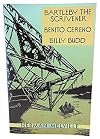
Benito Cereno / Billy Budd / Bartleby, the Scribner
by Herman Melville 
On This Page
Description
Presents Herman Melville's "Bartleby the Scrivener," in which Bartleby, a copyist at a New York City law office, begins to inexplicably refuse work with the line "I would prefer not to"Tags
Recommendations






















Member Reviews
After reading this book - I officially will not be reading Herman Melville. The style is too flowery and I had a hard time keeping track of who was who, and the roll they played in the story.
However, there are three stories in this book. Benito Cereno and Billy Budd are set on ships, and its clear that Melville knows his ships. There was too much sailing ship jargon for me to fully understand what was happening.
However, Bartleby the Scrivener was quite amazing - from Bartleby's "I'd rather not" to the description of the two clerks. In the introduction, there was a comparison to Kafka - an in this story, the comparison holds true. There is a feeling of being trapped in the process, and Bartleby is tragic figure with comedic show more inflections.
Benito Cereno was a challenge for me - It was evident what happened to the other ship right off, but Benito was blind to it based on his assumptions. I'm not sure if this story is against slavery or not, but I was rooting for the slaves and thought they were in the right the whole time.
Billy Bud is the story I really struggled with. Initially, describing characters that didn't seem to matter to the actual story, lots of characters that were minor, and the jargon left me loss. Billy Budd is a tragic figure - an innocent who happens to be at the wrong place at the wrong time - and there seems to be a Claggert in every group of people. But, between the difficult language, and the story that did not end, I found the story quite tedious. show less
However, there are three stories in this book. Benito Cereno and Billy Budd are set on ships, and its clear that Melville knows his ships. There was too much sailing ship jargon for me to fully understand what was happening.
However, Bartleby the Scrivener was quite amazing - from Bartleby's "I'd rather not" to the description of the two clerks. In the introduction, there was a comparison to Kafka - an in this story, the comparison holds true. There is a feeling of being trapped in the process, and Bartleby is tragic figure with comedic show more inflections.
Benito Cereno was a challenge for me - It was evident what happened to the other ship right off, but Benito was blind to it based on his assumptions. I'm not sure if this story is against slavery or not, but I was rooting for the slaves and thought they were in the right the whole time.
Billy Bud is the story I really struggled with. Initially, describing characters that didn't seem to matter to the actual story, lots of characters that were minor, and the jargon left me loss. Billy Budd is a tragic figure - an innocent who happens to be at the wrong place at the wrong time - and there seems to be a Claggert in every group of people. But, between the difficult language, and the story that did not end, I found the story quite tedious. show less
NARRATIVA NORTEAMERICANA. Tras un periodo de injustificado olvido, la figura de Herman Melville (1819-1891) fue rescatada por la critica de los años 20, para situarle entre los grandes escritores del siglo XIX. Las tres obras conjugan magistralmente los elementos caracteristicos de su estilo: la omniscencia del narrador, las perspectivas contrastadas y las bruscas rupturas formales. Todo ello se combina en un modelo unico de indagacion metafisica sobre los efectos aniquiladores para el ser humano de la opresion y el aislamiento.
Jun 30, 2016Spanish
Ratings
Members
- Recently Added By
Author Information

661+ Works 78,770 Members
Herman Melville (August 1, 1819 - September 28, 1891) was born into a seemingly secure, prosperous world, a descendant of prominent Dutch and English families long established in New York State. That security vanished when first, the family business failed, and then, two years later, in young Melville's thirteenth year, his father died. Without show more enough money to gain the formal education that professions required, Melville was thrown on his own resources and in 1841 sailed off on a whaling ship bound for the South Seas. His experiences at sea during the next four years were to form in part the basis of his best fiction. Melville's first two books, Typee (1846) and Omoo (1847), were partly romance and partly autobiographical travel books set in the South Seas. Both were popular successes, particularly Typee, which included a stay among cannibals and a romance with a South Sea maiden. During the next several years, Melville published three more romances that drew upon his experiences at sea: Redburn (1849) and White-Jacket (1850), both fairly realistic accounts of the sailor's life and depicting the loss of innocence of central characters; and Mardi (1849), which, like the other two books, began as a romance of adventure but turned into an allegorical critique of contemporary American civilization. Moby Dick (1851) also began as an adventure story, based on Melville's experiences aboard the whaling ship. However, in the writing of it inspired in part by conversations with his friend and neighbor Hawthorne and partly by his own irrepressible imagination and reading of Shakespeare and other Renaissance dramatists Melville turned the book into something so strange that, when it appeared in print, many of his readers and critics were dumbfounded, even outraged. By the mid-1850s, Melville's literary reputation was all but destroyed, and he was obliged to live the rest of his life taking whatever jobs he could find and borrowing money from relatives, who fortunately were always in a position to help him. He continued to write, however, and published some marvelous short fiction pieces Benito Cereno" (1855) and "Bartleby, the Scrivener" (1853) are the best. He also published several volumes of poetry, the most important of which was Battle Pieces and Aspects of the War (1866), poems of occasionally great power that were written in response to the moral challenge of the Civil War. His posthumously published work, Billy Budd (1924), on which he worked up until the time of his death, became Melville's last significant literary work, a brilliant short novel that movingly describes a young sailor's imprisonment and death. Melville's reputation, however, rests most solidly on his great epic romance, Moby Dick. It is a difficult as well as a brilliant book, and many critics have offered interpretations of its complicated ambiguous symbolism. Darrel Abel briefly summed up Moby Dick as "the story of an attempt to search the unsearchable ways of God," although the book has historical, political, and moral implications as well. Melville died at his home in New York City early on the morning of September 28, 1891, at age 72. The doctor listed "cardiac dilation" on the death certificate. He was interred in the Woodlawn Cemetery in The Bronx, New York, along with his wife, Elizabeth Shaw Melville. (Bowker Author Biography) show less
Herman Melville has a Legacy Library. Legacy libraries are the personal libraries of famous readers, entered by LibraryThing members from the Legacy Libraries group.
Awards and Honors
Notable Lists
Series
Belongs to Publisher Series
Work Relationships
Common Knowledge
- Canonical title
- Bartleby / Benito Cereno / Billy Budd; Benito Cereno / Billy Budd / Bartleby, the Scribner
- Original publication date
- 1853; 1855; 1924
Classifications
Statistics
- Members
- 285
- Popularity
- 113,068
- Reviews
- 2
- Rating
- (3.60)
- Languages
- English, Portuguese, Spanish
- Media
- Paper, Ebook
- ISBNs
- 5
- ASINs
- 14