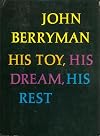
His Toy, His Dream, His Rest
by John Berryman
On This Page
Description
His Toy, His Dream, His Rest continues and concludes the poem, called The Dream Songs, begun in 77 Dream Songs, which was published in 1964 and awarded the Pulitzer Prize for poetry. It is a much longer volume than the earlier one and contains 308 songs in all, starting of course with number 78. "Some of the people who addressed themselves to 77 Dream Songs went so desperately astray," writes the author, "that I permit myself one word. The poem then, whatever its wide cast of characters, is show more essentially about an imaginary character (not the poet, not me) named Henry, a white American in early middle age sometimes in blackface, who has suffered an irreversible loss and talks about himself sometimes in the first person, sometimes in the third, sometimes even in the second; he has a friend, never named, who addresses him as Mr. Bones and variants thereof. Requiescant in pace." show lessTags
Recommendations















Member Reviews
235
Tears Henry shed for poor old Hemingway...
...
Save us from shotguns & fathers' suicides.
It all depends who you're the father of
if you want to kill yourself-
a bad example, murder of oneself,
the final death, in a paroxysm, of love
for which good mercy hides?
...
Mercy! my father; do not pull the trigger
or all my life I'll suffer from your anger
killing what you began.
384
The marker slants, flowerless, day's almost done,
I stand above my father's grave with rage,
often, often before
I've made this awful pilgrimage to one
who cannot visit me, who tore his page
out: I come back for more...
Tears Henry shed for poor old Hemingway...
...
Save us from shotguns & fathers' suicides.
It all depends who you're the father of
if you want to kill yourself-
a bad example, murder of oneself,
the final death, in a paroxysm, of love
for which good mercy hides?
...
Mercy! my father; do not pull the trigger
or all my life I'll suffer from your anger
killing what you began.
384
The marker slants, flowerless, day's almost done,
I stand above my father's grave with rage,
often, often before
I've made this awful pilgrimage to one
who cannot visit me, who tore his page
out: I come back for more...
Ratings
Members
- Recently Added By
Author Information

36+ Works 2,771 Members
John Berryman's poetry has a depth and obscurity that discourages many readers while it entices critics. His major work, The Dream Songs (1969), forms a poetic notebook that captures the ephemera of mood and attitude of this most mercurial of poets. Born John Smith in McAlester, Oklahoma, in 1914 and educated at Columbia University and Clare show more College, Cambridge, he later taught at several universities. Berryman received the Shelley Memorial Award (1948), the Harriet Monroe Award (1957), the Loines Award for poetry of the National Institute of Arts and Letters (1964), and the fellowship of the Academy of American Poets (1966). In 1964 he won the Pulitzer Prize in poetry for 77 Dream Songs (1964). His short story "The Imaginary Jew" received the Kenyon-Doubleday Award and was listed in Best American Short Stories, (1946). He also wrote Stephen Crane (1950) and is the author of a novel, Recovery (1973). Often listed along with Sylvia Plath and Anne Sexton as a major confessional poet, he was as much concerned with literary artifice as he was with personal revelation. His works include The Freedom of the Poet, Henry's Fate & Other Poems, 1967-1972, Collected Poems 1937-1971, Berryman's Shakespeare, and Selected Poems. Berryman committed suicide in 1972. (Bowker Author Biography) show less
Awards and Honors
Awards
Distinctions
Work Relationships
Is contained in
Classifications
Statistics
- Members
- 55
- Popularity
- 553,337
- Reviews
- 1
- Rating
- (3.67)
- Languages
- English
- Media
- Paper, Ebook
- ISBNs
- 3
- ASINs
- 1