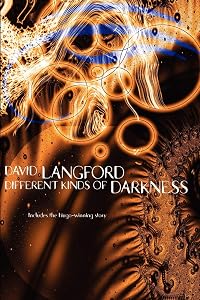
Different Kinds of Darkness
by David Langford
On This Page
Description
A major fiction collection from multiple Hugo Award winner David Langford, Different Kinds of Darkness complements his parody assortment He Do the Time Police in Different Voices. Besides the acclaimed, Hugo-winning title piece and its influential prequels, the 36 stories include the British SF Association Award winner "Cube Root", and eight "Year's Best" and "Best Of" anthology choices. SF, fantasy, horror, and unclassifiable Langford weirdness ranging from 1975 to 2003.Tags
Recommendations













Member Reviews
This is the fairly definitive collection of all of Dave Langford's serious short fiction up to 2004. It covers science fiction, fantasy and horror - though the horror is a particularly British type where the horrors are all of our own making. I was particularly struck by a 1994 story 'Serpent Eggs', wherein a UFO investigator follows up a story which takes him to a hippie commune on a remote Scottish island, and gets his comeuppance through his own lack of scientific knowledge. The writing in this story felt particularly dreich, as the Scots say, and the scene setting was particularly effective.
There are four outright fantasy stories in the collection; some have commented that they felt them to be so-so (although Dave Langford's 'so-so' show more would be the highest quality of many other writers in the genre), but I was well engaged with each of them, perhaps because I read very little heroic fantasy.
The best in the book is left to last; four of Dave's stories of 'basilisks', fractal images specifically designed to short-circuit the brains of anyone who looks at them. The last, from which the collection takes its name, shows the life-changing effects of taking any new thing to its ultimate conclusion, and is as good a piece of 'out-there' thinking as you could wish for. It won the Hugo Award for best short story in 2001. show less
There are four outright fantasy stories in the collection; some have commented that they felt them to be so-so (although Dave Langford's 'so-so' show more would be the highest quality of many other writers in the genre), but I was well engaged with each of them, perhaps because I read very little heroic fantasy.
The best in the book is left to last; four of Dave's stories of 'basilisks', fractal images specifically designed to short-circuit the brains of anyone who looks at them. The last, from which the collection takes its name, shows the life-changing effects of taking any new thing to its ultimate conclusion, and is as good a piece of 'out-there' thinking as you could wish for. It won the Hugo Award for best short story in 2001. show less
I love how a whole world can be created in a short story. Many of my early SF readings were the short stories in Analog magazine. I like short stories which I can read in up to 30 minutes. Longer than that they become something else. The perfect thing about outstanding short-stories like "Different Kinds of Darkness" is that it's short. I don't want to get to know the characters if I'm forced to part with them after 30 minutes or an hour. A lot of authors nowadays seem to be under the impression that all they have to do is write a scene and then just stop - no narrative, no message, no characters, no atmosphere, no point. Particularly true of single-author collections (but not Langford’s). I don't think I've really appreciated any show more writers in more than a single shorty story since the likes of Borges, Clarke, Langford & Bradbury. I measure shortness and thus quality of short stories by comparing how much of time passes in the narrative compared to how much time the book takes to read. Short stories - genre or literary - are more able to stun the reader in their entirety. You can forget bits of even the best novel. But an incisive short story hits you hard and hits you whole. I remember acutely reading Different Darkness” the first time round. The essence of Best Short Stories is something very difficult to attain. On the other hand, I’ve re-read entire novels I forgot which I read only a few years ago.
A well-executed short story is truly a Thing of Beauty. In this collection we have several Things of Beauty.
We all know Borges was the master of short stories. Langford comes a close second. show less
A well-executed short story is truly a Thing of Beauty. In this collection we have several Things of Beauty.
We all know Borges was the master of short stories. Langford comes a close second. show less
http://nhw.livejournal.com/598941.html
This is a collection of all Langford's short fiction not collected elsewhere (and also some that is). About half of it consists of his sf stories, ranging from decent to excellent in quality, including the brilliant "A Game of Consequences". Though I was struck that several of them revolved around a nuclear war and post-Holoocaust Britain; I guess we have different nightmares now.
Rather to my surprise the quality of the four pure fantasy stories in the collection is markedly inferior; I found them all somewhat formulaic. Again, rather to my surprise, I enjoyed almost all of the nine horror stories that followed, a genre I don't normally think of myself as liking much.
But the crowning glory of the show more collection is the sequence of "BLIT" stories. Langford has taken the idea of the drawings that kill you when you look at them and riffed it four different ways - police procedural ("BLIT"), academic politics ("What Happened at Cambridge IV"), usenet document ("comp.basilisk FAQ") and schoolboy yarn ("Different Kinds of Darkness", which won a Hugo). The third of these actually gives a genealogy of the concept including Fred Hoyle's The Black Cloud, J.B. Priestley's The Shapes of Sleep, Piers Anthony's Macroscope, William Gibson's Neuromancer, and Monty Python's sketch about the deadly effects of the World's Funniest Joke. I would add to these H.P. Lovecraft's "The Colour Out Of Space" and the experiments of Policeman MacCruiskeen in Flann O'Brien's The Third Policeman. show less
This is a collection of all Langford's short fiction not collected elsewhere (and also some that is). About half of it consists of his sf stories, ranging from decent to excellent in quality, including the brilliant "A Game of Consequences". Though I was struck that several of them revolved around a nuclear war and post-Holoocaust Britain; I guess we have different nightmares now.
Rather to my surprise the quality of the four pure fantasy stories in the collection is markedly inferior; I found them all somewhat formulaic. Again, rather to my surprise, I enjoyed almost all of the nine horror stories that followed, a genre I don't normally think of myself as liking much.
But the crowning glory of the show more collection is the sequence of "BLIT" stories. Langford has taken the idea of the drawings that kill you when you look at them and riffed it four different ways - police procedural ("BLIT"), academic politics ("What Happened at Cambridge IV"), usenet document ("comp.basilisk FAQ") and schoolboy yarn ("Different Kinds of Darkness", which won a Hugo). The third of these actually gives a genealogy of the concept including Fred Hoyle's The Black Cloud, J.B. Priestley's The Shapes of Sleep, Piers Anthony's Macroscope, William Gibson's Neuromancer, and Monty Python's sketch about the deadly effects of the World's Funniest Joke. I would add to these H.P. Lovecraft's "The Colour Out Of Space" and the experiments of Policeman MacCruiskeen in Flann O'Brien's The Third Policeman. show less
Frustratingly uneven.
Placeholder for Different Kinds of Darkness from LeVar Burton Reads
Really enjoyed this short story. It was unique and interesting.
Really enjoyed this short story. It was unique and interesting.
Ratings
Members
- Recently Added By
Author Information

104+ Works 2,263 Members
Work Relationships
Contains
Common Knowledge
- Original publication date
- 2004 (Collection) (Collection); 2000
- Disambiguation notice
- This is the collection of stories. Do not combine with the short story of the same name.
Classifications
Statistics
- Members
- 73
- Popularity
- 433,530
- Reviews
- 5
- Rating
- (4.12)
- Languages
- English
- Media
- Paper
- ISBNs
- 3