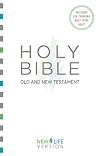
Holy Bible: New Life Version
by Barbour Publishing
On This Page
Description
Readable and affordable describe The New Life Version of the Bible, now available from Barbour. This unique scripture version, originally designed to reach people who did not speak English as their native language, uses a limited vocabulary of 850 words to simply and clearly share God's truth. For example, the term justified is rendered made right with God, and blaspheme is rendered speak against God. Ideal for seekers, new believers, or even mature Christians who want a new perspective on show more the Bible, The New Life Version provides the complete Old and New Testaments, along with topical studies and other helpful learning tools. show lessTags
Recommendations



















Member Recommendations

Member Reviews
This review casts no aspersions on the Bible itself - definitely a five-star work, amazing, exceptional, best book ever written, compelling, and all that.
Instead, this is a review of this particular translation of the Bible.
It has become all the rage to come out with "simplified" Bibles - Bible translations that get away from the "translationese" to become clearer to the modern reader/hearer.
From the introduction it seems this particular translation was the result of a desire to make concepts more clear and explainable in a mission context: to non-European or non-Western readers.
But what seems to be simplified are basic word concepts. "Prostitute" or "harlot" becomes "a woman who sells the use of her body." A prophet, at various show more times, is either "a person who tells what God will do in the future" or "a person who speaks for God" or something of the sort. Sentence structure is somewhat simplified, more in the New Testament than the Old.
Speaking of such, it is clear this was originally a New Testament translation with a later Old Testament translation appended to it. Reading through from Old to New becomes a jarring experience because the level of simplification is so much greater in the New than the Old.
Occasionally the simplification really succeeds and the full primary thrust of the passage really gets to you. Unfortunately, I had more moments where the simplification seemed to me to just make the text more clunky at best, and sometimes slightly misleading at worst. Prophets, for instance, don't always tell the future - they're just telling God's message for the people, and it's mostly rooted in the present, not the future. As with all such translations, to convey the primary meaning in a simplified form demands that secondary and tertiary nuances and flavors get completely missed or steamrolled over.
If it really helps out in the mission fields, I guess I can't complain much, but overall I do have to wonder about the value of endeavors such as these. It's not like place names or personal names are simplified, and in my experience, the learning curve for the novice Bible reader is made much worse by these rather than the use of "prophet" or "prostitute." It is a very interesting exercise to see the things translators prove willing to simplify ("regular" terminology) and the things they aren't (place names or people).
Also, it's based on the Majority text and all of its challenges, and includes the Comma Johannem. Why? I have no idea. Another strike against it.
If you as a reader are operating with a very limited vocabulary, or are working with a group of people with a limited vocabulary, this version might help. Otherwise, it's not even that helpful as a dynamic equivalence, to be honest. Meh. show less
Instead, this is a review of this particular translation of the Bible.
It has become all the rage to come out with "simplified" Bibles - Bible translations that get away from the "translationese" to become clearer to the modern reader/hearer.
From the introduction it seems this particular translation was the result of a desire to make concepts more clear and explainable in a mission context: to non-European or non-Western readers.
But what seems to be simplified are basic word concepts. "Prostitute" or "harlot" becomes "a woman who sells the use of her body." A prophet, at various show more times, is either "a person who tells what God will do in the future" or "a person who speaks for God" or something of the sort. Sentence structure is somewhat simplified, more in the New Testament than the Old.
Speaking of such, it is clear this was originally a New Testament translation with a later Old Testament translation appended to it. Reading through from Old to New becomes a jarring experience because the level of simplification is so much greater in the New than the Old.
Occasionally the simplification really succeeds and the full primary thrust of the passage really gets to you. Unfortunately, I had more moments where the simplification seemed to me to just make the text more clunky at best, and sometimes slightly misleading at worst. Prophets, for instance, don't always tell the future - they're just telling God's message for the people, and it's mostly rooted in the present, not the future. As with all such translations, to convey the primary meaning in a simplified form demands that secondary and tertiary nuances and flavors get completely missed or steamrolled over.
If it really helps out in the mission fields, I guess I can't complain much, but overall I do have to wonder about the value of endeavors such as these. It's not like place names or personal names are simplified, and in my experience, the learning curve for the novice Bible reader is made much worse by these rather than the use of "prophet" or "prostitute." It is a very interesting exercise to see the things translators prove willing to simplify ("regular" terminology) and the things they aren't (place names or people).
Also, it's based on the Majority text and all of its challenges, and includes the Comma Johannem. Why? I have no idea. Another strike against it.
If you as a reader are operating with a very limited vocabulary, or are working with a group of people with a limited vocabulary, this version might help. Otherwise, it's not even that helpful as a dynamic equivalence, to be honest. Meh. show less
I'm not fond of this version of the Bible. According to the author/editor/translators they use only 800 words in this version. While I appreciate keeping it simple, especially for younger readers, this version leaves out a lot of details and the meanings are not exactly the same as other versions. This also adds to wordiness in some instances. for example, instead of using one clearly recognizable word, they use an entire sentence to describe that one word.
It's an ok version for reading, but I would not use it to actually study. When comparing to other versions, this one falls short.
It's an ok version for reading, but I would not use it to actually study. When comparing to other versions, this one falls short.
Ratings
Members
- Recently Added By
Lists

Bible Translations
56 works; 1 member
Author Information

787 Works 8,648 Members
Common Knowledge
- Canonical title
- Holy Bible: New Life Version
Classifications
Statistics
- Members
- 82
- Popularity
- 386,816
- Reviews
- 2
- Rating
- (1.67)
- Languages
- English
- Media
- Paper, Ebook
- ISBNs
- 22
- ASINs
- 1