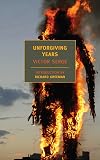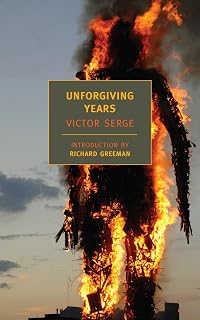
Unforgiving Years
by Victor Serge
On This Page
Description
A New York Review Books Original nbsp; Unforgiving Years is a thrilling and terrifying journey into the disastrous, blazing core of the twentieth century. Victor Serge's final novel, here translated into English for the first time, is at once the most ambitious, bleakest, and most lyrical of this neglected major writer's works. nbsp; The book is arranged into four sections, like the panels of an immense mural or the movements of a symphony. In the first, D, a lifelong revolutionary who has show more broken with the Communist Party and expects retribution at any moment, flees through the streets of prewar Paris, haunted by the ghosts of his past and his fears for the future. Part two finds D's friend and fellow revolutionary Daria caught up in the defense of a besieged Leningrad, the horrors and heroism of which Serge brings to terrifying life. The third part is set in Germany. On a dangerous assignment behind the lines, Daria finds herself in a city destroyed by both Allied bombing and Nazism, where the populace now confronts the prospect of total defeat. The novel closes in Mexico, in a remote and prodigiously beautiful part of the New World where D and Daria are reunited, hoping that they may at last have escaped the grim reckonings of their modern era. nbsp; A visionary novel, a political novel, a novel of adventure, passion, and ideas, of despair and, against all odds, of hope, Unforgiving Years is a rediscovered masterpiece by the author of The Case of Comrade Tulayev. show lessTags
Recommendations

























Member Reviews
An elegant literary thriller. It’s 1937 and D is an operative in the Soviet security services who, along with Nadine, his lover and fellow agent, is stationed in Paris. D, who poses as an antiques dealer, is appalled by the slaughter of his friends during Stalin’s show trials (see Robert Conquest's The Great Terror). He sends his letter of resignation prematurely to his superior, and then he and Nadine must run. In a drab hotel on Paris’s outskirts they keep Brownings on the bedside tables covered with silk handkerchiefs, ready for use. The nosy concierge, Gobfin, is an effete stool pigeon right out of Simenon who scares the living piss out of our heroes, who continue to run. There can be little question that Serge’s model for show more the first section--entitled “The Secret Agent”--is Conrad. There are touches of Simenon’s influence, too.
The second part, “The Flame Beneath the Snow,” focuses on the story of Daria, another of D’s Paris operatives. She’s just back from bleakest Kazakstan where she was been made to pay for her blameless association with D by years of work with impoverished Muslims. It’s 1943-44. We join Daria in the dead of winter descending into besieged Leningrad aboard a flak-riddled transport plane. Daria strikes us at first as a hypocrite, mouthing the absurd Soviet platitudes. In fact, although I always try to maintain objectivity, I’m afraid I weakened here and began to hate her a little. That’s how good the writing is. She composes journals so heavily self-censored that they’re little more than descriptions of the rain. For no names, no specifics about her many clandestine missions can ever be set to paper. But she’s a different person in private. After D and Paris her heart is no longer in the revolution. Once in Leningrad (one million Red Army soldiers and 643,000 civilians killed) she sleeps — how can she not! — with the athletically slim young Klimentii, a decorated soldier. Daria is assigned a desk job under Captain Potapov, whose long Dostoyevskian speech is a wonder of tortuous ratiocination.
A lovely taste of the 19th century Russian novel here, I thought. Of course, Hitler’s plan all along was to destroy Leningrad, to leave no inhabitant alive for the very reason Potapov cites. Then Daria is assigned to work with six soldiers ordered to crawl across the frozen Neva, behind enemy lines, and capture one or more Germans for questioning.
Part three — “Brigitte, Lightning, Lilacs” — is set in early April 1945 in flattened Berlin. The Allies are perhaps a week away from occupying the city. We begin in an air-raid shelter. Here is Brigitte, reduced to a tragic existence on the edge of madness, and Minus Two, a street-wise, prosthesis-adorned veteran. There are descriptions of Berlin streetscapes here that will curl your hair, or straighten it, depending. The overwhelming sense of loss, of destitution I can only hint at. This is the section of insanity. Many buildings have fallen on civilians which now reek of their contents. Every night the streets are destroyed but in the morning women and youngsters come out with their crude brooms to sweep up a semblance of the street grid. When the writing dips into the thoughts of Brigitte we are adrift, unmoored, grasping at figments.
Brigitte may make love to a Wehrmacht soldier, Günther, who brings her the surviving bits of her fiancé’s letters. It’s hard to know, since by this point everything has become so dreamlike. Minus Two combs the lethal streets at night — amid groups of armed rouges, official and otherwise — to see what he can scrounge, for much can be traded on the black market for food. Then the section shifts to a battlefield surgery behind the ever contracting German lines. Erna Laub’s career as a nurse is itemized by way of a dossier review. She’s not very good at what she does. In fact, she’s terrible at it.
In part four, "Journey's End," we return to Daria, now in flight. She is not entirely sure she is not followed. Much of what she goes through here smacks of PTSD. Daria takes ship, moves through American heartland, describing an arc from Brooklyn to the mid-west and south to Mexico. (Where Serge himself made his final home, where he wrote this novel and Comrade Tulayev as well as his revolutionary memoirs, knowing they would not be published in his lifetime. That, my friends, is commitment.) Daria joins D and Nadine hidden away in a backwater under aliases. There’s an overwrought, turgid quality to the writing in thIs part. Meaning often eluded me. I don’t blame the translator since he’s just given us 250 beautiful pages. I think the abstraction probably exists in the original French (I’d be delighted to hear from other GR friends with an opinion). Either Serge did not have time to revise this last section as much as he wanted to do, or he felt this was appropriate language for Daria’s state of mind. Needless to say, I believe it was the former. Even with this stylistic quibble, however, I give the novel five stars and ardently recommended it. (PS Unforgiving Years would make a fantastic movie.) show less
The second part, “The Flame Beneath the Snow,” focuses on the story of Daria, another of D’s Paris operatives. She’s just back from bleakest Kazakstan where she was been made to pay for her blameless association with D by years of work with impoverished Muslims. It’s 1943-44. We join Daria in the dead of winter descending into besieged Leningrad aboard a flak-riddled transport plane. Daria strikes us at first as a hypocrite, mouthing the absurd Soviet platitudes. In fact, although I always try to maintain objectivity, I’m afraid I weakened here and began to hate her a little. That’s how good the writing is. She composes journals so heavily self-censored that they’re little more than descriptions of the rain. For no names, no specifics about her many clandestine missions can ever be set to paper. But she’s a different person in private. After D and Paris her heart is no longer in the revolution. Once in Leningrad (one million Red Army soldiers and 643,000 civilians killed) she sleeps — how can she not! — with the athletically slim young Klimentii, a decorated soldier. Daria is assigned a desk job under Captain Potapov, whose long Dostoyevskian speech is a wonder of tortuous ratiocination.
So we find ourselves at a disadvantage, half beaten, yet doubly invincible since we cannot be beaten further without succumbing, and it is absolutely impossible for us to succumb.... ❡My guess is that the enemy deliberately put off the conquest of this position [Leningrad], when he could quite easily have taken it. He wanted to choose his moment, ensure his dominance over a hinterland, seize a great and serviceable port and not an isolated city, requiring to be fed, however little... It was a sensible decision but that moment has passed, never to return. In strategy as in life, lost opportunities are lost for good. The single factor of action with an overwhelming probability of disobedience is time, which is an admirable factor of inaction... (p. 132)
A lovely taste of the 19th century Russian novel here, I thought. Of course, Hitler’s plan all along was to destroy Leningrad, to leave no inhabitant alive for the very reason Potapov cites. Then Daria is assigned to work with six soldiers ordered to crawl across the frozen Neva, behind enemy lines, and capture one or more Germans for questioning.
Part three — “Brigitte, Lightning, Lilacs” — is set in early April 1945 in flattened Berlin. The Allies are perhaps a week away from occupying the city. We begin in an air-raid shelter. Here is Brigitte, reduced to a tragic existence on the edge of madness, and Minus Two, a street-wise, prosthesis-adorned veteran. There are descriptions of Berlin streetscapes here that will curl your hair, or straighten it, depending. The overwhelming sense of loss, of destitution I can only hint at. This is the section of insanity. Many buildings have fallen on civilians which now reek of their contents. Every night the streets are destroyed but in the morning women and youngsters come out with their crude brooms to sweep up a semblance of the street grid. When the writing dips into the thoughts of Brigitte we are adrift, unmoored, grasping at figments.
Brigitte’s eyes opened again, her hands sank to rest on her knees, her shoulders drooped forward as though with lassitude. A stealthy tremor was starting up at the base of her being, like the buzzing of malevolent insects in the gloom, like the approach of a solitary bomber in the sky. It was only the approach of the nameless terror, senseless, bottomless, lightless, lifeless and deathless, unspeakable, unendurable, ungraspable, imponderable; a wave rising from the very depths of darkness... Brigitte was tearing something to pieces, trying to rip the smallest shreds between sore fingers until her nails were tearing at one another. What more to destroy, how to sleep, where to disappear? She began reeling about the narrow room in short, crazed lunges. (p. 206)
Brigitte may make love to a Wehrmacht soldier, Günther, who brings her the surviving bits of her fiancé’s letters. It’s hard to know, since by this point everything has become so dreamlike. Minus Two combs the lethal streets at night — amid groups of armed rouges, official and otherwise — to see what he can scrounge, for much can be traded on the black market for food. Then the section shifts to a battlefield surgery behind the ever contracting German lines. Erna Laub’s career as a nurse is itemized by way of a dossier review. She’s not very good at what she does. In fact, she’s terrible at it.
In part four, "Journey's End," we return to Daria, now in flight. She is not entirely sure she is not followed. Much of what she goes through here smacks of PTSD. Daria takes ship, moves through American heartland, describing an arc from Brooklyn to the mid-west and south to Mexico. (Where Serge himself made his final home, where he wrote this novel and Comrade Tulayev as well as his revolutionary memoirs, knowing they would not be published in his lifetime. That, my friends, is commitment.) Daria joins D and Nadine hidden away in a backwater under aliases. There’s an overwrought, turgid quality to the writing in thIs part. Meaning often eluded me. I don’t blame the translator since he’s just given us 250 beautiful pages. I think the abstraction probably exists in the original French (I’d be delighted to hear from other GR friends with an opinion). Either Serge did not have time to revise this last section as much as he wanted to do, or he felt this was appropriate language for Daria’s state of mind. Needless to say, I believe it was the former. Even with this stylistic quibble, however, I give the novel five stars and ardently recommended it. (PS Unforgiving Years would make a fantastic movie.) show less
“Living among wolves, it would be reasonable to learn how to howl and bite like the wolves, but I preferred another fate, a more dangerous one I suppose because here as everywhere, a kind of sentence weighs upon the man who tries to be a bit more human than the general lot . . .”
—Unforgiving Years by Victor Serge
It’s not the greatness of “The Case of Comrade Tulayev”; but then again, very few books are. To contain any single line such as that quoted above within any text, however, speaks volumes to the greatness bound up in the beleaguered mind and body of Victor Serge
—Unforgiving Years by Victor Serge
It’s not the greatness of “The Case of Comrade Tulayev”; but then again, very few books are. To contain any single line such as that quoted above within any text, however, speaks volumes to the greatness bound up in the beleaguered mind and body of Victor Serge
Real forgotten classic. It's in four parts: the best are the first and last, where the plot actually happens. The middle two show the hallmarks of a lack of editor: bleak poetic descriptions of wartime Stalingrad and Berlin are beautiful but rather samey after 100 pages. One would've done.
Disclaimer. I am a Victor Serge fan from his previous novel, The Case of Comrade Tuleyev. This novel works less effectively than the brilliant Tuleyev work. The Paris scenes of two justifiably paranoid spy-lovers who have left the service flows effectively, not nearly like the narration of the four doomed party stalwarts in Tuleyev. The shift to the character in the city during the the last days of Nazi Germany has a challenging ebb and flow. Some of it wonderful. When Serge shifts to comments on art in the midst of bombardments, I had to gird myself, not for tedium, but a detour which left me wondering why this section was not edited out. In reading the memorir of Olga Ivanskaya, I noted how Olga comments how she and Boris Pasternak show more decided to expunge a part where Boris writes about flowers on a gravesite signifying continued presence of the loved one. She quoted the passage. Beautiful and brilliant. It interrupted the narrative, Olga wrote. She and Boris agreed it needed to be edited out. Serge had not Olga Ivanskaya to help with such decisions. While not rising to the level of Tuleyev, this work by Victor Serge worth the read, espeically for those who love Serge's writing. show less
This novel, set among disillusioned Soviet agents before, during and after World War II, reminded me in many ways of Boris Pasternak's Doctor Zhivago. It has Zhivago's strengths: depth of character study, memorable set pieces, delicate painting-in of the political background. It also has that novel's weaknesses: choppy, episodic, too many long sections in which nothing much happens.
Yet there are some truly memorable scenes here which make it worth persisting through the rough patches, especially the portrayals of Leningrad under siege, and of some disillusioned agents' attempts to escape history in Mexico. Recommended.
Yet there are some truly memorable scenes here which make it worth persisting through the rough patches, especially the portrayals of Leningrad under siege, and of some disillusioned agents' attempts to escape history in Mexico. Recommended.
Unforgiving Years is certainly not summer reading. With elements of Solzhenitsyn and John Le Carre (with a little romance), it isn’t War and Peace either. I picked it up at the Andover [MA] Public Library on spec. not thinking there was much chance I'd get through it. BTW, it’s a paperback with rather small writing for its 341 pages. It's a spy novel spanning the Second World War and beyond. It details the ambivalence, deceit, and futility of it all.
This one appeared messy to me. Not taut and talonned like Comrade Tulayev. I still enjoyed such.
Members
- Recently Added By
Lists

Russian Literature
184 works; 35 members
Author Information

83+ Works 3,542 Members
Victor Serge (1890-1947), best known as a novelist, was an active participant in the anarchist movement before becoming a committed Bolshevik once he reached Russia in 1939. An eloquent critic of tyranny no matter its form, Serge was a leading member of the Left Opposition in its struggle against Joseph Stalin, a cause that ultimately resulted in show more his exile from Russia. Ian Birchall is an independent writer and translator. His translations from the French include the writings of Victor Serge and Alfred Rosmer. He is on the editorial board of Revolutionary History and is a long-standing member of the British Socialist Workers Party. show less
Some Editions
Awards and Honors
Awards
Series
Belongs to Publisher Series
Common Knowledge
- Canonical title
- Unforgiving Years
- Original title
- Les Années sans pardon
- Original publication date
- 1971; 1932 (original French) (original French)
- People/Characters
- D (Sacha); Nadine; Alain; Daria; Klimentii; Brigitte (show all 7); Franz
- Important places
- Paris, France; Leningrad, Russia; Berlin, Germany; San Blas, Jalisco, Mexico
- Important events
- World War II
- First words
- Around seven in the morning, D personally loaded his two suitcases into the taxi.
- Quotations
- What is conscience? A residue of beliefs inculcated in us from the time of primitive taboos until today's mass press? Psychologists have come up with an appropriate term for these imprints deep within us: the superego, they s... (show all)ay. I have nothing left to invoke but conscience, and I don't even know what it is. I feel an ineffectual protest surging up from within a deep and unknown part of me to challenge destructive expediency, power, the whole of material reality, and in the name of what? Inner enlightenment? I'm behaving almost like a believer. I cannot do otherwise: Luther's words. Except that the German visionary who flung his inkwell at the devil went on to add, "God help me!" What will come to help me?
- Last words
- (Click to show. Warning: May contain spoilers.)"Me, cry? Are you kidding?"
- Original language
- French
Classifications
Statistics
- Members
- 385
- Popularity
- 81,254
- Reviews
- 10
- Rating
- (4.23)
- Languages
- 6 — Dutch, English, French, German, Italian, Spanish
- Media
- Paper, Audiobook, Ebook
- ISBNs
- 9
- UPCs
- 1
- ASINs
- 3