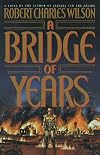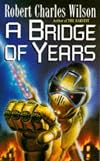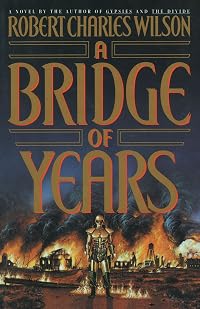
A Bridge of Years
by Robert Charles Wilson
On This Page
Description
"Tom Winter thought the secluded cottage in the Pacific Northwest would be the perfect refuge--a place to nurse the wounds of lost love and happiness. But Tom soon discovers that his safe haven is the portal of a tunnel through time. At one end is the present. At the other end--New York City, 1963. His journey back to the early 1960s seems to offer him the chance to start over in a simpler, safer world. But he finds that the tunnel holds a danger far greater than anything he left behind: a show more human killing machine escaped from a bleak and brutal future, who will do anything to protect the secret passage that he thought was his alone. To preserve his worlds, past and present, Tom Winter must face the terrors of an unknown world to come. "-- show lessTags
Recommendations















Member Reviews
In 1989, fresh from a traumatizing divorce, Tom Winter moves back to his hometown, buying a house on the outskirts of the woods. He notices the house is in remarkably good condition, considering it's supposedly been empty for the last 10 years, but then he discovers stranger things - robotic bugs performing maintenance and a time-traveling tunnel that leads to the New York City of 1962, hidden in the basement. Escaping the present and shacking up with a nice 60's beatnik girl seems like a good idea at the time...
But the tunnel was jammed open by a Terminator-like AWOL soldier from the 22nd century and the 60's may not be the safe haven they seem to be. Toms ex-, a ghost-chasing real estate agent, and the original custodian of the show more time-tunnel may all have to try to get Tom back before it's too late
A definitely mainstream-thriller feel to this book, but quite entertaining. Not one of my favorite books, but not bad either. show less
But the tunnel was jammed open by a Terminator-like AWOL soldier from the 22nd century and the 60's may not be the safe haven they seem to be. Toms ex-, a ghost-chasing real estate agent, and the original custodian of the show more time-tunnel may all have to try to get Tom back before it's too late
A definitely mainstream-thriller feel to this book, but quite entertaining. Not one of my favorite books, but not bad either. show less
The people of the very far future have discovered that temporary fractures form in the fabric of space time through which it's possible to travel to past eras. Since the 20th-22nd centuries were inordinately turbulent, little is known of their history; thus those far-future folk are eager to investigate it. They recruit people from those centuries to act as custodians to the time tunnels, rewarding them after the tunnels collapse with rejuvenation, wealth, etc. In the present (1989) Ben Collier, who originates from the mid-22nd century, has been maintaining a house in the sleepy little Pacific town of Belltower which is the front for a time-tunnel terminus. Into this world one day bursts Billy, a cyborg warrior from the late 21st show more century, a refugee from a weather war that's been raging for decades in the southeastern US; climate change has seriously damaged the US's viability and reduced its land area, but even so it's better off than the Caribbean, where a permanent hurricane-like feature now rages -- hence the war, as refugees try to find some safety. Billy murders and mutilates Ben, then carries on down the time tunnel to NYC in the early 1950s. Luckily the house comes equipped with "cybernetics" -- small robots, from rat-size down to nanobots, and these begin the excruciatingly slow, decade-long task of rebuilding Ben.
The decade is nearly up when, unwitting, Tom Winter -- fleeing a shattered marriage and a bout with the bottle -- buys it and tries to start a new life. Within hours he becomes aware of the bots, who are cleaning up every scrap of protein to aid in their task of reconstituting the dead time traveller. He establishes rudimentary communication with them, then travels down the tunnel to NYC, where it's now 1962. Soon Tom is deep in a love affair with Village folksinger Joyce, and decides that he'd like to live the rest of his days along this earlier timeline. But Billy becomes aware of his presence, and regards him as a threat to be eliminated . . .
Clearly Wilson is not much concerned with the customary supposed taboo of time-travel stories whereby it's supposed to be verboten for earlier/later versions of the same person to co-exist. Tom never in fact meets his infant self, and later a similar encounter between the two versions of Joyce is averted by a simple plot Bandaid; the inference is that Wilson decided merely to avoid the philosophical wrangle. Yet elsewhere (p240) he adopts an interesting take on the nature of time and time paradoxes: Wherever you are in time at the moment, your past in unalterable and your future malleable. If, however, you travel back in time such that what used to be your past is now your future, the relevant period shifts from the unalterable to the malleable state:
"You said there was a math for this?"
"So I'm told."
"You don't know it?"
"It's not twenty-second-century math. It's several millennia beyond that. I doubt you or I could contain it without a certain amount of neural augmentation."
Me too. But I've had lots of fun playing with the concept since reading the page or so in which Wilson presents it!
I'm a great fan of Wilson's, as is elsewhere evident. For some reason, though, this early work of his didn't seize me the same way that I can recall other books of his of that era doing, in particular A Hidden Place. It's as if, here, someone told him he had to write something that was a bit more like the skiffy the other kids were writing (little Billy in his bright gold armour, coming back from the future with lethal intent, has more than a whiff of Terminator about him, even though circumstances and motivation are entirely different; and so on). The result is that A Bridge of Years is very good of its kind but doesn't have that extra something we've come to expect from a Wilson novel -- or, at least, doesn't have as much of it. That said, the book was way ahead of the curve on climate change at a time when much of the world seemed to have forgotten earlier murmurings: the possibility of a permanent weather feature in the Gulf (or thereabouts) is so far as I know a purely fictional notion, but all the other aspects of AGW that he describes are absolutely in line with the predictions climate scientists have been coming out with more recently. show less
The decade is nearly up when, unwitting, Tom Winter -- fleeing a shattered marriage and a bout with the bottle -- buys it and tries to start a new life. Within hours he becomes aware of the bots, who are cleaning up every scrap of protein to aid in their task of reconstituting the dead time traveller. He establishes rudimentary communication with them, then travels down the tunnel to NYC, where it's now 1962. Soon Tom is deep in a love affair with Village folksinger Joyce, and decides that he'd like to live the rest of his days along this earlier timeline. But Billy becomes aware of his presence, and regards him as a threat to be eliminated . . .
Clearly Wilson is not much concerned with the customary supposed taboo of time-travel stories whereby it's supposed to be verboten for earlier/later versions of the same person to co-exist. Tom never in fact meets his infant self, and later a similar encounter between the two versions of Joyce is averted by a simple plot Bandaid; the inference is that Wilson decided merely to avoid the philosophical wrangle. Yet elsewhere (p240) he adopts an interesting take on the nature of time and time paradoxes: Wherever you are in time at the moment, your past in unalterable and your future malleable. If, however, you travel back in time such that what used to be your past is now your future, the relevant period shifts from the unalterable to the malleable state:
"You said there was a math for this?"
"So I'm told."
"You don't know it?"
"It's not twenty-second-century math. It's several millennia beyond that. I doubt you or I could contain it without a certain amount of neural augmentation."
Me too. But I've had lots of fun playing with the concept since reading the page or so in which Wilson presents it!
I'm a great fan of Wilson's, as is elsewhere evident. For some reason, though, this early work of his didn't seize me the same way that I can recall other books of his of that era doing, in particular A Hidden Place. It's as if, here, someone told him he had to write something that was a bit more like the skiffy the other kids were writing (little Billy in his bright gold armour, coming back from the future with lethal intent, has more than a whiff of Terminator about him, even though circumstances and motivation are entirely different; and so on). The result is that A Bridge of Years is very good of its kind but doesn't have that extra something we've come to expect from a Wilson novel -- or, at least, doesn't have as much of it. That said, the book was way ahead of the curve on climate change at a time when much of the world seemed to have forgotten earlier murmurings: the possibility of a permanent weather feature in the Gulf (or thereabouts) is so far as I know a purely fictional notion, but all the other aspects of AGW that he describes are absolutely in line with the predictions climate scientists have been coming out with more recently. show less
The engrossing fun of reading A Bridge of Years comes from starting out in the normal, almost boring world of the American northwest late 1980s, and then watching the layers peel back as the story shifts to something more supernatural with each passing chapter.
For a tale that literally spans years, as suggested by the title, the heart of it feels deceptively in the moment. A Bridge of Years is more personal than epic.
For a tale that literally spans years, as suggested by the title, the heart of it feels deceptively in the moment. A Bridge of Years is more personal than epic.
This late eighties time travel SF is very sedate and careful, focused more on characters and mystery than anything directly related to the two main timelines. Early sixties and late eighties. The SF aspect and plot is actually rather sophisticated, building some nice rules and much better method, and the hints and descriptions of our future and even a much more distant future kept me going nicely.
But what was the best part of the novel?
It read like a thriller/horror. :) Lots of careful character build-up, curiosity, awe, and exploring new situations, if not times. Just with this aspect, I had a great time.
Yes, there is a lot of great time travel SF novels out there, but so many lack good characters and heart. This one succeeds on that show more level. :) It's not flashy, but it kept me on the edge of my seat for the entire time. show less
But what was the best part of the novel?
It read like a thriller/horror. :) Lots of careful character build-up, curiosity, awe, and exploring new situations, if not times. Just with this aspect, I had a great time.
Yes, there is a lot of great time travel SF novels out there, but so many lack good characters and heart. This one succeeds on that show more level. :) It's not flashy, but it kept me on the edge of my seat for the entire time. show less
Would give it a 3.5 if possible. Robert Charles Wilson is one of my favorite sci-fi authors. He always presents thoughtful perspectives/speculations, his characters have dimension, and his prose can at times be lyrical. I'm actually judging this book in light of Wilson's own later work, as (so we would expect) he has only gotten better with time.
I enjoyed the book, though in the wake of many other things that have been written since the employ themes of nanotechnology, the marriage of man-machine, not to mention time-travel, the story now had a certain sense of conventionality about it (might have been revelatory at the time of its publication date).
There is one thing that bugged me, though, as a resident of the Pacific Northwest: show more Wilson keeps talking about the pine forests that dominate the landscape. Shame! He should know better, given that at the time he wrote this book he was living in BC. The coastal Northwest forests are dominated by firs, not pines, and we're eager to point out to newcomers the difference. show less
I enjoyed the book, though in the wake of many other things that have been written since the employ themes of nanotechnology, the marriage of man-machine, not to mention time-travel, the story now had a certain sense of conventionality about it (might have been revelatory at the time of its publication date).
There is one thing that bugged me, though, as a resident of the Pacific Northwest: show more Wilson keeps talking about the pine forests that dominate the landscape. Shame! He should know better, given that at the time he wrote this book he was living in BC. The coastal Northwest forests are dominated by firs, not pines, and we're eager to point out to newcomers the difference. show less
I liked the beginning, it had a super interesting premise. I had a bit of a hard time following some of the sudden jumps in perspective and I did not really fully understand the ending :/ . I noticed the "moral" of the story seemed really similar to Stephen King's 11/22/63 (I know it was written earlier). Basically that you should not try to live out of your time because no time is fundamentally different.
A fun, light read. Recommended for time travel fans, though there's nothing here you haven't seen before. I enjoyed it.
Members
- Recently Added By
Lists

Best Time Travel Novels
165 works; 123 members

Best time travel books
56 works; 21 members
Author Information

47+ Works 14,413 Members
Some Editions
Awards and Honors
Awards
Series
Belongs to Publisher Series
Gallimard, Folio SF (449)
Common Knowledge
- Canonical title*
- À travers temps
- Original title
- A Bridge of Years
- Original publication date
- 1991
- People/Characters
- Tom Winter; Doug Archer; Ben Collier; Joyce Casella; Billy Gargullo
- Important places
- Belltower, Washington; Greenwich Village, Manhattan, New York
- Epigraph
- Woe is me, woe is me!
The acorn's not yet fallen from the tree
That's to grow the wood
That's to make the cradle
That's to rock the babe
That's to grow a man
That's to lay me to my rest.
-Anonymous, "The ... (show all)Ghost's Song" - Dedication
- For Paul ... for whom the future is more than theoretical
- First words
- Prologue: April 1979
Soon the time traveler would face the necessity of his own death. - Last words
- (Click to show. Warning: May contain spoilers.)"I'm tired," he said. The sun was hot and made him tired and he felt like he'd walked for a very long way.
- Blurbers
- King, Stephen
- Original language*
- Anglais canadien
*Some information comes from Common Knowledge in other languages. Click "Edit" for more information.
Classifications
Statistics
- Members
- 395
- Popularity
- 78,866
- Reviews
- 8
- Rating
- (3.43)
- Languages
- English, French, German
- Media
- Paper, Audiobook, Ebook
- ISBNs
- 13
- ASINs
- 5