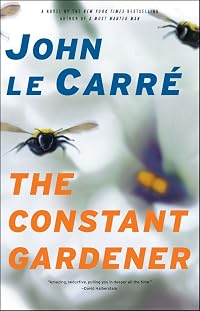
The Constant Gardener
by John le Carré
On This Page
Description
Frightening, heartbreaking, and exquisitely calibrated, John le Carré's new novel opens with the gruesome murder of the young and beautiful Tessa Quayle near northern Kenya's Lake Turkana, the birthplace of mankind. Her putative African lover and traveling companion, a doctor with one of the aid agencies, has vanished from the scene of the crime. Tessa's much older husband, Justin, a career diplomat at the British High Commission in Nairobi, sets out on a personal odyssey in pursuit of the show more killers and their motive. A master chronicler of the deceptions and betrayals of ordinary people caught in political conflict, le Carré portrays, in The Constant Gardener, the dark side of unbridled capitalism. His eighteenth novel is also the profoundly moving story of a man whom tragedy elevates. Justin Quayle, amateur gardener and ineffectual bureaucrat, seemingly oblivious to his wife's cause, discovers his own resources and the extraordinary courage of the woman he barely had time to love. The Constant Gardener is a magnificent exploration of the new world order by one of the most compelling and elegant storytellers of our time. show lessTags
Recommendations

















Member Recommendations
Member Reviews
News comes in that a British subject has been found violently murdered near Lake Turkana in Kenya. Tessa, the wife of a British diplomat named Justin Quayle, is found dead in a locked car with the headless corpse of her driver next to her. Her companion on the trip, Dr. Arnold Bluhm, a handsome black Belgian doctor, is nowhere to be found, putting him on the top of the police's suspect list. He is not the only person of interest, both Justin and his superior, Sandy, are also on the list, the latter because he had a large crush on Tessa. British police fly out to work on the case, which has far reaching implications.
Tessa is the thorn in the side of the authorities, she has thrown herself into aid work in Kenya, not content to be a lady show more who lunches. She is passionate about the country and its people, and not unwilling to speak out about injustices. Along with Dr. Arnold, she uncovers discrepancies in a pharmaceutical company's drug trials. As investigations into the murders goes deeper, attempts at getting at the truth are hindered, with no one, not even her husband, Justin, telling the whole truth.
The author jumps from narrator to narrator, as well as using Tessa's own words, to give us the insider's view, as the characters struggle with their conscience, reminding us that we are all human and life can not be determined in black and white.
Le Carre brings together a convincing, compelling thriller, one which in today's climate appears all too realistic. The God of Profit, as one of the characters terms it, is all too omnipresent today. The reality is that developing world is being used as a testing ground for new drugs and that our governments pick and choose when to support or condemn a regime on financial grounds. The book had even more resonance for me in the wake of the Arab Spring and various scandals about the misuse of aid.
This arrived in a bookbox not long after seeing the film adaptation. The film differs rather a lot from the book, but both are worth your attention. show less
Tessa is the thorn in the side of the authorities, she has thrown herself into aid work in Kenya, not content to be a lady show more who lunches. She is passionate about the country and its people, and not unwilling to speak out about injustices. Along with Dr. Arnold, she uncovers discrepancies in a pharmaceutical company's drug trials. As investigations into the murders goes deeper, attempts at getting at the truth are hindered, with no one, not even her husband, Justin, telling the whole truth.
The author jumps from narrator to narrator, as well as using Tessa's own words, to give us the insider's view, as the characters struggle with their conscience, reminding us that we are all human and life can not be determined in black and white.
Le Carre brings together a convincing, compelling thriller, one which in today's climate appears all too realistic. The God of Profit, as one of the characters terms it, is all too omnipresent today. The reality is that developing world is being used as a testing ground for new drugs and that our governments pick and choose when to support or condemn a regime on financial grounds. The book had even more resonance for me in the wake of the Arab Spring and various scandals about the misuse of aid.
This arrived in a bookbox not long after seeing the film adaptation. The film differs rather a lot from the book, but both are worth your attention. show less
Justin Quayle is a member of the British Foreign Legation in Kenya. He has a beautiful, younger wife Tessa who is involved with various NGO aid projects – which she keeps mostly hidden from her husband as he probably wouldn’t approve.
In the opening scene she is brutally murdered.
Justin leaves his beloved gardening and his bureaucratic job to search out her projects and solve her murder.
He finds many more bodies, questionable ethical decisions and huge amounts of money leading back to big Pharma – and a drug purported to be a cure-all for the multiple drug resistant TB strains found in AIDS patients in Africa.
But too much is on the line for those in power to let their schemes be discovered.
I enjoyed this. It was very engaging and show more twisty and turn-y. It also brought up the ethics of big pharmaceutical countries donating their expired drugs to poor countries as well as the morality of doing testing on populations that are not fully informed and have no other alternatives for treatment. show less
In the opening scene she is brutally murdered.
Justin leaves his beloved gardening and his bureaucratic job to search out her projects and solve her murder.
He finds many more bodies, questionable ethical decisions and huge amounts of money leading back to big Pharma – and a drug purported to be a cure-all for the multiple drug resistant TB strains found in AIDS patients in Africa.
But too much is on the line for those in power to let their schemes be discovered.
I enjoyed this. It was very engaging and show more twisty and turn-y. It also brought up the ethics of big pharmaceutical countries donating their expired drugs to poor countries as well as the morality of doing testing on populations that are not fully informed and have no other alternatives for treatment. show less
John le Carré is incapable of writing a bad sentence, and frequently writes good ones. This gives him a major head start on the pack and always has. Yes, he writes thrillers, but they are highbrow thrillers which attempt to do more than while away a few hours in the airport lounge. This book took me a fortnight to read, which is unusual for me. It is not a page-turner. More precisely, I found turning the pages to be a good idea, but not absolutely essential. The highlight for me was the masterful way in which grief was explored: Justin for his murdered Tessa. The lowlight was the over-elaborate way the plot was spun out with what the author considered to be subtle nuances of characterisation and colour; some worked, others got on my show more nerves. Particularly irritating - because incomprehensible - was the cagey way Justin responded to the police, as though he didn't want Tessa's murderers found. This labouring of tension - taking secrecy and subterfuge to the limit and then slightly beyond - is a gripe I've had with several other of his works as well. But the ending was very fine, and the book is staying in my memory warts and all. show less
I absolutely loved the first 40ish percent of this audiobook read by John le Carre (and he is a marvelous reader, btw.) It was a rich and complex tale with a complicated web of relationships laid on top of the tragic story of Western companies offloading and testing questionable products in the developing world. Then Le Carre fell into some of the tropes that make me not love these sorts of adventure thrillers.
The pharma CEO villain was a mustache twirler. The murder victim, Tessa, was a preternaturally beautiful woman whose characterization as a Madonna (holy mother, not Detroit bred pop star) was so over the top Le Carre actually included a scene of her nursing the infant of a dying African woman. This is a 21st century entertainment show more so our Madonna had a sprinkling of whore about her as well (maybe more like the pop star than I had been thinking!) to keep things interesting and to seem just a touch less dichotomous. Also, Tessa was supposed to be a lawyer, but everything she did was driven by emotion with no thought at all given to risk or next steps. She was ditzy and weepy and anti-intellectual, so not very lawyer-like at all. But again, it is 2005 so our distressed damsel had to have an advanced degree. The male Brits were all cold reserved pragmatists, the resourceful and good women were beautiful, the one fat woman was bad. I mostly liked this, I adored the end completely, but the genre standard choices shattered the tension for me and made this less gripping and fun than it could have been. My reader friends with excellent taste have been telling me for years that I needed to read Le Carre, that he was the master, so the second half slide into boilerplate thriller was particularly disappointing. I did love the writing in the first portion, and I was a big fan of Justin as a character so I am definitely going to read more from Le Carre and hope that the next will be tighter. show less
The pharma CEO villain was a mustache twirler. The murder victim, Tessa, was a preternaturally beautiful woman whose characterization as a Madonna (holy mother, not Detroit bred pop star) was so over the top Le Carre actually included a scene of her nursing the infant of a dying African woman. This is a 21st century entertainment show more so our Madonna had a sprinkling of whore about her as well (maybe more like the pop star than I had been thinking!) to keep things interesting and to seem just a touch less dichotomous. Also, Tessa was supposed to be a lawyer, but everything she did was driven by emotion with no thought at all given to risk or next steps. She was ditzy and weepy and anti-intellectual, so not very lawyer-like at all. But again, it is 2005 so our distressed damsel had to have an advanced degree. The male Brits were all cold reserved pragmatists, the resourceful and good women were beautiful, the one fat woman was bad. I mostly liked this, I adored the end completely, but the genre standard choices shattered the tension for me and made this less gripping and fun than it could have been. My reader friends with excellent taste have been telling me for years that I needed to read Le Carre, that he was the master, so the second half slide into boilerplate thriller was particularly disappointing. I did love the writing in the first portion, and I was a big fan of Justin as a character so I am definitely going to read more from Le Carre and hope that the next will be tighter. show less
My previous reading of le Carré has been limited to his political thrillers. This book is in some regards quite different, although I'd have to say that overall it does carry the same sensibility.
The enemy in this book is Big Pharma, and Africa is the land under attack. A multi-national is ruthlessly testing an anti-tuberculosis drug with lethal side-effects, especially for pregnant women, on impoverished native populations. Their objective is to work out the kinks quickly without bothering with proper clinical trials, before presenting it for sale in well-paying Western markets.
Note: [b:The Constant Gardener|19000|The Constant Gardener|John le show more Carré|https://i.gr-assets.com/images/S/compressed.photo.goodreads.com/books/1348649766l/19000._SY75_.jpg|1442776] was written in 2001, well before so much of the US was victimized by the opioid crisis unleashed by real world Big Pharma. The setting was different, but the greed and the human costs were uncannily similar, and the comparison was continuously on the edges of my mind as I read.
le Carré exposes these exploitative crimes by means of a love story set within the British embassy community in Nairobi. Tessa is the decades-younger wife of Justin Quayle, a career diplomat who has studiously created a pleasant but somewhat uninvolved life where his greatest passion is cultivating plants, not relationships. That changes once they meet, and the momentum of the book stems from Justin's attempts at becoming reconciled to his failure to commit fully to his love for Tessa, and to her zeal for confronting injustice.
Although his interior life was upended by his unanticipated love for her, externally Justin he attempted to maintain the same public face - until she was murdered while on a humanitarian mission. His determination to unearth the truth about what she was investigating and the circumstances of her death lead him to actions that are completely inconsistent with his prior understanding of himself.
But what of Tessa? Well, she's certainly more fully developed as a character than most women in le Carré novels. Coming from a background of extreme privilege she chooses to ignore her wealth and beauty unless they are used in the service of obtaining justice for the underserved. She defiantly pursues her own agendas rather than meeting the typical expectations of a spouse of an embassy official. This is what we see of her from the outside, but we are not privileged to an interior view. We learn much more of Justin than of her.
Which brings me to an element of the book that is, in a way, the most different from le Carré's spy novels. There is no moral ambiguity to the characters or the causes. Tessa is a paragon of virtue, as is Justin following her death. There are no real redeeming qualities to Big Pharma, and while some of its representatives may regret their involvement (Lara wholeheartedly and Lorbeer in a conflicted way), all are driven by greed.
By contrast, the cold war thrillers were haunted by a sense of whether the things that Smiley (and others) did in pursuit of their cause justified the outcomes. There is no question that this is a very different story and perhaps that equivocal quality would be inappropriate, but I will confess to becoming a bit discouraged with the unrelenting rightness of Tessa's/Justin's cause.
Or maybe that's just a form of compassion fatigue by the time I'd finished the book. There was so much to be outraged about, such a sharp demonstration of the weaknesses of the human condition, of "man's inhumanity to man" on so many levels. Of how easy it is to look the other way when its inconvenient.
As always, le Carré has much to share, and does it with his incomparable prose. show less
The enemy in this book is Big Pharma, and Africa is the land under attack. A multi-national is ruthlessly testing an anti-tuberculosis drug with lethal side-effects, especially for pregnant women, on impoverished native populations. Their objective is to work out the kinks quickly without bothering with proper clinical trials, before presenting it for sale in well-paying Western markets.
Note: [b:The Constant Gardener|19000|The Constant Gardener|John le show more Carré|https://i.gr-assets.com/images/S/compressed.photo.goodreads.com/books/1348649766l/19000._SY75_.jpg|1442776] was written in 2001, well before so much of the US was victimized by the opioid crisis unleashed by real world Big Pharma. The setting was different, but the greed and the human costs were uncannily similar, and the comparison was continuously on the edges of my mind as I read.
le Carré exposes these exploitative crimes by means of a love story set within the British embassy community in Nairobi. Tessa is the decades-younger wife of Justin Quayle, a career diplomat who has studiously created a pleasant but somewhat uninvolved life where his greatest passion is cultivating plants, not relationships. That changes once they meet, and the momentum of the book stems from Justin's attempts at becoming reconciled to his failure to commit fully to his love for Tessa, and to her zeal for confronting injustice.
Although his interior life was upended by his unanticipated love for her, externally Justin he attempted to maintain the same public face - until she was murdered while on a humanitarian mission. His determination to unearth the truth about what she was investigating and the circumstances of her death lead him to actions that are completely inconsistent with his prior understanding of himself.
But what of Tessa? Well, she's certainly more fully developed as a character than most women in le Carré novels. Coming from a background of extreme privilege she chooses to ignore her wealth and beauty unless they are used in the service of obtaining justice for the underserved. She defiantly pursues her own agendas rather than meeting the typical expectations of a spouse of an embassy official. This is what we see of her from the outside, but we are not privileged to an interior view. We learn much more of Justin than of her.
Which brings me to an element of the book that is, in a way, the most different from le Carré's spy novels. There is no moral ambiguity to the characters or the causes. Tessa is a paragon of virtue, as is Justin following her death. There are no real redeeming qualities to Big Pharma, and while some of its representatives may regret their involvement (Lara wholeheartedly and Lorbeer in a conflicted way), all are driven by greed.
By contrast, the cold war thrillers were haunted by a sense of whether the things that Smiley (and others) did in pursuit of their cause justified the outcomes. There is no question that this is a very different story and perhaps that equivocal quality would be inappropriate, but I will confess to becoming a bit discouraged with the unrelenting rightness of Tessa's/Justin's cause.
Or maybe that's just a form of compassion fatigue by the time I'd finished the book. There was so much to be outraged about, such a sharp demonstration of the weaknesses of the human condition, of "man's inhumanity to man" on so many levels. Of how easy it is to look the other way when its inconvenient.
As always, le Carré has much to share, and does it with his incomparable prose. show less
A brisk but rickety read. Le Carre's got an excellent, twisty mind for subterfuge and intringue and gimlet-eyed maneuvering, as well as an occasional supernatural ability to twist out a mind-bogglingly crisp, gorgeous phrase. These are great things! And Le Carre at full speed is pretty much unstoppable. Too bad he spends most of THE CONSTANT GARDENER chugging in place and treading water. It's hard to pin down the novel's failure to any one point, but a huge, blaring weakness is the almost malevolently uneven characterization all around. Le Carre doesn't usually make a point of rubberstamping SAINTS and SINNERS, which means that all of his characters usually have free range to be both good and bad and COMPLEX; free range to scheme and show more tussle with one another to, you know, crab together a decent, intriguing, chaos-fueled plot. There's none of this in THE CONSTANT GARDENER. While there are a few beginning spurts, and while the initial multi-perspective take is interesting, it all collapses into such clearly demarcated lines of NOBILITY versus VENAL SCUM that the battles don't seem quite fair, and the book begins to read more as a parable than, you know, an actual thriller. The overall effect - combined in particular with Le Carre's absolutely noxious and amateurish reliance on droning on and on about his characters' physical traits (Cliffnotes: willowy = good, fatty = bad)- is one of smarmy sanctimony. The truth is, the realities actually underlying Le Carre's plot are, in themselves and without any embellishment, so fucking grim that his attempts to jerk our heartstrings plays out as sort of groping and cloying and just plain hammy.
SIDENOTE: Also! A personal grudge! Gotta say that I'm sick of stories about the Beloved White Saviors (hi Tessa!) of Poor Impoverished, Corrupt, Helpless Africa (hi Wanza! And, you know. All the other African characters of any real significance!). The narrative makes my skin crawl (see also: The Last King of Scotland; Blood Diamond). Because, seriously, Le Carre deifies Tessa to grotesque levels - if he strung any more garlands around her neck he'd have garroted her - and takes an especially clammy, patronizing bullshit tone towards all the Africans throughout the novel. BEHOLD LE CARRE'S AFRICA of (1) Saints, (2) Corrupt Grifters/Rapists/Murderers, (3) Victims. Anyone with balls and a personality need not apply.
But, yeah. White Man's Burden, not a literary theme that needs bringing back! Let's get real, and let's not simplify it to some overemoted crap. The current situation isn't angels versus demons; it's complex and it's people versus people. show less
SIDENOTE: Also! A personal grudge! Gotta say that I'm sick of stories about the Beloved White Saviors (hi Tessa!) of Poor Impoverished, Corrupt, Helpless Africa (hi Wanza! And, you know. All the other African characters of any real significance!). The narrative makes my skin crawl (see also: The Last King of Scotland; Blood Diamond). Because, seriously, Le Carre deifies Tessa to grotesque levels - if he strung any more garlands around her neck he'd have garroted her - and takes an especially clammy, patronizing bullshit tone towards all the Africans throughout the novel. BEHOLD LE CARRE'S AFRICA of (1) Saints, (2) Corrupt Grifters/Rapists/Murderers, (3) Victims. Anyone with balls and a personality need not apply.
But, yeah. White Man's Burden, not a literary theme that needs bringing back! Let's get real, and let's not simplify it to some overemoted crap. The current situation isn't angels versus demons; it's complex and it's people versus people. show less
If you have seen the movie, this is a tough book to read, with its tragic, almost spiritual, ending. For me it felt a bit padded out, as the "hero" is not terribly interesting, although the cast of fatuous and corrupt British civil servants and remorseful corporate stooges kind of makes up for it. This is another one of Le Carre's "travelogue" novels, where he vividly recreates places (and probably also real people) that he encountered on a sprawling reporting jaunt. I find Le Carre at his best deflating the upper crust British bureaucrats in the upper echelons of government and corporations. I was deeply moved by the film adaptation when it came out 20 years ago; now, reading the novel, it feels a bit silly. I suppose it could be read show more as a critique of the white savior trope, but Le Carre seems really taken with it, although his white saviors do not seem particularly effective. show less
Members
- Recently Added By
Published Reviews
ThingScore 88
Im Nachwort seines 18. Romans schreibt John le Carré: "Je tiefer ich in den pharmazeutischen Dschungel eindrang, desto klarer wurde mir, dass mein Roman, verglichen mit der Wirklichkeit, ungefähr so harmlos ist wie eine Urlaubspostkarte." Was so nicht stimmt, denn der Roman ist weder harmlos noch sollte man ihn an der Realität messen. John le Carré hat eine blutige Variante der show more Verstrickung von Politik und Wirtschaft in Szene gesetzt, von der wir inständig hoffen, dass sie niemals Realität wird. Schon die Vorstellung solcher Zusammenhänge, wie sie John le Carré in seinem Roman aufgezeigt hat, flößt Angst ein und sensibilisiert das Unrechtsbewusstsein des Lesers. Eine positive Nebenwirkung! Aus diesem Grund und für einige spannende Lektürestunden sollte man dem Autor dankbar sein. show less
added by Indy133
added by DouglasAtEik
Lists

The Guardian's 1000 Novels Everyone Must Read
1,005 works; 552 members

Best Spy Fiction
153 works; 102 members

The Guardian's 100 best books of the 21st century
100 works; 21 members

Books About Murder
313 works; 7 members

Most Popular Books Tagged Africa
35 works; 3 members

Unread books
1,063 works; 87 members

Read in 2014
334 works; 11 members

So you want to get into medicine
29 works; 6 members

Stories set on African soil
183 works; 2 members

Fiction: Thriller
78 works; 1 member
Author Information

212+ Works 99,299 Members
David John Moore Cornwell was born in Poole, Dorsetshire, England in 1931. He attended Bern University in Switzerland from 1948-49 and later completed a B.A. at Lincoln College, Oxford. He taught at Eton from 1956-58 and was a member of the British Foreign Service from 1959 to 1964. He writes espionage thrillers under the pseudonym John le Carré. show more The pseudonym was necessary when he began writing, in the early 1960s because, at that time, he held a diplomatic position with the British Foreign Office and was not allowed to publish under his own name. When his third book, The Spy Who Came in from the Cold, became a worldwide bestseller in 1964, he left the foreign service to write full time. His other works include Call for the Dead; A Murder of Quality; Tinker, Tailor, Soldier, Spy; The Honourable Schoolboy; and Smiley's People. He has received numerous awards for his writing, including the Grand Master Award from the Mystery Writers of America in 1986 and the Diamond Dagger from the Crime Writers Association in 1988. In 2011 he accepted the Goethe Medal. And in 2020, he accepted the Olof Palme Prize. Ten of his books have been adapted for television and motion pictures including The Spy Who Came in from the Cold, The Russia House, The Constant Gardener, A Most Wanted Man, and Our Kind of Traitor. Le Carré's memoir, The Pigeon Tunnel: Stories from my Life, became a New York Times bestseller in 2016. In 2019, he published a spy thriller, Agent Running in the Field. John Le Carré died on December 12, 2020 from pneumonia at the age of 89. (Bowker Author Biography) John le Carre was born in 1931. After attending the univesities of Berne and Oxford, he spent five years in the British Foreign Service. He's the author of eighteen novels, translated into twenty-five languages. He lives in England. (Publisher Provided) show less
Some Editions
Awards and Honors
Series
Belongs to Publisher Series
Work Relationships
Common Knowledge
- Canonical title*
- De toegewijde tuinier
- Original title
- The Constant Gardener
- Original publication date
- 2001
- People/Characters
- Justin Quayle; Tessa Quayle (née Abbott); Sandy Woodrow; Ghita; Arnold Bluhm
- Important places
- Africa; East Africa; Kenya; Nairobi, Kenya
- Related movies
- The Constant Gardener (2005 | IMDb)
- Epigraph
- Ah, but a man's reach should exceed his grasp,
Or what's a heaven for?
—"Andrea del Sarto" by Robert Browning - Dedication
- For Yvette Pierpaoli who lived and died giving a damn
- First words
- The news hit the British High Commission in Nairobi at nine-thirty on a Monday Morning.
- Last words
- (Click to show. Warning: May contain spoilers.)He heard a sound of feet sliding down white rock.
- Blurbers
- Wolfe, Tom; Turow, Scott
*Some information comes from Common Knowledge in other languages. Click "Edit" for more information.
Classifications
Statistics
- Members
- 5,707
- Popularity
- 2,318
- Reviews
- 97
- Rating
- (3.61)
- Languages
- 24 — Catalan, Chinese, Czech, Danish, Dutch, English, Finnish, French, German, Greek, Hebrew, Hungarian, Italian, Japanese, Norwegian (Bokmål), Norwegian, Polish, Romanian, Russian, Slovenian, Spanish, Swedish, Turkish, Portuguese (Portugal)
- Media
- Paper, Audiobook, Ebook
- ISBNs
- 138
- UPCs
- 1
- ASINs
- 34