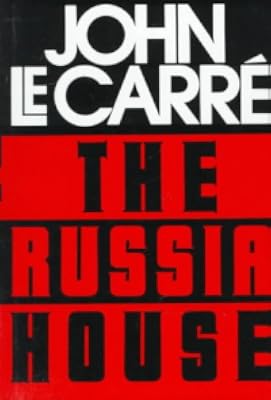
The Russia House
by John le Carré
On This Page
Description
John le Carre has earned worldwide acclaim with extraordinary spy novels, including The Russia House, an unequivocal classic. Navigating readers through the shadow worlds of international espionage with critical knowledge culled from his years in British Intelligence, le Carre tracks the dark and devastating trail of a document that could profoundly alter the course of world events. In Moscow, a sheaf of military secrets changes hands. If it arrives at its destination, and if its import is show more understood, the consequences could be cataclysmic. Along the way it has an explosive impact on the lives of three people: a Soviet physicist burdened with secrets; a beautiful young Russian woman to whom the papers are entrusted; and Barley Blair, a bewildered English publisher pressed into service by British Intelligence to ferret out the document's source. A magnificent story of love, betrayal, and courage, The Russia House catches history in the act. For as the Iron Curtain begins to rust and crumble, Blair is left to sound a battle cry that may fall on deaf ears. show lessTags
Recommendations













Member Recommendations
Member Reviews
Probably not a book for reading on the bus. The Russia House is one of those slow-burn, deliberately told stories that requires contemplation and uninterrupted reading time. The story begins at a book fair in Russia, where a woman named Katya delivers a manuscript for the attention of Bartholomew Scott "Barley" Blair, a publisher. The contents: Soviet defence secrets. Naturally, once the British Secret Service and the CIA find out about the manuscript, they have to get their hands on it. The story is told from the perspective of Horatio dePalfrey, a Service lawyer, as they do a postmortem on l'affaire "Bluebird" (their code name for the author of the manuscript). Of course, nobody will take the blame for anything, but "note was taken. show more Passively, since active verbs have an unpleasant way of betraying the actor."
This is the first le Carré I can recall reading that has first-person narration, and overall it works very well. Palfrey (most often referred to without the "de" for some reason) is self-effacing and unobtrusive, like the good Service lawyer he is. It's over 200 pages before we find out he's even married, for example. One does have to suspend a bit of disbelief when he reconstructs conversations to which he was not directly privy, but one could then counter with the idea that interviews with the people involved and transcripts from taped conversations would help him fill in the gaps. The conflict between the US and UK intelligence officers was also entertaining -- just like the Cold War, when the UK was almost more concerned about keeping secrets from the Americans than from the KGB.
I may try reading this again after getting some more historical background of the period, since most of my Cold War reading takes place before perestroika/glasnost. And if you're interested in reading it, do give it a spin, but make sure you read it without distractions! show less
This is the first le Carré I can recall reading that has first-person narration, and overall it works very well. Palfrey (most often referred to without the "de" for some reason) is self-effacing and unobtrusive, like the good Service lawyer he is. It's over 200 pages before we find out he's even married, for example. One does have to suspend a bit of disbelief when he reconstructs conversations to which he was not directly privy, but one could then counter with the idea that interviews with the people involved and transcripts from taped conversations would help him fill in the gaps. The conflict between the US and UK intelligence officers was also entertaining -- just like the Cold War, when the UK was almost more concerned about keeping secrets from the Americans than from the KGB.
I may try reading this again after getting some more historical background of the period, since most of my Cold War reading takes place before perestroika/glasnost. And if you're interested in reading it, do give it a spin, but make sure you read it without distractions! show less
This is almost perfect Le Carré — world weary but romantic; cynical but whimsical. The setting is a world thrown into confusion by Gorbachev's glasnost and perestroika. And I guess much like spy-novelists, the spies are unsure whether to pull up stumps and congratulate each on a 'good game' or to dig in for the inevitable double-cross. With such a rich and complex milieu, it is perhaps understandable — forgivable? beneficial? — that the plot is more straightforward than his earlier works. That's not to say it lacks excitement, but at times Le Carré is actively deflating the tension — hinting at what will transpire — as if he (through his proxy, the equivocating legal council to the secret service, with a faint whiff of show more regret and reluctance) no longer wants to participate in the inflationary hyperbole of the cold war of words, which supported the ever-accelerating arms race.
All that said, this is very recognisable Le Carré, with strong echoes of some of his best work. It acts as a wonderful, questioning, almost absurd (with its protagonist of a alcoholic, jazz sax-playing, minor publisher) punctuation mark to a long phase of his career, wrestling with the practice of and theory behind the cold war.
Perhaps because of that, it is a very thoughtful book, and offers no easy answers (though Le Carré's leanings certainly come through). Beautifully written, with some marvelous bon mots. I fully expect to re-read this at some point.
One final note — I was amazed to see that the shabby, dissolute publisher is played on film by Sean Connery; I had pictured him as a glasses-wearing cross between Christopher Hitchens and Peter Mannion from The Thick Of It. show less
All that said, this is very recognisable Le Carré, with strong echoes of some of his best work. It acts as a wonderful, questioning, almost absurd (with its protagonist of a alcoholic, jazz sax-playing, minor publisher) punctuation mark to a long phase of his career, wrestling with the practice of and theory behind the cold war.
Perhaps because of that, it is a very thoughtful book, and offers no easy answers (though Le Carré's leanings certainly come through). Beautifully written, with some marvelous bon mots. I fully expect to re-read this at some point.
One final note — I was amazed to see that the shabby, dissolute publisher is played on film by Sean Connery; I had pictured him as a glasses-wearing cross between Christopher Hitchens and Peter Mannion from The Thick Of It. show less
I enjoyed reading this book as much as I did the first time: Few books have that effect with me. It contains some of Le Carre's most insightful and finely crafted descriptive passages - he captures fragments of a Russia undergoing sweeping changes with the confusion of people unused to free choice and uncertain if it is what they want or their decaying Soviet masters will actually allow.
Within that (now) spasm of historic evolution is the premise of the story: Everything Russians and the West have been told and assumed about the 'might' of the USSR is possibly a fabrication!
The perplexed uncertainty and paranoia of the West is also on display. Le Carre portrays the crumbling Communist structure, but can something fall apart if it was show more never really there? The vaunted, Nuclear Weapons arsenal, the power of the State apparatus... If they're no longer genuine then all that remains is Russia's one and only real asset, its people. Who is Goethe? Is his manuscript fact or fiction? Is the great monolith USSR a reality or an emperor without a nuclear vest!?
Le Carre blends all that with a couple of superbly portrayed characters, Barley Blair and Katya whose love affair overlays the whole narrative.
'The Russia House' ranks in the top 5 of this masterful spy-thriller author's legendary work. show less
Within that (now) spasm of historic evolution is the premise of the story: Everything Russians and the West have been told and assumed about the 'might' of the USSR is possibly a fabrication!
The perplexed uncertainty and paranoia of the West is also on display. Le Carre portrays the crumbling Communist structure, but can something fall apart if it was show more never really there? The vaunted, Nuclear Weapons arsenal, the power of the State apparatus... If they're no longer genuine then all that remains is Russia's one and only real asset, its people. Who is Goethe? Is his manuscript fact or fiction? Is the great monolith USSR a reality or an emperor without a nuclear vest!?
Le Carre blends all that with a couple of superbly portrayed characters, Barley Blair and Katya whose love affair overlays the whole narrative.
'The Russia House' ranks in the top 5 of this masterful spy-thriller author's legendary work. show less
A great story involving British intelligence efforts to gain Russian secrets. The characters have great depth and the story wrestles with the human and moral aspects of the player. The ending is one that makes you think and the book is well worth the tred. I wouldn't say the book is a "page turner", but rather its one where the story remains off interest and quite a pleasure to read, with ample "food for thought" provided on the study of both human nature and geo-politics.
I have been thinking about reading le Carre for a while and wasn't sure where to start. I don't know if this was the right place. The book takes place in the late 1980s and concerns British/American intelligence training of a civilian spy (i.e., not a career "espiocrat," possibly an absolutely wonderful le Carre neologism) to extract information from a Russian scientist about the state of the Soviet nuclear program, and the complications that arise from his personal investment in the players on the Russian side. I really enjoyed this book for its stylishness, beautiful writing, and interesting central character, but I did not feel enough tension in the plot.
Not that I want things necessarily to move a mile a minute with lots of show more action--I'm given to understand that's not le Carre's bailiwick, and that's fine. More just that the justifications given for why the mission was important rang somewhat hollow given the period/setting. Of course there was still espionage and counter-espionage between the west and Soviets even as it became clear that the USSR was untenable; I just didn't feel that the information the secret services were hoping to capture from the "Bluebird" mission would have been all that earth-shattering. Not enough to hang the plot on. Just my opinion.
But, the good: The atmosphere is wonderfully, evocatively stifling. The characters are complex, or at least complexly-motivated, which usually comes to the same thing. The prose is astounding. My quibbles are not enough to turn me off of trying again with more from le Carre. show less
Not that I want things necessarily to move a mile a minute with lots of show more action--I'm given to understand that's not le Carre's bailiwick, and that's fine. More just that the justifications given for why the mission was important rang somewhat hollow given the period/setting. Of course there was still espionage and counter-espionage between the west and Soviets even as it became clear that the USSR was untenable; I just didn't feel that the information the secret services were hoping to capture from the "Bluebird" mission would have been all that earth-shattering. Not enough to hang the plot on. Just my opinion.
But, the good: The atmosphere is wonderfully, evocatively stifling. The characters are complex, or at least complexly-motivated, which usually comes to the same thing. The prose is astounding. My quibbles are not enough to turn me off of trying again with more from le Carre. show less
My first Le Carre book, and I will read many more.
I've heard Le Carre described as "too slow"; I would say instead that he's very deliberate. I can handle deliberate if the author/narrator say enough interesting things along the way (see Nelson DeMille). And while it does feel as if it's developing slowly at times, by the time you're done it's clear that he's packed an awful lot into just 353 pages. Great characters and scene descriptions, some absolutely brilliant turns of phrase, and a solid ending make this an easy recommendation.
I've heard Le Carre described as "too slow"; I would say instead that he's very deliberate. I can handle deliberate if the author/narrator say enough interesting things along the way (see Nelson DeMille). And while it does feel as if it's developing slowly at times, by the time you're done it's clear that he's packed an awful lot into just 353 pages. Great characters and scene descriptions, some absolutely brilliant turns of phrase, and a solid ending make this an easy recommendation.
This proved to be a good holiday read. You know what you are going to get when you pick up a Le Carré novel especially one entitled The Russia House. It is the time of Perestroika in Russia, but the spying game continues as normal. The British spies think that they have stumbled onto a scoop with a high placed Russian teetering on the edge of revealing the state of Russia's armaments programme. The only problem is that the connection has been made by the director of a publishing firm who publishes occasional Russian novels and who twenty years ago had been on the books of the British secret services. Barley Blair is typically upper class English with possible communist leanings: we all know the type, but there is a file on Blair on show more which someone had written 20 years ago "No Further Action (in brackets Ever)." What could possibly go wrong in recruiting Blair again, but the prize or the bait was so tempting.
The first part of the story deals with the services attempts re-recruit Blair, he is reluctant, but has fallen under the charms of a Russian woman he met at a publishing bash in Moscow, who is the key to the source of the tantalising information. The Americans get involved working with the British in trying to ascertain the reliability of Blair and the information source. The British team full of characters, old hands in the world of spying, pitch in to work with the more professional American Team. Barley Blair likes a drink, in fact drinking gets him through much of his life, but he has charm and is intelligent enough to avoid obvious pit falls. Much of the early part of the book is conversations usually with or about Barley Blair and it is these conversation that provide a link to a narrative that drives the second part of the novel.
Le Carré makes his spies human, they are characters, not cogs in a machine. Probably the office clerks or the computer people do all the hard background and number crunching work, but we do not hear much about this. We understand that agents in the field play a dangerous game and that "Joes" (people controlled by the professionals) are in fear of their lives, but any violence or assassinations take place outside of the narrative. It is a novel that thrives on mystery, the dropping of clues as to who is reliable or who plays a better game. Office politics seems more dangerous than the actual spying; It's all a bit of a cuddle really, but I was happy to go along for the ride and so 3.5 stars. show less
The first part of the story deals with the services attempts re-recruit Blair, he is reluctant, but has fallen under the charms of a Russian woman he met at a publishing bash in Moscow, who is the key to the source of the tantalising information. The Americans get involved working with the British in trying to ascertain the reliability of Blair and the information source. The British team full of characters, old hands in the world of spying, pitch in to work with the more professional American Team. Barley Blair likes a drink, in fact drinking gets him through much of his life, but he has charm and is intelligent enough to avoid obvious pit falls. Much of the early part of the book is conversations usually with or about Barley Blair and it is these conversation that provide a link to a narrative that drives the second part of the novel.
Le Carré makes his spies human, they are characters, not cogs in a machine. Probably the office clerks or the computer people do all the hard background and number crunching work, but we do not hear much about this. We understand that agents in the field play a dangerous game and that "Joes" (people controlled by the professionals) are in fear of their lives, but any violence or assassinations take place outside of the narrative. It is a novel that thrives on mystery, the dropping of clues as to who is reliable or who plays a better game. Office politics seems more dangerous than the actual spying; It's all a bit of a cuddle really, but I was happy to go along for the ride and so 3.5 stars. show less
Members
- Recently Added By
Published Reviews
Why is it that writers who take the bleakest view of the human condition - Pascal, Swift, Graham Greene, John le Carré - make such excellent entertainers? ''The Russia House,'' though bleak in its political implications, is essentially an ''entertainment'' in the Graham Greene sense. That is to say it is an exciting spy story, which is at the same time a lively international comedy of show more manners. The comedy is black, most of the manners being those of spies. The book is also a well-informed, up-to-the-minute political parable, incisive and instructive. show less
added by John_Vaughan
Lists

Best Spy Fiction
153 works; 102 members
Best Espionage (Fiction)
55 works; 20 members

1980s
356 works; 23 members

Five star books
1,767 works; 110 members

Books Read in 2023
5,638 works; 147 members

Stories set in a cold Mother Russia
24 works; 1 member

Which house?
423 works; 16 members

Books With Place Names in the Title
315 works; 12 members
Author Information

212+ Works 99,369 Members
David John Moore Cornwell was born in Poole, Dorsetshire, England in 1931. He attended Bern University in Switzerland from 1948-49 and later completed a B.A. at Lincoln College, Oxford. He taught at Eton from 1956-58 and was a member of the British Foreign Service from 1959 to 1964. He writes espionage thrillers under the pseudonym John le Carré. show more The pseudonym was necessary when he began writing, in the early 1960s because, at that time, he held a diplomatic position with the British Foreign Office and was not allowed to publish under his own name. When his third book, The Spy Who Came in from the Cold, became a worldwide bestseller in 1964, he left the foreign service to write full time. His other works include Call for the Dead; A Murder of Quality; Tinker, Tailor, Soldier, Spy; The Honourable Schoolboy; and Smiley's People. He has received numerous awards for his writing, including the Grand Master Award from the Mystery Writers of America in 1986 and the Diamond Dagger from the Crime Writers Association in 1988. In 2011 he accepted the Goethe Medal. And in 2020, he accepted the Olof Palme Prize. Ten of his books have been adapted for television and motion pictures including The Spy Who Came in from the Cold, The Russia House, The Constant Gardener, A Most Wanted Man, and Our Kind of Traitor. Le Carré's memoir, The Pigeon Tunnel: Stories from my Life, became a New York Times bestseller in 2016. In 2019, he published a spy thriller, Agent Running in the Field. John Le Carré died on December 12, 2020 from pneumonia at the age of 89. (Bowker Author Biography) John le Carre was born in 1931. After attending the univesities of Berne and Oxford, he spent five years in the British Foreign Service. He's the author of eighteen novels, translated into twenty-five languages. He lives in England. (Publisher Provided) show less
Awards and Honors
Distinctions
Series
Belongs to Publisher Series
Work Relationships
Common Knowledge
- Canonical title*
- La casa Rússia
- Original title
- The Russia House
- Original publication date
- 1989
- People/Characters
- Bartholomew Scott 'Barley' Blair; Horatio Benedict 'Harry' dePalfrey; Yekaterina 'Katya' Borisovna Orlova; Yakov 'Goethe' Yefremovich Savelyev; Ned; Nicholas P. Landau (show all 14); Palmer Wellow; Peter Oliphant; Vitaly Nezhdanov; Leonard Carl Wicklow; Alik Zapadny; Andrew George Macready; Ben Lugg; Russell Sheriton
- Important places
- Moscow, Russia; Leningrad, Russia; London, England, UK
- Related movies
- The Russia House (1990 | IMDb)
- Epigraph
- Indeed, I think that people want peace so much that one of these days governments had better get out of the way and let them have it. Dwight D. Eisenhower
One must think like a hero to behave like a merely decent human being.
May Sarto - Dedication*
- For Bob Gottlieb, a great editor and a long suffering friend
- First words
- In a broad Moscow street not two hundred yards from the Leningrad station, on the upper floor of an ornate and hideous hotel built by Stalin in the style known to Muscovites as Empire During the Plague, the British Council's ... (show all)first ever audio fair for the teaching of the English language and the spread of British culture was grinding to its excruciating end.
- Quotations
- Todd and Larry were Quinn’s people. They were clean-limbed and pretty and, for a man of my age, ludicrously youthful.
(p 244) ... 'My God, don't tell me he's still around! At his age I wouldn't even buy unripe bananas!'
(p 309) Katya is still free.
Why?
They have not stolen her children, ransacked her flat, thrown Matvey in the madhouse or displayed any of the delicacy traditionally reserved for Russian ladies playing courier to Sov... (show all)iet defence physicists who have decided to entrust their nation's secrets to a derelict Western publisher. - Last words
- (Click to show. Warning: May contain spoilers.)Spying is waiting.
- Blurbers
- Bitov, Andrei; Korotich, Vitaly
- Original language*
- English
*Some information comes from Common Knowledge in other languages. Click "Edit" for more information.
Classifications
Statistics
- Members
- 4,261
- Popularity
- 3,581
- Reviews
- 52
- Rating
- (3.65)
- Languages
- 21 — Catalan, Czech, Danish, Dutch, English, Estonian, Finnish, French, German, Hungarian, Italian, Japanese, Norwegian (Bokmål), Norwegian, Polish, Portuguese, Romanian, Russian, Spanish, Swedish, Turkish
- Media
- Paper, Audiobook, Ebook
- ISBNs
- 132
- UPCs
- 1
- ASINs
- 57