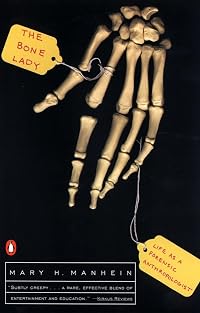
The Bone Lady: Life as a Forensic Anthropologist
by Mary H. Manhein
On This Page
Description
"On the first day of the search, I failed to find the body." So writes forensic anthropologist and bioarchaeologist Mary H. Manhein -- or "the bone lady" as law enforcement personnel call her. In this, one of dozens of stories recollected in her powerful memoir, Manhein and the state police eventually unearth a black plastic bag buried in the banks of the Mississippi River containing the body of a man who has been missing for five years. After the painstaking process of examining the show more remains, confirming the victim's identity, and preparing a formal report for the police, Manhein testifies for the prosecution at the murder trial. The defendant is convicted (due in no small part to Manhein), and the bone lady has helped solve yet another mystery. As director of the Forensic Anthropology and Computer Enhancement Services (FACES) Laboratory at Louisiana State University, Manhein unravels mysteries of life and death every day. In The Bone Lady, she shares, with the compassion and humor of a born storyteller, many fascinating cases that include the science underlying her analyses as well as the human stories behind the remains. Manhein, an expert on the human skeleton, assists law enforcement by providing profiles of remains that narrow the identification process when the traditional means used by medical examiners or coroners to conduct autopsies are no longer applicable -- simply put, when bones are all that are left to tell the story. She assesses age, sex, race, height, signs of trauma, and time since death, and creates clay facial reconstructions. The case studies Manhein includes in The Bone Lady highlight the diversity of the field of forensic anthropology. She presents some ofher more lighthearted cases, such as that instigated by the suburban man who discovers a box of bones buried in his backyard labeled "Patsy Lou Bates -- Sis." A coroner, police investigators, and swarms of media are present when Manhein identifies Patsy Lou as a dearly departed family pet. One of her most chilling cases concerns a husband who murdered his wife, buried her in their yard, planted a rose garden over her grave, and continued to garden there for eight years until his deed was discovered. Manhein's involvement in historic cases includes her participation in the exhumation of Dr. Carl Weiss, the alleged assassin of Huey P. Long. Although Manhein enjoys solving high-profile cases, her personal crusade is identifying the John and Jane Does who wait in her lab. Manhein's own words perfectly characterize her mission: "Identifying a victim can bring peace of mind to the family and can help them to go on with their lives. Sometimes, peace of mind is the only gift that I can give." -- Publisher's description. show lessTags
Recommendations








Member Reviews
This is an easy read, with each chapter covering one investigation that the author was part of. However, I found the easy going voice, at times a little to glib about what was happening.
Also, there were one or two chapters that seemed incredibly tone deaf, specifically the chapter about doing research on native American skeletons, against the will of their of descendants. The condescending voice of the author really pulled me out of the book.
But overall, the stories are interesting, and while some of the science is outdated, Its an interesting topic.
Also, there were one or two chapters that seemed incredibly tone deaf, specifically the chapter about doing research on native American skeletons, against the will of their of descendants. The condescending voice of the author really pulled me out of the book.
But overall, the stories are interesting, and while some of the science is outdated, Its an interesting topic.
Some readers didn't like this book because of its length and lack of forensic depth into cases. I however did like this book. I think what most people are forgetting is that although anthropologists are scientific based they are also story tellers. I think what Mary set out to do was to tell a good story, I don't believe her focus was to write a science based book. So factoring that into my review I very much enjoyed it and look forward to reading Mary's other titles.
A nice little read in between larger titles.
A nice little read in between larger titles.
It amazes me that each time I read a book about Forensic Anthropology, I learn more and more about the human body. This was a very quick read, but I am glad that I had read several other books on the subject prior to this book.
It is obvious this book was written before the big interest in the forensic sciences as it now seems quite quaint in its descriptions of the trials and tribulations the author went through in her career spanning from the 1980's to early 90's. Lacking much scientific information it reads more like a short story than non-fiction, and at 137 pages it is a very quick read. There are a lot of tales that I wish she had fleshed out more but I found the references to her upbringing in 1950's Louisiana quite interesting.
A series of vignettes about the author's work as a forensic anthropologist, an anthropologist trained in examining human skeletal remains and determining age, gender, time since death, and possible causes of death. Interesting little stories and brief insights into why Manhein finds her job so satisfying. If you're looking for a book with an overarching theme or in-depth information on forensic anthropology, this is not the book you're looking for, and I'm not sure there's enough detail to satisfy those interested in true crime. But for an overview of the kinds of cases a forensic anthropologists deals with, it'd work.
It was a nice overview of what a forensic anthropologist does and what they sometimes have to deal with in their work. It's a pretty fast read. I had just finished reading an unnecessarily lengthy novel before I picked up this book, so I appreciated the brevity. If you're looking for something more in depth, then this might not be the one for you.
I gave this one 2 out of 5 stars. For me the chapters were too short and I was left always wishing for the stories to be fleshed out. Many were based around her childhood. An example would be that she starts one story out talking about how she's been sent on a mission to get horse bones for an insurance company that wants her to prove that the horses were starved to death. Within 2 paragraphs she tells us what her objective is and that she can't do it due to the fact that she really doesn't work with horses, but decides to collect the bones to send over to a friend. While collecting she notices a storm brewing and just like that, by the end of the paragraph (number 3 maybe it is?) we go into a long winded story about a time when she was show more little and a storm came and her aunt stopped a tornado with an ax, bean and bible. Then she finishes the chapter by saying they grabbed the bones, a tornado never came and the friend could not prove the horses were starved so the insurance company had to pay out.
Many chapters ran like this. No information about her profession or the case and how she worked it. When there was a case, she seemed to hold back, not giving details or giving one example of what she did and then filling the rest of the space with filler. On top of that those chapters were cut short making you want to know more.
In fact, I actually got on the computer and started searching for information, but got no where. The book was truly frustrating and I could only give it 2 stars because it was an easy read. show less
Members
- Recently Added By
Author Information
10 Works 389 Members
Mary H. Manhein is the director of the Forensic Anthropology and Computer Enhancement Services (FACES) Laboratory at Louisiana State University and a deputy coroner for East Baton Rouge Parish.
Classifications
Statistics
- Members
- 309
- Popularity
- 103,583
- Reviews
- 12
- Rating
- (3.56)
- Languages
- English
- Media
- Paper, Ebook
- ISBNs
- 4
- ASINs
- 1