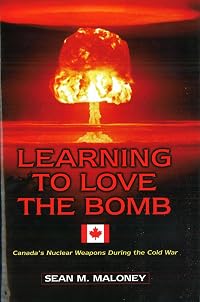
Learning to Love the Bomb: Canada's Nuclear Weapons During the Cold War
by Sean M. Maloney
On This Page
Description
In Learning to Love the Bomb, Sean M. Maloney explores the controversial subject of Canada's acquisition of nuclear weapons during the Cold War. Based on newly declassified Canadian and U.S. documents, it examines policy, strategy, operational, and technical matters and weaves these seemingly disparate elements into a compelling story that finally unlocks several Cold War mysteries. For example, while U.S. military forces during the 1962 Cuban Missile Crisis were focused on the Caribbean Sea show more and the southeastern United States, Canadian forces assumed responsibility for defending the northern United States, with aircraft armed with nuclear depth charges flying patrols and guarding against missile attack by Soviet submarines. This defensive strategy was a closely guarded secret because it conflicted with Canada's image as a peacekeeper and therefore a more passive member of NATO than its ally to the south. It is revealed here for the first time. The place of nuclear weapons in Canadian history has, until now, been a highly secret and misunderstood field subject to rumor, rhetoric, half-truths, and propaganda. Learning to Love the Bomb reveals the truth about Canada's role as a nuclear power. show lessTags
Recommendations













Member Reviews
Learning to Love the Bomb: Canada's Nuclear Weapons During the Cold War by Sean M. Maloney is an in depth study of Canada’s exploration, acquisition and eventual disposal of nuclear weapons during the Cold War.
Yes, that’s right, Canada and nuclear weapons in the same sentence. I am sure many would be shocked to hear that any part of the Canadian military once had access to nuclear weapons. They would be totally stunned to know that in fact, most of Canada’s defensive and offensive force was nuclear equipped for a time.
From the CF-101 Voodoos on alert at RCAF bases throughout the country to Canadian Starfighters ready to drop nuclear bombs in Europe. Not to be left out, the Royal Canadian Navy, although not possessing any nuclear show more weapons of its own, had most of its aircraft and ships modified for their use.
Those who pictured Canada’s armed forces doing nothing but standing around in blue berets keeping the peace are in for a very rude awakening.
Mr. Maloney has dug deep in his research and one thing I found pleasing is that he shows no fear in naming names. If you are a fan of Canadian History and Prime Ministers in particular, you will want to read this book. In fact, you need to read it. The author shows no bias and skewers Liberals and Conservatives with equal enthusiasm.
Some of the information is painfully dry but this attribute allows the reader to form their own opinions regarding the events which took place when Canada was a nuclear force to be reckoned with.
www.daniellittle.com show less
Yes, that’s right, Canada and nuclear weapons in the same sentence. I am sure many would be shocked to hear that any part of the Canadian military once had access to nuclear weapons. They would be totally stunned to know that in fact, most of Canada’s defensive and offensive force was nuclear equipped for a time.
From the CF-101 Voodoos on alert at RCAF bases throughout the country to Canadian Starfighters ready to drop nuclear bombs in Europe. Not to be left out, the Royal Canadian Navy, although not possessing any nuclear show more weapons of its own, had most of its aircraft and ships modified for their use.
Those who pictured Canada’s armed forces doing nothing but standing around in blue berets keeping the peace are in for a very rude awakening.
Mr. Maloney has dug deep in his research and one thing I found pleasing is that he shows no fear in naming names. If you are a fan of Canadian History and Prime Ministers in particular, you will want to read this book. In fact, you need to read it. The author shows no bias and skewers Liberals and Conservatives with equal enthusiasm.
Some of the information is painfully dry but this attribute allows the reader to form their own opinions regarding the events which took place when Canada was a nuclear force to be reckoned with.
www.daniellittle.com show less
Ratings
Members
- Recently Added By
Lists

The Cold War
54 works; 2 members
Author Information
19 Works 130 Members
Common Knowledge
- People/Characters
- Robert Bryce; Hugh Campbell; John Diefenbaker; Charles Foulkes; Howard Green; Douglas Harkness (show all 14); Paul Hellyer; Max Hendrick; John F. Kennedy; Frank Miller; Lauris Norstad; George R. Pearkes; Lester B. Pearson; Norman Robertson
- Epigraph
- "Nowadays you have to think like a hero, merely to behave like a decent human being!"
--John Le Carré, The Russia House - Dedication
- This book is dedicated to the Members of The Organization.
- Blurbers
- Kindsvatter, Peter S.; Isby, David C.; Grau, Lester
Classifications
- Genres
- Nonfiction, History, General Nonfiction, Politics and Government
- DDC/MDS
- 355.02 — Society, government, & culture Public administration & military science The Military - Land, Air & Sea / Warfare War
- LCC
- UA600 .M36 — Military Science Armies: Organization, distribution, military situation Armies: Organization, distribution, military situation By region or country
- BISAC
Statistics
- Members
- 24
- Popularity
- 1,113,872
- Reviews
- 1
- Rating
- (3.88)
- Languages
- English
- Media
- Paper, Ebook
- ISBNs
- 2
- ASINs
- 1