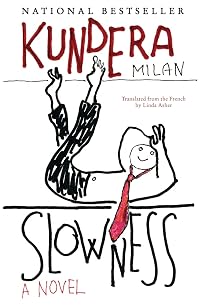
Slowness
by Milan Kundera
On This Page
Description
A novel on the theme that the pleasure inherent in a slower rhythm of life has disappeared from our speed-obsessed age. The protagonists are two men, one who has a romance in the 18th Century, the other in the 20th Century. Subsequently, they meet for a morning-after chat. By the author of The Unbearable Lightness of Being.Tags
Recommendations
























Member Reviews
สำนวนการเขียนร้ายกาจ เสียดสีทุกอย่างรอบตัว และเจ็บแสบยิ่งขึ้นไปอีกเมื่อตระหนักได้ว่าอ้ายคนที่น่าหมั่นไส้เล่านี้นี้ดำรงอยู่รอบ ๆ ตัวเราอย่างแยกไม่ออก และบางทีเราก็อาจจะเป็นเช่นนั้นด้วย
Not sure how to describe or review this book, except to say that I find it rather daunting that this is apparently considered one of Kundera's lightest works. It is very philosophical, theorizing about the modern world's obsession with speed (and this was written over a decade ago - if he only knew) and its relation to our desire to forget. I don't think he means forgetting in the micro-ish sense (where are my keys, what was my high school locker combination) so much as the macro sense - repressing the pain of past relationships or traumatic childhoods, or even more to the point the broader social forgetting of troubling cultural and socio-political attitudes and actions. There is a plot, but I found it really only relevant in the show more aspects of Kundera's (who essentially narrates the work as himself) philosophical musings that it illuminates. I definitely need to test the waters in the rest of his fiction, but I'm glad the season is changing as these strike me as books that might be too heavy and ennui-inducing to read in the gloomy winter months. show less
J'ai peu lu Kundera; ce court récit me donne envie de lire cet auteur pour le jeu qui lie oeuvre passée et présente, réalité d'un présent du récit et de la fiction...une certaine complexité bien gérée par l'auteur, auquel s'ajoute une dimension onirique.
Court, léger, stimulant; et une promotion de l'hédonisme!
Court, léger, stimulant; et une promotion de l'hédonisme!
Kundera wonders why we are always in a hurry. Don't we know that real pleasure is achieved only slowly. He explores our need to rush and our belief that the faster we reach ecstasy the better. As far as he is concerned nothing could be farther from the truth. He makes this point eloquently by exploring Les Liaisons dangereuses. His central character suddenly is in that time and place, Seventeenth century France, and wandering through a chateau with Madame de T as they slowly proceed through stages eventually spending the night together. But we are brought back to modern France and see Czech emigrees as they attend to a conference of entomologists. As they explore dancers who want everyone's attention and seek alternatives such as show more throwing off their clothes and swimming naked in a pool with lots of onlookers some of whom choose to jump in with other intentions. By this point Kundera's thoughts and imaginations are on full display as he takes us through erotic adventures. What is lost in the process is the original focus, slowness. Eventually characters from the Seventeenth show up in the present. We're not sure if the central character is dreaming or perhaps we are. Pure Kundera. Written in French with passages where we wonder whether Kundera is slowing this down to find just the right word in what is not his native tongue show less
My initial reading was couched in rain. I spent an afternoon in Indianapolis after dropping off a client and I ingested six shots of espresso and marvelled at the philosophical origami that Kundera constructs on nearly every page.
I reread this in the last year or so, largely to see if it had become dated. It hadn't. I still marvelled at this spare masterpiece.
I reread this in the last year or so, largely to see if it had become dated. It hadn't. I still marvelled at this spare masterpiece.
Okay, cards on the table time... I'd read the three books for which Milan Kundera is best known - 'The Joke', 'The Book of Laughter and Forgetting' and 'The Unbearable Lightness of Being' - and I loved them all. In fact, I'd just re-read TULOB again and was as impressed and immersed as last time, the simplistic, anti-leftist rants with which it concludes aside (strangely, I didn't remember those from my previous reading). So much did I enjoy it that I decided to read one of his later works that I hadn't tried before. And so I picked up 'Slowness'...
I'm going to re-title it 'Slightness' (unbearable, but there it is...). Is that due to the philosophical slights of hand that the author performs? No. To me, it really did feel rather show more insubstantial. The novella comprises two romances staged across a single night, one set in current times and the other in the eighteenth century. I think that the modern day episodes were supposed to be funny. I just found them rather silly. The philosophical elements felt bolted on. None of the characters were believable. I wanted to like it. Although it pains me to say it, if I'd come to this book first, I might never have read the others. Perhaps I've missed the point. Please, someone persuade me that I have... show less
I'm going to re-title it 'Slightness' (unbearable, but there it is...). Is that due to the philosophical slights of hand that the author performs? No. To me, it really did feel rather show more insubstantial. The novella comprises two romances staged across a single night, one set in current times and the other in the eighteenth century. I think that the modern day episodes were supposed to be funny. I just found them rather silly. The philosophical elements felt bolted on. None of the characters were believable. I wanted to like it. Although it pains me to say it, if I'd come to this book first, I might never have read the others. Perhaps I've missed the point. Please, someone persuade me that I have... show less
I would read this book while taking a train, flight, or while sitting in a small coffee shop near my apartment. It stayed with me, because of it's beauty & brevity. Mr. Kundera makes observations that are accurate, especially in our busy world. Thoughtful are the comments on speed and forgetting, and the frailty of individual(s) as they fail to appreciate--time, aging, and our selective memory of what has occurred in our past lives (plural emphasis).
Members
- Recently Added By
Published Reviews
Dieses kleine Buch ist ein langer Seufzer. Aber was unternimmt Milan Kundera nicht alles, um diesen Seufzer zu maskieren. "Die Langsamkeit" ist Medienschelte und Kulturkritik [...]. Das alles ist nicht falsch, und so könnte der Leser zerstreut, aber beifällig mit dem Kopf nicken und sich mit großer Geschwindigkeit einem besseren Buch zuwenden.
added by chwiggy
Der Kult der Langsamkeit – Milan Kundera hat eine verlorene Tugend wiederentdeckt
added by chwiggy
Lists

Lithub: The 50 Best Contemporary Novels Under 200 Pages
50 works; 4 members

Authors from the Czech Republic
3 works; 1 member

Authors from France
23 works; 2 members

Books Read in 2020
4,379 works; 123 members

Translingualism
191 works; 4 members

The Books I've Read 2018
143 works; 1 member

Books Read in 2018
4,360 works; 110 members

Favorite French Fiction
128 works; 57 members
Author Information

58+ Works 61,480 Members
One of the foremost contemporary Czech writers, Kundera is a novelist, poet, and playwright. His play The Keeper of the Keys, produced in Czechoslovakia in 1962, has long been performed in a dozen countries. His first novel, The Joke (1967), is a biting satire on the political atmosphere in Czechoslovakia in the 1950s. It tells the story of a show more young Communist whose life is ruined because of a minor indiscretion: writing a postcard to his girlfriend in which he mocks her political fervor.The Joke has been translated into a dozen languages and was made into a film, which Kundera wrote and directed. His novel Life Is Elsewhere won the 1973 Prix de Medicis for the best foreign novel. Kundera has been living in France since 1975. His books, for a long time suppressed in his native country, are once again published.The Unbearable Lightness of Being (1984), won him international fame and was a successful English-language film. In this work Kundera moves toward more universal and philosophically tinged themes, thus transforming himself from a political dissident into a writer of international significance. (Bowker Author Biography) show less
Some Editions
Awards and Honors
Awards
Series
Belongs to Publisher Series
L'àncora [Destino] (77)
Gallimard, Folio (2981)
Work Relationships
Is contained in
Was inspired by
Common Knowledge
- Canonical title
- Slowness
- Original title
- La lenteur
- Original publication date
- 1995
- Important places
- Czechoslovakia
- First words
- We suddenly had the urge to spend the evening and night in a chateau.
- Last words
- (Click to show. Warning: May contain spoilers.)The chaise has vanished in the mist, and I start the car.
- Original language
- French
Classifications
- Genres
- Fiction and Literature, General Fiction
- DDC/MDS
- 891.8635 — Literature & rhetoric Literatures of other languages East Indo-European and Celtic literatures West and South Slavic languages (Bulgarian, Slovene, Polish, Czech, Slovak, Serbo-Croatian, and Macedonian) Czech Czech fiction 1900–1989
- LCC
- PQ2671 .U47 .L4613 — Language and Literature French, Italian, Spanish and Portuguese literatures French literature Modern literature 1961-2000
- BISAC
Statistics
- Members
- 2,483
- Popularity
- 7,803
- Reviews
- 32
- Rating
- (3.54)
- Languages
- 23 — Arabic, Catalan, Chinese, Danish, Dutch, English, Estonian, Finnish, French, German, Greek, Hebrew, Hungarian, Icelandic, Italian, Lithuanian, Norwegian (Bokmål), Polish, Romanian, Spanish, Swedish, Turkish, Portuguese (Portugal)
- Media
- Paper, Audiobook, Ebook
- ISBNs
- 74
- ASINs
- 24