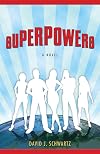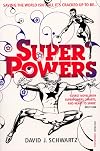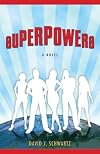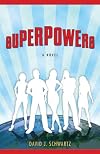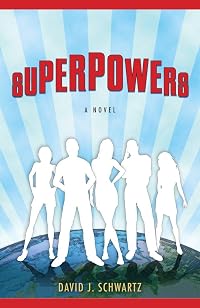
Superpowers
by David J. Schwartz 
On This Page
Description
A party in a college flat in May 2001. A case of dodgy home-brewed beer. A violent storm. Next day: the mother of all hangovers. What would you do if you the morning after the night before brought a banging head, a raging thirst... Oh, and your very own superpower? Meet the All-Stars: Harriet, Charlie, Caroline, Mary-Beth and Jack. Harriet can make herself invisible, Charlie can read your mind, Caroline can fly, and Jack, well, Jack can run faster than a speeding bullet. Determined to become show more costumed crime-fighters, but baffled by the lack of super-villains to tackle, the quintet soon finds that the ramifications of their new powers are more complicated than they anticipated, and that humans (even themselves) are much more fragile than they'd realised. show lessTags
Recommendations











Member Reviews
Superpowers is a truly mediocre book: it definitely isn't good, but it's certainly not bad enough that I could enjoy hating it. It's just…a read, which is too bad because there's a lot of potential in its concept (namely, what happens when five college students wake up and discover they have superpowers? Screw the "how did they get them and who are the supervillains?" stuff—what are their moral obligations? Do they tell their families? Help the cops? Are they responsible when they hurtg innocent bystanders while aiding others?)
Unfortunately, Schwartz is not talented enough to pull this concept off. The main characters are literally indistinguishable from one another—each has one defining physical and one defining show more emotional/familial trait, and that's it. I had to bookmark the page where they were introduced in order to remember who was who…and kept referring to it all the way up to the final page of the book. Schwartz also introduces a plethora of secondary and tertiary characters who are even less well-defined than the leads and contribute nothing to the story outside of word count.
Finally, the narrative contains two major flaws. The first is that whenever a hero's family member discovers that he or she has superpowers, said family member comes to terms with it within the space of a sentence or two. Every single time. This is hardly what one would expect from a realistic superhero story, especially one that aims to deal with the personal fallout caused by superpowers. The second is the truly inexplicable and gratuitous insertion of 9/11 and its aftermath into the final fourth of the novel. It neither forwards the plot nor adds anything to readers' understanding of that day's horrible events.
Schwartz wraps up the narrative in a trite slap-dash fashion that isn't terribly different from the standard superhero narrative he set out not to write. According to the back cover, he's penned several short stories, and I get the feeling that many sections of Superpowes would have worked reasonably well as such, but they don't succeed in novel format. Final verdict: not a horrible book, but not one that contributes anything to the reader for having read it. It'd make a decent book for air travel or daily commuting, but that's about it. show less
Unfortunately, Schwartz is not talented enough to pull this concept off. The main characters are literally indistinguishable from one another—each has one defining physical and one defining show more emotional/familial trait, and that's it. I had to bookmark the page where they were introduced in order to remember who was who…and kept referring to it all the way up to the final page of the book. Schwartz also introduces a plethora of secondary and tertiary characters who are even less well-defined than the leads and contribute nothing to the story outside of word count.
Finally, the narrative contains two major flaws. The first is that whenever a hero's family member discovers that he or she has superpowers, said family member comes to terms with it within the space of a sentence or two. Every single time. This is hardly what one would expect from a realistic superhero story, especially one that aims to deal with the personal fallout caused by superpowers. The second is the truly inexplicable and gratuitous insertion of 9/11 and its aftermath into the final fourth of the novel. It neither forwards the plot nor adds anything to readers' understanding of that day's horrible events.
Schwartz wraps up the narrative in a trite slap-dash fashion that isn't terribly different from the standard superhero narrative he set out not to write. According to the back cover, he's penned several short stories, and I get the feeling that many sections of Superpowes would have worked reasonably well as such, but they don't succeed in novel format. Final verdict: not a horrible book, but not one that contributes anything to the reader for having read it. It'd make a decent book for air travel or daily commuting, but that's about it. show less
I'll admit I was pleasantly surprised by this light superhero read. In some places I was confused (the one character takes quite a head trip), other places had less of a surprise - but overall it was an easy, quick read. I did pick it up and read it cover to cover in one sitting. I think there could have been richer character development, especially the character that can fly (am trying not to give too much away!), but perhaps the author was also leaving the story a little open-ended so that the characters could be expanded on in a future novel. I think this was a more realistic viewpoint on how people would respond to waking up and suddenly one day having superhero powers than other similar novels I've read. Overall, a light enjoyable show more afternoon read. show less
Superpowers was nominated for a Nebula, and deservedly so, though it didn’t win. It’s a "realistic" take on superheroes, focusing on the personal. In the story, having super abilities isn’t a boon. The five main characters were all richly conceived. I disagree with some reviewers who took issue with the number and quality of secondary characters. I thought they added quite a bit to the story. Unlike a lot of superhero fiction, the conflict is primarily that of self-doubt and that doubt is not caused by facing a nemesis. It’s also a pretty quick read.
After an end-of-term party, five college housemates wake up not only with hangovers, but also superpowers. None of them are sure where these superpowers came from, and none of them really care. All that matters now is that one of them can fly, one can turn herself invisible, one is super strong, one is telepathic and one is really, really fast. And as any group of friends might do if they all discovered they had superpowers, these five friends decide to become superheroes – with costumes, code names and all. Only, things don’t go as smoothly as they’d like. First, they have to keep their identities secret, but people keep noticing that something is up. Secondly, what happens when a superhero can’t always save everyone, or is the show more one to hurt other people?
There was potential for this book. Sadly, it wasn’t as good as I had been hoping. There were so many things about it that bothered me.
For one thing, there were way too many characters to keep straight. Five main characters, and about five times that in secondary characters that only show up once every ten chapters (and good luck remembering exactly who they all are). Because there are so many characters, there wasn’t any time to really develop the main ones. In fact, they all were very two-dimensional with no personality – a few of them even felt rather Mary Sue or Gary Stu-ish, imo.
The narration was confusing and jarring. The first chapter of the book is written by one of the minor characters, Marcus Hatch, who is a conspiracy theorist and runs his own newspaper. He says that he’s telling the story of these five college kids because no one else believes that it was real, or knows that it actually happened. He’s telling it to prove that he’s not crazy. But then it gets into the story, and we see it from the perspectives of the five main characters. My questions is, how would he know what they were thinking when they were the main characters? How would he know when a character falls asleep in class, or when they stopped being invisible after forgetting how to turn visible again? Yes, the telepath was supposed to have told Hatch everything that was going on, but there were periods when he (the telepath) was completely overwhelmed by his power he couldn’t even figure out what he was thinking, let alone what his friends were thinking. I wouldn’t have been this picky about it, though, if Hatch just did the first and last chapters. But when every few chapters there was something by Hatch, it kept reminding me that it was supposed to be written by some guy outside of the story, and it was jarring. If he was going to interrupt every once in a while and spew how this is a true story and real journalism, etc. then it would’ve flowed a lot better had Schwartz written it less like a novel and more like an expose or something along those lines. It could’ve been really cool like that. Instead, it just felt disjointed.
Not that it was all bad. It got in depth about some issues that were really interesting to explore – like the effect that superpowers would have on your mental and physical health. It dealt with morality and laws – if you were to have superpowers and could use them to help people, but it would be against the law to do so, what would be the right thing to do? So, yes, it was interesting at points.
What it comes down to, however, is that I wouldn’t recommend reading this book unless all you had experienced of superheroes was on tv or in the movies. If you’ve read comic books or graphic novels, stick with them. show less
There was potential for this book. Sadly, it wasn’t as good as I had been hoping. There were so many things about it that bothered me.
For one thing, there were way too many characters to keep straight. Five main characters, and about five times that in secondary characters that only show up once every ten chapters (and good luck remembering exactly who they all are). Because there are so many characters, there wasn’t any time to really develop the main ones. In fact, they all were very two-dimensional with no personality – a few of them even felt rather Mary Sue or Gary Stu-ish, imo.
The narration was confusing and jarring. The first chapter of the book is written by one of the minor characters, Marcus Hatch, who is a conspiracy theorist and runs his own newspaper. He says that he’s telling the story of these five college kids because no one else believes that it was real, or knows that it actually happened. He’s telling it to prove that he’s not crazy. But then it gets into the story, and we see it from the perspectives of the five main characters. My questions is, how would he know what they were thinking when they were the main characters? How would he know when a character falls asleep in class, or when they stopped being invisible after forgetting how to turn visible again? Yes, the telepath was supposed to have told Hatch everything that was going on, but there were periods when he (the telepath) was completely overwhelmed by his power he couldn’t even figure out what he was thinking, let alone what his friends were thinking. I wouldn’t have been this picky about it, though, if Hatch just did the first and last chapters. But when every few chapters there was something by Hatch, it kept reminding me that it was supposed to be written by some guy outside of the story, and it was jarring. If he was going to interrupt every once in a while and spew how this is a true story and real journalism, etc. then it would’ve flowed a lot better had Schwartz written it less like a novel and more like an expose or something along those lines. It could’ve been really cool like that. Instead, it just felt disjointed.
Not that it was all bad. It got in depth about some issues that were really interesting to explore – like the effect that superpowers would have on your mental and physical health. It dealt with morality and laws – if you were to have superpowers and could use them to help people, but it would be against the law to do so, what would be the right thing to do? So, yes, it was interesting at points.
What it comes down to, however, is that I wouldn’t recommend reading this book unless all you had experienced of superheroes was on tv or in the movies. If you’ve read comic books or graphic novels, stick with them. show less
I've always thought super heroes should stick to the visual media of comics and movies but if you're going to read a super hero novel then this is a good place to start. 'Superpowers' works as a novel because it is more introspective than simply trying to be a prose version of stuff that would look cool on screen. There are no super villains, no bombastic evil plots for the super heroes to foil. It's a study on what might actually happen if five people woke up with super powers. A flawed but enjoyable three and a half stars.
I grabbed this book on a whim, brought to my attention by some online ad at a web comic site that I forget and I'm quite happy with the decision. I've read comic books as a kid, and even now I occasionally pick one up, so I've always been interested in the concept of superpowers. Rarely have I seen anything done with integrating the existence of said powers into the world as we know it. Meaning, of course, a world with out "supervillians" to act as adversaries to superheroes.
This book does a wonderful job of investigating the lives of five young adults who suddenly find themselves gifted with various superpowers. While it does cover thier exploits as heroes in a world that isn't sure how to deal with them, it also does a very good job show more of considering what these five people have to adjust to. In addition to dealing a legal system that isn't ready for them, they have to still maintain thier lives as normal college students in a world undergoing a major change (I won't give it away, but if you pick it up pay attention to the dates on the chapter headings).
Overall I really enjoyed this book, I read it in a day, something I haven't sat down and done in a very long time. It's a fantastical adventure that remains grounded with very real issues that can and do affect many of us on a daily basis. show less
This book does a wonderful job of investigating the lives of five young adults who suddenly find themselves gifted with various superpowers. While it does cover thier exploits as heroes in a world that isn't sure how to deal with them, it also does a very good job show more of considering what these five people have to adjust to. In addition to dealing a legal system that isn't ready for them, they have to still maintain thier lives as normal college students in a world undergoing a major change (I won't give it away, but if you pick it up pay attention to the dates on the chapter headings).
Overall I really enjoyed this book, I read it in a day, something I haven't sat down and done in a very long time. It's a fantastical adventure that remains grounded with very real issues that can and do affect many of us on a daily basis. show less
What a surprise of a book! I did find the first 50 pages or so a liiiittttle bit slow admitedly, however I powered through it and came out on the other side feeling happy that I did. Initially the book annoyed me, but I'll explain why.
The book starts from the perspective of Marcus Hatch, our "Editor". He starts of telling us how this is a true story, and I guess setting the book up. Then as the book suggests, our characters have a night on the alcohol and wake up mysteriously with superpowers.
One of my biggest questions, that I expected would be answered was "How did that happen?". Instead of answering it though, I think the book took the cheap way out by having Editor Marcus Hatch intervene at that time saying:
"So don't think I don't show more realize that some of you are expecting me to explain how five ordinary college students acquired these extraordinary powers. Well, you're going to have to get used to disappointment."
I just didn't like that. I felt like instead of actually explaining it there was an excuse or reason not to. I almost want to say that I felt like it wasn't treating the readers as though they are smart.
BUT I persevered! And you know, the book got really good. Especially when it started to get more into of the personal stories of each of the characters. It had some really sad and heartfelt moments.
We know early on that this book is heading towards including events from September 11 2001. At first I wasn't looking forward to this, because well, let's face it - that time was a dark time for us all. But it was written tactfully and made us want the superheroes to band together to save the day.
A surprisingly touching book, but also very entertaining. I did enjoy the book even if there was a couple of parts early on I didn't entirely love. The book overall as a whole was really very entertaining and worth a read.
View more of my reviews at http://www.booknerdreviews.com show less
The book starts from the perspective of Marcus Hatch, our "Editor". He starts of telling us how this is a true story, and I guess setting the book up. Then as the book suggests, our characters have a night on the alcohol and wake up mysteriously with superpowers.
One of my biggest questions, that I expected would be answered was "How did that happen?". Instead of answering it though, I think the book took the cheap way out by having Editor Marcus Hatch intervene at that time saying:
"So don't think I don't show more realize that some of you are expecting me to explain how five ordinary college students acquired these extraordinary powers. Well, you're going to have to get used to disappointment."
I just didn't like that. I felt like instead of actually explaining it there was an excuse or reason not to. I almost want to say that I felt like it wasn't treating the readers as though they are smart.
BUT I persevered! And you know, the book got really good. Especially when it started to get more into of the personal stories of each of the characters. It had some really sad and heartfelt moments.
We know early on that this book is heading towards including events from September 11 2001. At first I wasn't looking forward to this, because well, let's face it - that time was a dark time for us all. But it was written tactfully and made us want the superheroes to band together to save the day.
A surprisingly touching book, but also very entertaining. I did enjoy the book even if there was a couple of parts early on I didn't entirely love. The book overall as a whole was really very entertaining and worth a read.
View more of my reviews at http://www.booknerdreviews.com show less
Members
- Recently Added By
Published Reviews
ThingScore 25
Schwartz is telling us that even with superpowers, life is still filled with problems. While that is a bit depressing, his message is neither bleak, nor even particularly original. They keep the streets of Madison safe, but face no supervillain or any major threat other than lawsuits and keeping up their GPAs. There is also some attempt at political allegory, observations of the media and law, show more even a tantalizing hint of other superheroes in the world. Alas, none of it really goes anywhere. I cannot recommend this lightweight, bland tale of nice kids with superpowers and personal tragedies. It might make a perfect show for the CW, but I doubt I would ever watch it. show less
added by PhoenixTerran
Lists

Superhero Fantasy
81 works; 7 members
Author Information
12+ Works 355 Members
David J. Schwartz is a LibraryThing Author, an author who lists their personal library on LibraryThing.
Some Editions
Awards and Honors
Awards
Common Knowledge
- Canonical title
- Superpowers
- Original publication date
- 2008-06-10
- People/Characters
- Charlie Frost; Jack Robinson (superhero); Caroline Bloom; Harriet Bishop; Mary Beth Layton; Marcus Hatch
- Important places
- Madison, Wisconsin, USA; Wisconsin, USA
- First words
- It all started at a party, which is damn convenient if you ask me.
- Blurbers
- Link, Kelly; Fowler, Karen Joy
Classifications
Statistics
- Members
- 248
- Popularity
- 130,873
- Reviews
- 20
- Rating
- (3.25)
- Languages
- English
- Media
- Paper, Ebook
- ISBNs
- 5
- ASINs
- 1