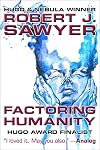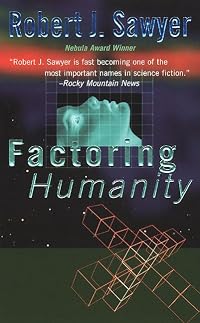
Factoring Humanity
by Robert J. Sawyer
On This Page
Description
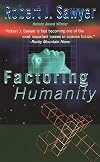
In the near future, a signal is detected coming from the Alpha Centauri system. Mysterious, unintelligible data streams in for ten years. Heather Davis, a professor in the University of Toronto psychology department, has devoted her career to deciphering the message. Her estranged husband, Kyle, is working on the development of artificial intelligence systems and new computer technology utilizing quantum effects to produce a near-infinite number of calculations simultaneously. When Heather show more achieves a breakthrough, the message reveals a startling new technology that rips the barriers of space and time, holding the promise of a new stage of human evolution. In concert with Kyle's discoveries of the nature of consciousness, the key to limitless exploration---or the end of the human race---appears close at hand. Sawyer has created a gripping thriller, a pulse-pounding tour of the farthest reaches of technology. Factoring Humanity is a 1999 Hugo Award Nominee for Best Novel. show lessTags
Recommendations


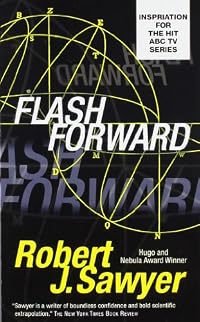
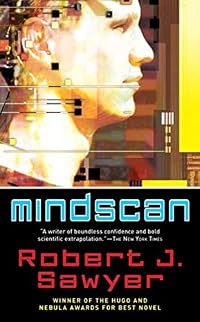
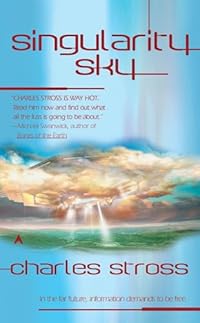
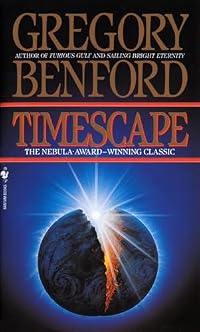





Member Recommendations
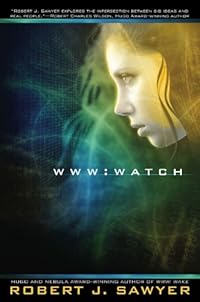
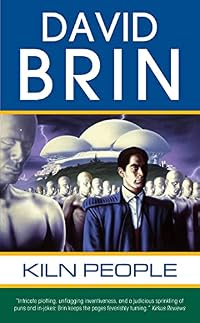
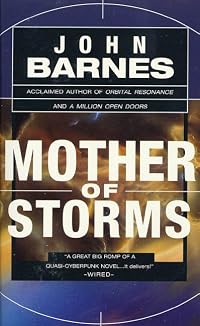
psybre Love and Physics!
Member Reviews
Factoring Humanity hits some rather huge emotional triggers. From the start, I'm totally prepared to hate one of the main characters and the starting gun already has everyone on pins and needles. Estranged couple, suicided daughter, and the other daughter is accusing her father of molestation.
This is one hell of a hardcore start for a novel ostensibly revolving around alien contact, with a very Contact feel and development, artificial intelligence research and development, and quantum computing.
And yet, it's only an accusation under suspicious circumstances and the AI hasn't seemed to progress that far into self-awareness and we, as humanity, have refused to respond to the Alpha Centaurians.
This makes for a strangely placid novel with show more deep undertones of conflict and/or disturbing reveals to come. I'm pretty amazed how much I got into it. It's not flashy or fast paced. It's focused on ideas and tragedy and moving on through all the permutations of each.
Are there good reveals? Yep. Are there cool reveals? Yes, indeed. I REALLY like the way the Contact-like scenario plays out. The scientific concepts, the math, the implications, and especially the psychology underpinning it all makes this an impressive SF.
It's workmanlike in it's writing, but the ideas are completely top notch. :) show less
This is one hell of a hardcore start for a novel ostensibly revolving around alien contact, with a very Contact feel and development, artificial intelligence research and development, and quantum computing.
And yet, it's only an accusation under suspicious circumstances and the AI hasn't seemed to progress that far into self-awareness and we, as humanity, have refused to respond to the Alpha Centaurians.
This makes for a strangely placid novel with show more deep undertones of conflict and/or disturbing reveals to come. I'm pretty amazed how much I got into it. It's not flashy or fast paced. It's focused on ideas and tragedy and moving on through all the permutations of each.
Are there good reveals? Yep. Are there cool reveals? Yes, indeed. I REALLY like the way the Contact-like scenario plays out. The scientific concepts, the math, the implications, and especially the psychology underpinning it all makes this an impressive SF.
It's workmanlike in it's writing, but the ideas are completely top notch. :) show less
es el que más me ha gustado de sawyer, pero tiene los mismos problemas de todos sus libros: gran premisa inicial, estilo directo y accesible que a la mitad se vuelve simplón y condescendiente, personajes que pasan de creíbles a odiosos, ideas interesantes y diversas basadas en ciencia superficial pero sólida, que poco a poco se convierten en extrapolaciones apresuradas y convenientes basadas en seudociencia, etcétera. pero hay al menos una sorpresa cerca del final, y el final mismo es menos decepcionante que los de las otras novelas suyas que he leído (el cálculo de dios, mindscan y la trilogía homínidos). anyway, se lee rápido.
What I love about Sawyer's books is that he's on the cutting edge of blending modern science and spirituality with a dash of psychology for good measure. It's quite an innovative convergence. What I dislike is that most of his novels still seem as if he's learning basic dialogue and social interaction much like those awkward moments when you're talking to somebody that has a genius IQ but lacks the social EQ to go with it. On the whole Factoring Humanity is a creative exploration of Jung's cosmic consciousness, but there are enough awkward moments to make it less than satisfying.
Protagonist studying the inscrutable messages of aliens. Ends with some fun Jungian stuff, so that was cool.
Positives: A lot of "cool skiffy concepts" and "science porn." Negatives: Not much character development, a writing style best described as "functional," and an unfortunate tendency to end his storiesby leveling up to some "transcendent" experience that is by definition indescribable .
Positives: A lot of "cool skiffy concepts" and "science porn." Negatives: Not much character development, a writing style best described as "functional," and an unfortunate tendency to end his stories
In Factoring Humanity, Robert Sawyer explores the possibility of contact with another life form while focusing on how that would change humanity as we know it. There is a fine line between solving our most complex problems and opening ourselves up to total domination. How could we possibly understand an alien species when we don't understand ourselves?
I love Robert Sawyer's books. I always miss the characters, and he leaves me thinking about the possibilities he proposes in his books.
I love Robert Sawyer's books. I always miss the characters, and he leaves me thinking about the possibilities he proposes in his books.
So much is all woven together in this book. There is a mystery and family interaction. And there is a brilliant look at life in the universe and how it connects. Included is some good stuff on AI and thoughts about where that is going. And a look at the 4th dimension and Schrodinger's Cat. I loved the descriptions of some of the more unusual experiences of our characters (no spoilers here) to include the mechanical one. Sawyer as usual made me think about what really matters.
This is one of Sawyer's better books, although it takes a while to get into it. Be patient and you'll be rewarded. Good story line. Imaginative science. Upbeat. Without giving away the ending, I'll just say that the book begs for a sequel. Sawyer's hallmark is a thin story line that he uses to carry his speculations about science and human cultures. His imagination and scientific speculation seems well grounded. The story line and his scientific discourses complement each other very nicely. Reading a Sawyer sci-fi novel is a treat.
Members
- Recently Added By
Author Information

107+ Works 20,019 Members
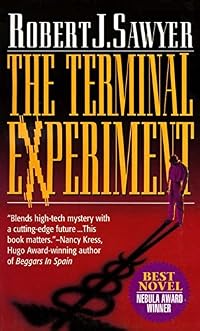
Robert J. Sawyer was born in Ottawa on April 29, 1960, but raised in Toronto. In 1980, while still in high school, Sawyer submitted a short story to the the Rochester Museum and Science Center, which was running a contest for light show ideas. Sawyer didn't win, but the Museum purchased his story Motive anyway and it ran for 192 performances. show more Sawyer went on to attend Toronto's Ryerson Polytechnical Institute, majoring in Radio and Television Arts. In September 1979, he had his first piece of fiction published at the end of his first year, in Ryerson's literary annual, White Wall Review. Sawyer graduated from Ryerson in 1982. Sawyer was hired back the following semester to teach television studio production techniques to second- and third-year students. In the four months interim, he worked for minimum wage at the local SF bookstore, spending all his earnings on books. From 1984 to 1992, while teaching, Sawyer also coordinated a social group of Toronto-area science-fiction writers founded by SF editor Judith Merril. He established a Canadian region of the Science Fiction and Fantasy Writers of America; and in 1998, served as that organization's president. Sawyer also retained freelance nonfiction writing contracts, writing articles for newspapers and magazines, press releases and brochures for corporations, newsletters for government departments. He churned out vast amounts of promotional materials and over 200 articles for computing and personal-finance magazines in a span of five years. But in that time, his only really significant publication was the novelette Golden Fleece, which appeared as the cover story in the September 1988 edition of Amazing Stories. The novel-length Golden Fleece was sold to Warner Books a year later in 1989. The sales of his first five books were uninspiring and Sawyer faced being dropped by his publisher. Sawyer decided to take the time to write a book, without a contract, take as long as necessary, and produce a blockbuster. He also wanted to tackle a controversial issue and deal with it head on. With that in mind, Sawyer wrote The Terminal Experiment, about abortion and the soul. His publisher rejected it on grounds of controversy. HarperPrism then bought the book and serialization rights were sold to Analog, the number-one best-selling English-language SF magazine. The Terminal Experiment went on to win the Science Fiction and Fantasy Writers of America's Nebula Award for Best Novel of 1995. His novel Frameshift was his first book published in hardcover, and was nominated for the Hugo Award, and won Japan's Seiun Award for best foreign novel of the year. (Bowker Author Biography) show less
Some Editions
Awards and Honors
Awards
Work Relationships
Is contained in
Common Knowledge
- Original title
- Factoring Humanity
- Alternate titles
- Factor de humanidad (España) (España)
- Original publication date
- 1998
- People/Characters
- Mycroft Holmes; John H. Watson; Sherlock Holmes
- Epigraph
- What is mind? No matter.
What is matter? Never mind
-- Thomas Hewitt Key
(1799 - 1875)
British cla... (show all)ssicist - First words
- I had been pulled into the future first, ahead of my companion.
- Last words
- (Click to show. Warning: May contain spoilers.)On that day, the rest of the world celebrated, but I do confess I shed a tear and drank a special toast to my good friend, the late Mr. Sherlock Holmes.
- Original language
- English
Classifications
Statistics
- Members
- 944
- Popularity
- 27,918
- Reviews
- 21
- Rating
- (3.53)
- Languages
- English, French, Italian, Spanish
- Media
- Paper, Audiobook, Ebook
- ISBNs
- 14
- ASINs
- 5