On This Page
Description
The Face of God is what every young saurian learns to call the immense, glowing object which fills the night sky on the far side of the world. Young Afsan is privileged, called to the distant Capital City to apprentice with Saleed the court astrologer. But when the time comes for Afsan to make his coming-of-age pilgrimage, to gaze upon the Face of God, his world is changed forever- for what he sees will test his faith...and may save his world from disasterTags
Recommendations




































Member Reviews
This book was completely different than anything else by Robert Sawyer that I have read. And I thought it was good. Now I will have to find book #2 in the Quintaglio series as I already have book #3.
The inhabitants of Quintaglio are sentient dinosaurs. They live on a large island in The River and are exclusively carnivores. They have learned to mostly overcome their violent impulses by adopting a religion that encourages peace. There is a rigid hierarchy and at the very top is the Empress. Afsan, an apprentice astrologer, is quite low in the hierarchy but he is friends with Dybo, the Empress's son and heir to the throne. So when Afsan asks Dybo to accompany him on the pilgrimage to the Face of God it helps them get the necessary show more permissions. Before they go they must take part in a hunt that is a right of passage for all Quintaglions. Afsan distinguishes himself in the hunt and he becomes well-known for his prowess. The pilgrimage takes place on a ship as The Face of God is far to the east of the Island on which all the Quintaglions live. The ship's captain has an instrument called a far-seer which Afsan borrows and makes observations of the surrounding celestial objects. As the ship nears The Face of God Afsan determines that The Face is actually a planet and Quintaglio is a moon of that planet. This is heresy but Afsan figures he can prove it by getting the captain to circumnavigate their world. He knows it will be a challenge to convince people of this but there is an urgent need to do so. Afsan believes that their world is too near the planet and that it will be pulled apart in the not too distant future. Increasing numbers of volcanic eruptions and earthquakes signal that the end is near.
I read one online comment that likened Afsan to Galileo. Humans now accept Galileo's thoughts but at the time he was imprisoned by the Inquisition and forced to recant. I think Sawyer is showing us a different model for that kind of world-shaking thought. show less
The inhabitants of Quintaglio are sentient dinosaurs. They live on a large island in The River and are exclusively carnivores. They have learned to mostly overcome their violent impulses by adopting a religion that encourages peace. There is a rigid hierarchy and at the very top is the Empress. Afsan, an apprentice astrologer, is quite low in the hierarchy but he is friends with Dybo, the Empress's son and heir to the throne. So when Afsan asks Dybo to accompany him on the pilgrimage to the Face of God it helps them get the necessary show more permissions. Before they go they must take part in a hunt that is a right of passage for all Quintaglions. Afsan distinguishes himself in the hunt and he becomes well-known for his prowess. The pilgrimage takes place on a ship as The Face of God is far to the east of the Island on which all the Quintaglions live. The ship's captain has an instrument called a far-seer which Afsan borrows and makes observations of the surrounding celestial objects. As the ship nears The Face of God Afsan determines that The Face is actually a planet and Quintaglio is a moon of that planet. This is heresy but Afsan figures he can prove it by getting the captain to circumnavigate their world. He knows it will be a challenge to convince people of this but there is an urgent need to do so. Afsan believes that their world is too near the planet and that it will be pulled apart in the not too distant future. Increasing numbers of volcanic eruptions and earthquakes signal that the end is near.
I read one online comment that likened Afsan to Galileo. Humans now accept Galileo's thoughts but at the time he was imprisoned by the Inquisition and forced to recant. I think Sawyer is showing us a different model for that kind of world-shaking thought. show less
Interesting, sure. So much reads like fantasy though, what with royalty, and a quest, and rites of passage, and a prophecy, even a chosen One... I prefer my sf to be more sciency. Otoh, this is all about one genius, one Galileo analogue, who discovers the scientific method (observation, not experimentation) while discovering the truth about the nature of their world.
I happen to own this and the sequel and so am reading them, but am not sure whether I'll be recommending them or looking for the third. I guess I do recommend them to teens who have been raised by creationists.... ;)
I do like some of the psychology-building. Carnivorous dinosaurs are intensely territorial. So there are all sorts of codes of conduct, including the knowledge show more that "civilized beings did not fight."
There's a bit of a language lesson here, in that a pack vs. a Pack is "written in left-facing glyphs instead of right."
The lesson, that science is more useful than faith, is hammered home in a number of ways. I particularly like our hero's declaration, while in prison, "I'm against no one. I'm for the truth." show less
I happen to own this and the sequel and so am reading them, but am not sure whether I'll be recommending them or looking for the third. I guess I do recommend them to teens who have been raised by creationists.... ;)
I do like some of the psychology-building. Carnivorous dinosaurs are intensely territorial. So there are all sorts of codes of conduct, including the knowledge show more that "civilized beings did not fight."
There's a bit of a language lesson here, in that a pack vs. a Pack is "written in left-facing glyphs instead of right."
The lesson, that science is more useful than faith, is hammered home in a number of ways. I particularly like our hero's declaration, while in prison, "I'm against no one. I'm for the truth." show less
Far-Seer follows the life of young Sal-Afsan on the journey of a lifetime. He is a Quintaglio, a race of sentient t-rexes living on a distant planet and enjoying a unique culture and religion centered on the ritual of the hunt and a seafaring pilgrimage. During his coming-of-age adventures, Afsan makes several discoveries whose repercussions threaten to destroy his society in this re-telling of the lives of Galileo and Copernicus in one.
This novel is best described as charming. The prose is simple yet effective, and tightly written. Clocking in at just over 300 pages it’s a short read despite a few lulls in the pace. Being a planet of carnivorous dinosaurs, there is plenty of violence. The action is well-written and striking. Brevity show more is a strong point for this author; this is no Martin or Tolkien getting distracted describing food or clothing for 3 pages at a time.
Characters are a little simple but have enough unique traits to avoid being caricatures. There are some inconsistencies in personality. Afsan is described as naïve but comes off more as strangely ignorant for a genius; he can do calculations in his head and is one of the few Quintaglios that can read, yet doesn’t know anything about basic reproduction. Dybo is typically placid but has moments of viciousness that ebb and flow. Protagonists are strong, taking direct action for their interests.
The worldbuilding is solid but could stand for more alien-ness. Quintaglio culture has some fascinating facets: dagamant, or the violent territorial madness that can be triggered by too-close proximity to others, cutting off body parts for punishment (they regenerate), the inability to lie openly (their muzzles turn blue when they fib), hunting rituals. Other aspects are entirely too human without providing the rationale for the unlikely behavior/concepts. The Quintalios are similar enough that one can empathize but different enough to be interesting. Clunky exposition is minimal, for both Afsan’s past as well as the general society; it would just be nice if Afsan had a reason to be as ignorant as he was.
As with his other novels, Sawyer’s boner for science is painfully obvious. While not as strictly anti-religion as his other trilogy, the Neanderthal Parallax, Sawyer comes down extremely hard on the faith. For example,priests are the only ones who can lie openly. In scripture, only demons can do this. Priests do it effortlessly and guiltlessly. This doesn’t offend me, per se, but it is rather graceless. One thing that I did like was that this is a sci-fi/fantasy novel where religion is not homogeneous: there are different religions followed at different levels of fanaticism, which made it feel much more real.
The book contains a lot of explanations of astrological movement. It takes several repetitions before Sawyer realizes he can summarize Afsan’s observations and arguments without having to re-iterate them again and again. This did not occur enough to annoy me. However, with Sawyer’s unmitigated lust for the scientific method, you’d think that he’d get the facts correct. Which he does not. To be specific,a tidally-locked moon would not be ripped apart by gravitational forces. To cause earthquakes, the planet would have to have tidal forces a tidally-locked planet does not have. To break up, a planet would have to have an extremely fast rotation and be a reasonable young planet, which is not the case with Land. Lastly, having a single landmass would not impact the planet’s orientation nor whether or not it is tidally-locked. If nothing else, the planet should have been either in the oncoming path of an asteroid or in a deteriorating orbit, causing it to impact its planet. I could write this off as Afsan being incorrect in some of his theory (mistakes drive science just as much as successes do), but the later books play it completely straight and correct without any revisions. It irked me to no end and I find myself mentally editing the book to something more accurate.
TL;DR: The story of Galieo vs. the Church, told on a distant moon with a cast composed of sentient tyrannosaurs. Poor science can be overlooked with action-filled prose and intriguing society.
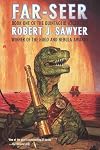
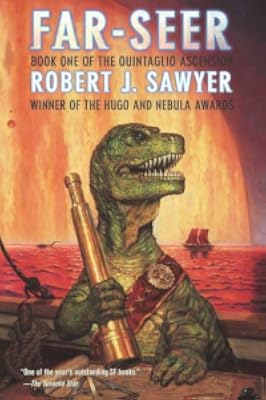
Final Verdict: Worth a read. The worst part of the novel is being a grown adult carrying around a book with a dinosaur holding a telescope on the cover. show less
This novel is best described as charming. The prose is simple yet effective, and tightly written. Clocking in at just over 300 pages it’s a short read despite a few lulls in the pace. Being a planet of carnivorous dinosaurs, there is plenty of violence. The action is well-written and striking. Brevity show more is a strong point for this author; this is no Martin or Tolkien getting distracted describing food or clothing for 3 pages at a time.
Characters are a little simple but have enough unique traits to avoid being caricatures. There are some inconsistencies in personality. Afsan is described as naïve but comes off more as strangely ignorant for a genius; he can do calculations in his head and is one of the few Quintaglios that can read, yet doesn’t know anything about basic reproduction. Dybo is typically placid but has moments of viciousness that ebb and flow. Protagonists are strong, taking direct action for their interests.
The worldbuilding is solid but could stand for more alien-ness. Quintaglio culture has some fascinating facets: dagamant, or the violent territorial madness that can be triggered by too-close proximity to others, cutting off body parts for punishment (they regenerate), the inability to lie openly (their muzzles turn blue when they fib), hunting rituals. Other aspects are entirely too human without providing the rationale for the unlikely behavior/concepts. The Quintalios are similar enough that one can empathize but different enough to be interesting. Clunky exposition is minimal, for both Afsan’s past as well as the general society; it would just be nice if Afsan had a reason to be as ignorant as he was.
As with his other novels, Sawyer’s boner for science is painfully obvious. While not as strictly anti-religion as his other trilogy, the Neanderthal Parallax, Sawyer comes down extremely hard on the faith. For example,
The book contains a lot of explanations of astrological movement. It takes several repetitions before Sawyer realizes he can summarize Afsan’s observations and arguments without having to re-iterate them again and again. This did not occur enough to annoy me. However, with Sawyer’s unmitigated lust for the scientific method, you’d think that he’d get the facts correct. Which he does not. To be specific,
TL;DR: The story of Galieo vs. the Church, told on a distant moon with a cast composed of sentient tyrannosaurs. Poor science can be overlooked with action-filled prose and intriguing society.
Final Verdict: Worth a read. The worst part of the novel is being a grown adult carrying around a book with a dinosaur holding a telescope on the cover. show less
I have enjoyed several of Robert J. Sawyer’s science fiction novels, but “Far-Seer” is the first fantasy sci-fi I’ve read of this author.
The back of the book of this particular paperback has spoilers, information on the characters of the book that are not revealed (apparently) until the later books in the trilogy, and I was disappointed by that. Of course I won’t reveal that!
Plots:
This is Book One of the Quintaglio Ascension. A “Quintaglio” is a species of intelligent dinosaur, genetically related to Tyrannosaurus Rex, that are on a moon orbiting a gas giant.
The gas giant has religious significance on this moon. The people there believe the world is flat, going down a river and that the gas giant is The Face of God. show more Asfan, apprentice astrologer, makes discoveries of his universe that fly in the face (sorry for the pun) of the scholars and religionists of the day.
Asfan realizes that if he claims there is no God, that the Face of God is just a planet, that he will crash and burn the religion which has kept his kind civilized for many hundreds of years. On the other hand, he needs to if he wants to have an honest heart and tell the truth.
He discovers the truth with the “Far-Seer” (a telescope), notes the movements of the planets and makes his discoveries. Asfan is also a very skilled killer and some of the more gory aspects of the book make for some intense reading.
The truth has costs, however. A faction that considers him “The One” (holy Matrix!) wants to believe Asfan has been prophesized for the final coming of the world. Asfan on the other hand just wants to help people get off the planet!
Bottom Line: We get to know the Quintaglio society, its language, swear words and even partake of some dinosaur sex. The parallels to our own Galileo is purposeful and enjoyable to say the least. The author really blasts adherence to dogma rather than having an open mind, which should open the door to discussion of these topics, especially with young adult readers.
Not sure if I will continue with this trilogy, but this book is a great start. Just don’t read the back of the book! Recommended.
. show less
The back of the book of this particular paperback has spoilers, information on the characters of the book that are not revealed (apparently) until the later books in the trilogy, and I was disappointed by that. Of course I won’t reveal that!
Plots:
This is Book One of the Quintaglio Ascension. A “Quintaglio” is a species of intelligent dinosaur, genetically related to Tyrannosaurus Rex, that are on a moon orbiting a gas giant.
The gas giant has religious significance on this moon. The people there believe the world is flat, going down a river and that the gas giant is The Face of God. show more Asfan, apprentice astrologer, makes discoveries of his universe that fly in the face (sorry for the pun) of the scholars and religionists of the day.
Asfan realizes that if he claims there is no God, that the Face of God is just a planet, that he will crash and burn the religion which has kept his kind civilized for many hundreds of years. On the other hand, he needs to if he wants to have an honest heart and tell the truth.
He discovers the truth with the “Far-Seer” (a telescope), notes the movements of the planets and makes his discoveries. Asfan is also a very skilled killer and some of the more gory aspects of the book make for some intense reading.
The truth has costs, however. A faction that considers him “The One” (holy Matrix!) wants to believe Asfan has been prophesized for the final coming of the world. Asfan on the other hand just wants to help people get off the planet!
Bottom Line: We get to know the Quintaglio society, its language, swear words and even partake of some dinosaur sex. The parallels to our own Galileo is purposeful and enjoyable to say the least. The author really blasts adherence to dogma rather than having an open mind, which should open the door to discussion of these topics, especially with young adult readers.
Not sure if I will continue with this trilogy, but this book is a great start. Just don’t read the back of the book! Recommended.
. show less
Much of the lifestyle of the dinosaurs in this book is distressing. They’re obligate carnivores, and so their civilization is non-agrarian. But Robert Sawyer managed to make me care about the main character, Afsan. Quite an achievement. Some interesting ideas in this book too.
I have enjoyed several of Robert J. Sawyer’s science fiction novels, but “Far-Seer” is the first fantasy sci-fi I’ve read of this author.
The back of the book of this particular paperback has spoilers, information on the characters of the book that are not revealed (apparently) until the later books in the trilogy, and I was disappointed by that. Of course I won’t reveal that!
Plots:
This is Book One of the Quintaglio Ascension. A “Quintaglio” is a species of intelligent dinosaur, genetically related to Tyrannosaurus Rex, that are on a moon orbiting a gas giant.
The gas giant has religious significance on this moon. The people there believe the world is flat, going down a river and that the gas giant is The Face of God. show more Asfan, apprentice astrologer, makes discoveries of his universe that fly in the face (sorry for the pun) of the scholars and religionists of the day.
Asfan realizes that if he claims there is no God, that the Face of God is just a planet, that he will crash and burn the religion which has kept his kind civilized for many hundreds of years. On the other hand, he needs to if he wants to have an honest heart and tell the truth.
He discovers the truth with the “Far-Seer” (a telescope), notes the movements of the planets and makes his discoveries. Asfan is also a very skilled killer and some of the more gory aspects of the book make for some intense reading.
The truth has costs, however. A faction that considers him “The One” (holy Matrix!) wants to believe Asfan has been prophesized for the final coming of the world. Asfan on the other hand just wants to help people get off the planet!
Bottom Line: We get to know the Quintaglio society, its language, swear words and even partake of some dinosaur sex. The parallels to our own Galileo is purposeful and enjoyable to say the least. The author really blasts adherence to dogma rather than having an open mind, which should open the door to discussion of these topics, especially with young adult readers.
Not sure if I will continue with this trilogy, but this book is a great start. Just don’t read the back of the book! Recommended.
. show less
The back of the book of this particular paperback has spoilers, information on the characters of the book that are not revealed (apparently) until the later books in the trilogy, and I was disappointed by that. Of course I won’t reveal that!
Plots:
This is Book One of the Quintaglio Ascension. A “Quintaglio” is a species of intelligent dinosaur, genetically related to Tyrannosaurus Rex, that are on a moon orbiting a gas giant.
The gas giant has religious significance on this moon. The people there believe the world is flat, going down a river and that the gas giant is The Face of God. show more Asfan, apprentice astrologer, makes discoveries of his universe that fly in the face (sorry for the pun) of the scholars and religionists of the day.
Asfan realizes that if he claims there is no God, that the Face of God is just a planet, that he will crash and burn the religion which has kept his kind civilized for many hundreds of years. On the other hand, he needs to if he wants to have an honest heart and tell the truth.
He discovers the truth with the “Far-Seer” (a telescope), notes the movements of the planets and makes his discoveries. Asfan is also a very skilled killer and some of the more gory aspects of the book make for some intense reading.
The truth has costs, however. A faction that considers him “The One” (holy Matrix!) wants to believe Asfan has been prophesized for the final coming of the world. Asfan on the other hand just wants to help people get off the planet!
Bottom Line: We get to know the Quintaglio society, its language, swear words and even partake of some dinosaur sex. The parallels to our own Galileo is purposeful and enjoyable to say the least. The author really blasts adherence to dogma rather than having an open mind, which should open the door to discussion of these topics, especially with young adult readers.
Not sure if I will continue with this trilogy, but this book is a great start. Just don’t read the back of the book! Recommended.
. show less
Sawyer has captivated me with his explicitly theological and philosophical explorations through science fiction adventure. This is the earliest one I've read by him and it seemed a little clunkier than his more recent work, but I still enjoyed it and will probably end up reading the rest of the trilogy. A species of highly evolved, sentient Tyrannosaurs (Quintaglios) play out a thinly veiled version of human history through some well-known characters (Galileo, for example, in this volume).
"...maybe it wasn't just individuals who went through rites of passage on their way to adulthood. Maybe his whole species had to do that...And what is to come? What awaited the Quintaqlio race, after its childhood's end?"
What indeed? Lucky this is show more just a fantasy about dinosaurs... show less
"...maybe it wasn't just individuals who went through rites of passage on their way to adulthood. Maybe his whole species had to do that...And what is to come? What awaited the Quintaqlio race, after its childhood's end?"
What indeed? Lucky this is show more just a fantasy about dinosaurs... show less
Members
- Recently Added By
Author Information

107+ Works 20,048 Members
Robert J. Sawyer was born in Ottawa on April 29, 1960, but raised in Toronto. In 1980, while still in high school, Sawyer submitted a short story to the the Rochester Museum and Science Center, which was running a contest for light show ideas. Sawyer didn't win, but the Museum purchased his story Motive anyway and it ran for 192 performances. show more Sawyer went on to attend Toronto's Ryerson Polytechnical Institute, majoring in Radio and Television Arts. In September 1979, he had his first piece of fiction published at the end of his first year, in Ryerson's literary annual, White Wall Review. Sawyer graduated from Ryerson in 1982. Sawyer was hired back the following semester to teach television studio production techniques to second- and third-year students. In the four months interim, he worked for minimum wage at the local SF bookstore, spending all his earnings on books. From 1984 to 1992, while teaching, Sawyer also coordinated a social group of Toronto-area science-fiction writers founded by SF editor Judith Merril. He established a Canadian region of the Science Fiction and Fantasy Writers of America; and in 1998, served as that organization's president. Sawyer also retained freelance nonfiction writing contracts, writing articles for newspapers and magazines, press releases and brochures for corporations, newsletters for government departments. He churned out vast amounts of promotional materials and over 200 articles for computing and personal-finance magazines in a span of five years. But in that time, his only really significant publication was the novelette Golden Fleece, which appeared as the cover story in the September 1988 edition of Amazing Stories. The novel-length Golden Fleece was sold to Warner Books a year later in 1989. The sales of his first five books were uninspiring and Sawyer faced being dropped by his publisher. Sawyer decided to take the time to write a book, without a contract, take as long as necessary, and produce a blockbuster. He also wanted to tackle a controversial issue and deal with it head on. With that in mind, Sawyer wrote The Terminal Experiment, about abortion and the soul. His publisher rejected it on grounds of controversy. HarperPrism then bought the book and serialization rights were sold to Analog, the number-one best-selling English-language SF magazine. The Terminal Experiment went on to win the Science Fiction and Fantasy Writers of America's Nebula Award for Best Novel of 1995. His novel Frameshift was his first book published in hardcover, and was nominated for the Hugo Award, and won Japan's Seiun Award for best foreign novel of the year. (Bowker Author Biography) show less
Some Editions
Awards and Honors
Awards
Notable Lists
Series

Work Relationships
Is contained in
Common Knowledge
- Canonical title
- Far-Seer
- Original title
- Far-Seer
- Original publication date
- 1992-06
- People/Characters
- Afsan; Dybo; Val-Keenir
- Important places
- Capital City, Land; Dasheter [ship]
- Original language
- English
Classifications
Statistics
- Members
- 530
- Popularity
- 56,715
- Reviews
- 14
- Rating
- (3.86)
- Languages
- English, German
- Media
- Paper, Audiobook, Ebook
- ISBNs
- 10
- ASINs
- 7